This article was automatically translated from the original Turkish version.
+1 More
Type of Geographical İndication | Mahreç Sign | ||||||||
|---|---|---|---|---|---|---|---|---|---|
Application Date | 08.10.2021 | ||||||||
Registration Number | 1415 | ||||||||
Registration Date | 19.07.2023 | ||||||||
Product / Product Group(s) | Textiles | ||||||||
Province(s) | Amasya | ||||||||
Applicant/Registrant(s) | Amasya Chamber of Commerce and Industry | ||||||||
Gediksaray Weaving is a traditional handwoven textile unique to the province of Amasya. Registered on 19 July 2023 under Application No. 6769 of the Industrial Property Law, this product is a traditional textile bearing a geographical indication. The registration was carried out by the Amasya Chamber of Commerce and Industry, and the weaving is associated with the province of Amasya due to its historical and cultural ties within its geographical boundaries.
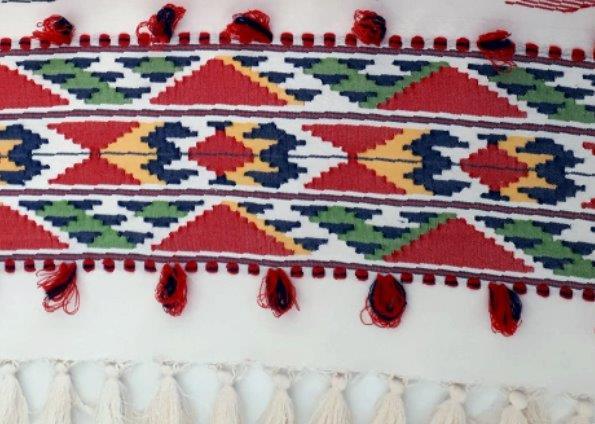
Gediksaray Weaving is produced by hand on two-legged, two- or four-frame looms using cotton or silk yarn and the mıymıy püsküllü technique. Yarn counts are 40/2 or 60/2 for cotton and 75/36 for silk. The color palette includes red as the dominant hue, along with black, yellow, white, green, and brown tones.
The motifs are symbols reflecting the emotions and thoughts of the local population. Among the most commonly used patterns are the comb, mevreş, snake back, hourglass, half of Amasya, and the whole of Amasya. The products are classified into three main categories:
Traditional handlooms are used in production, combined with various mechanical components: the loom frame, scissors, butterflies, warp bridge, tefe, foot pedals, comb, shuttle, cloth beam, and yarn types. The weaving process follows a repetitive sequence involving opening the shed, passing the shuttle, and beating the weft yarn.
Motifs are transferred to the warp from pattern templates drawn on graph paper. In the mıymıy püsküllü technique, three-ply yarns are pulled onto the surface with a hook; the frames are moved vertically using scissors and pedals. This system does not employ springs or weights.
Textile products, except for table and side table covers, undergo a traditional mercerization process. In the method applied in Gediksaray, the fabric is soaked overnight in diluted cattle manure. It is then rinsed thoroughly with water to lighten the color, dried on earthen ground, and beaten to achieve softness and sheen.
Gediksaray Weaving forms the basis of numerous products, ranging from shirts, pique fabric, bags, and quilts to decorative objects. Its inclusion in dowry chests within the geographical region reinforces its place in the cultural memory of the community.
All stages of production must take place within the boundaries of the province of Amasya. Monitoring is conducted at least once a year by a five-member expert team coordinated by the Amasya Chamber of Commerce and Industry. Criteria for monitoring include the suitability of materials used, the variety of motifs, and the weaving technique.
Turk Patent and Trademark Office. "Gediksaray Dokuması." *Coğrafi İşaretler Portalı*. Accessed July 19, 2025. https://ci.turkpatent.gov.tr/cografi-isaretler/detay/5306.
Turkish Patent and Trademark Office. "Gediksaray Dokuması. Tescil Belgesi." Accessed July 19, 2025. https://ci.turkpatent.gov.tr/Files/GeographicalSigns/055b3f15-8812-439a-bb1a-df3b69567ce8.pdf.

Type of Geographical İndication | Mahreç Sign | ||||||||
|---|---|---|---|---|---|---|---|---|---|
Application Date | 08.10.2021 | ||||||||
Registration Number | 1415 | ||||||||
Registration Date | 19.07.2023 | ||||||||
Product / Product Group(s) | Textiles | ||||||||
Province(s) | Amasya | ||||||||
Applicant/Registrant(s) | Amasya Chamber of Commerce and Industry | ||||||||
Distinguishing Features and Product Variants
Production Method
Traditional Finishing
Uses and Identity Elements
Monitoring and Protection