

This article was automatically translated from the original Turkish version.
Team(s) | Primates | ||||||||
|---|---|---|---|---|---|---|---|---|---|
Family | Cercopithecidae | ||||||||
Conservation Status | IUCN: Least Concern | ||||||||
Specie(s) | Theropithecus gelada | ||||||||
Genus | Theropithecus | ||||||||
Class | Mammalia | ||||||||
Geographic Distribution | Eritrea Ethiopia | ||||||||
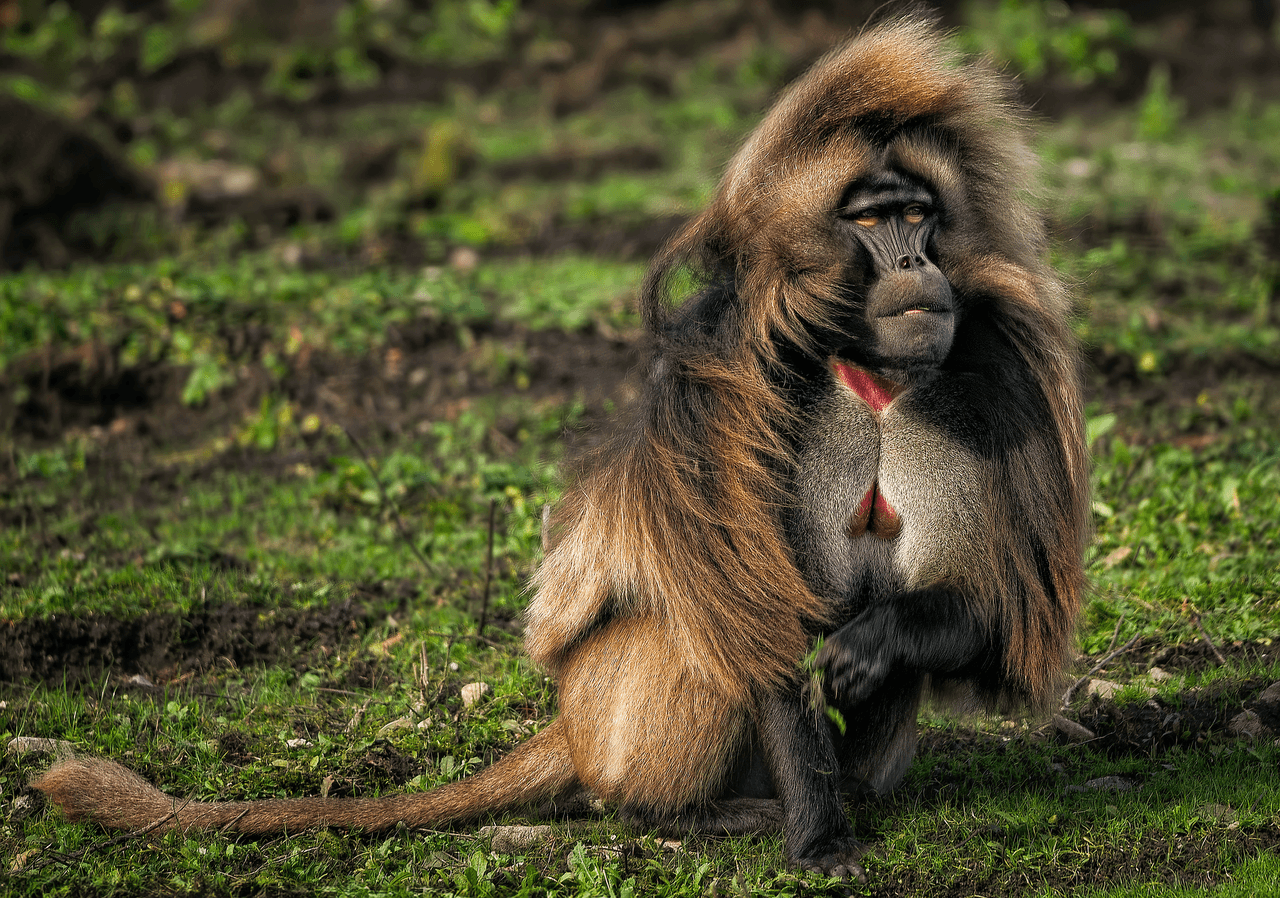
Geladas are large primates exhibiting marked sexual dimorphism. Adult males weigh an average of 20.25 kg while females are smaller, averaging around 14.8 kg.【1】The most distinctive morphological feature of the species is a hairless, triangular patch of skin on the chest, surrounded by white fur in both sexes; the color and size of this patch vary according to hormonal cycles in females. Facial structure is characterized by a short rostrum and broad nasal openings, as well as pale eyelids used in visual communication. Males differ from females by having prominent manes and facial tufts. As an adaptation to their feeding strategy, geladas possess the highest degree of opposability between the thumb and index finger among all catarrhine primates, enabling them to selectively pick individual blades of grass with precision. They also have short, robust fingers adapted for digging up subterranean food sources.
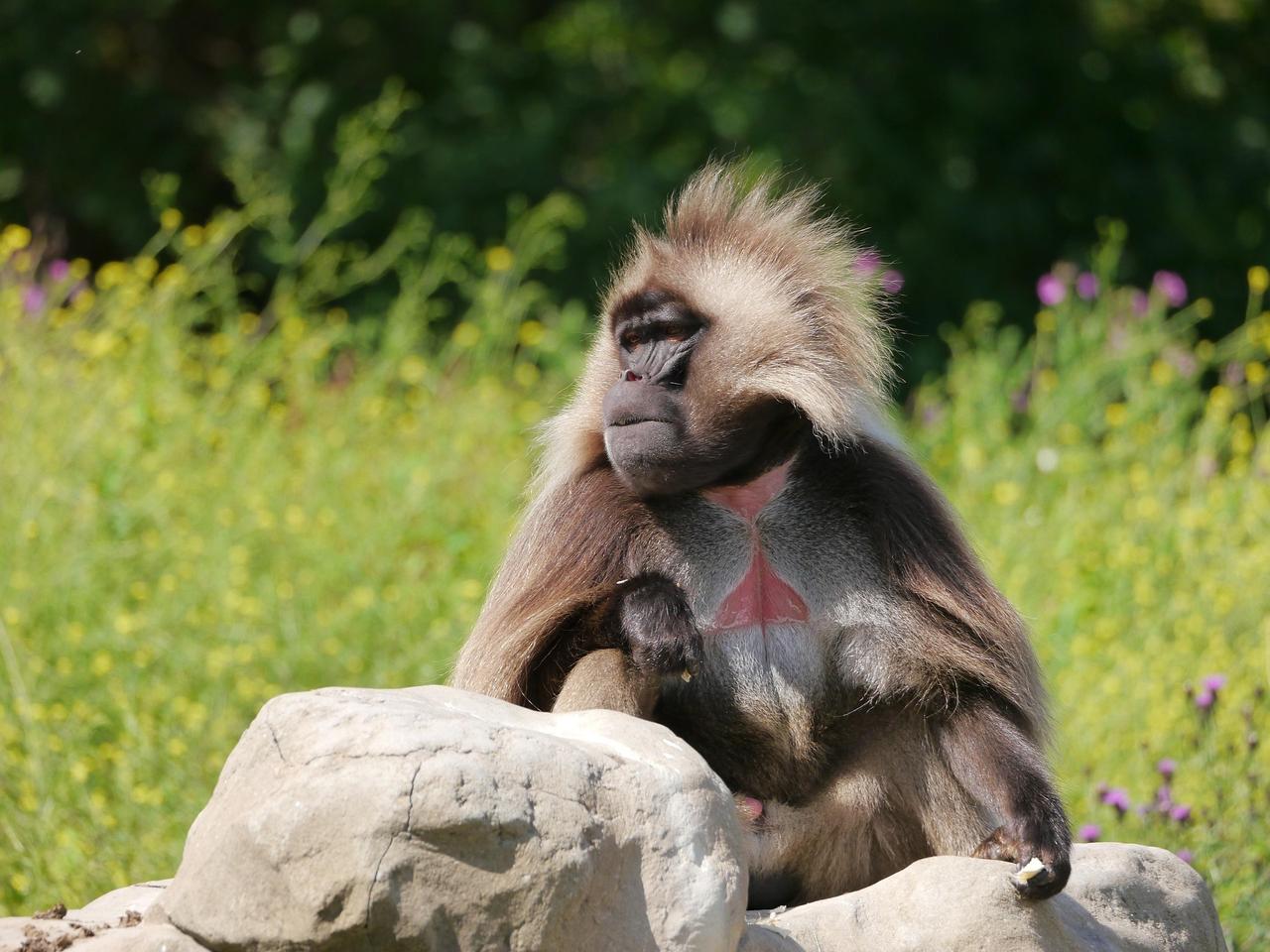
Gelada Monkey (Pixabay)
The species prefers high-altitude mountain grasslands between 2,000 and 5,000 meters above sea level. The majority of the population in Etiyopya is concentrated in the Gich and Sankaber regions of Simien Mountains National Park. Geladas spend nights on ledges of steep cliffs for protection from predators and disperse to nearby plateaus and grasslands during the day to forage. Their habitats consist of microhabitats such as plateaus, cliff edges, and valleys, which exhibit seasonal variability depending largely on rainfall patterns. The population distribution in the Simien Mountains is fragmented by deep valleys such as those of the Tekezé River and the Blue Nile; these geographic barriers are believed to cause genetic isolation among populations.
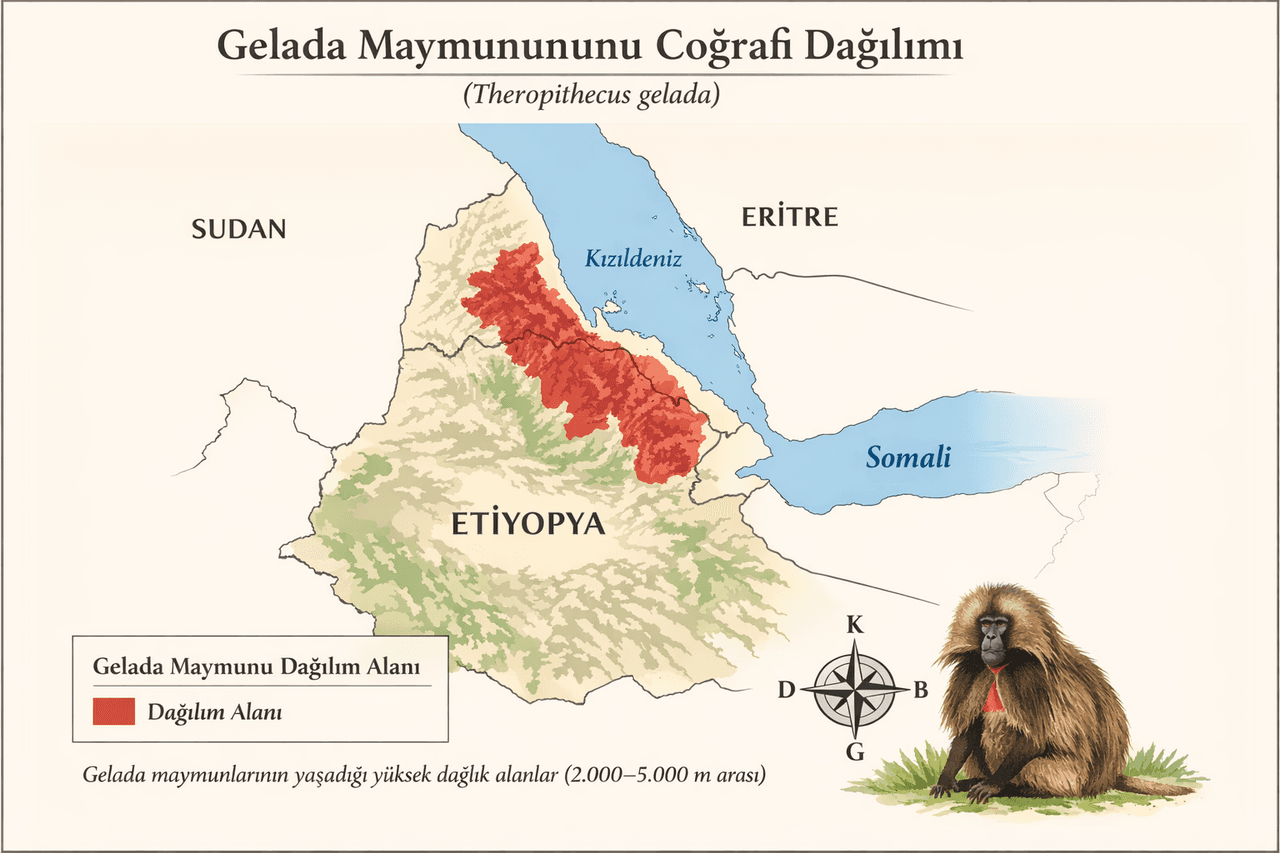
Geographic Distribution of the Gelada Monkey (AI-Generated Image)
Geladas occupy a unique ecological niche as the world’s only graminivorous primate species. More than 90 percent of their diet consists of monocotyledonous grasses. However, their food selection changes dramatically according to seasonal availability. During periods of abundant rainfall, fresh green grass leaves make up 93 percent of the diet, while during the dry season this proportion declines and animals turn to underground rhizomes, tubers, and bulbs. Grass roots account for approximately 67 percent of the diet during the dry season. Geladas spend significantly more time feeding than other herbivorous primates, with feeding occupying a large portion of their daily time budget.
The decline in green grasses during the dry season forces individuals to expend more energy digging for subterranean resources; this increased foraging time compensates for the reduced nutritional quality of the diet.【2】
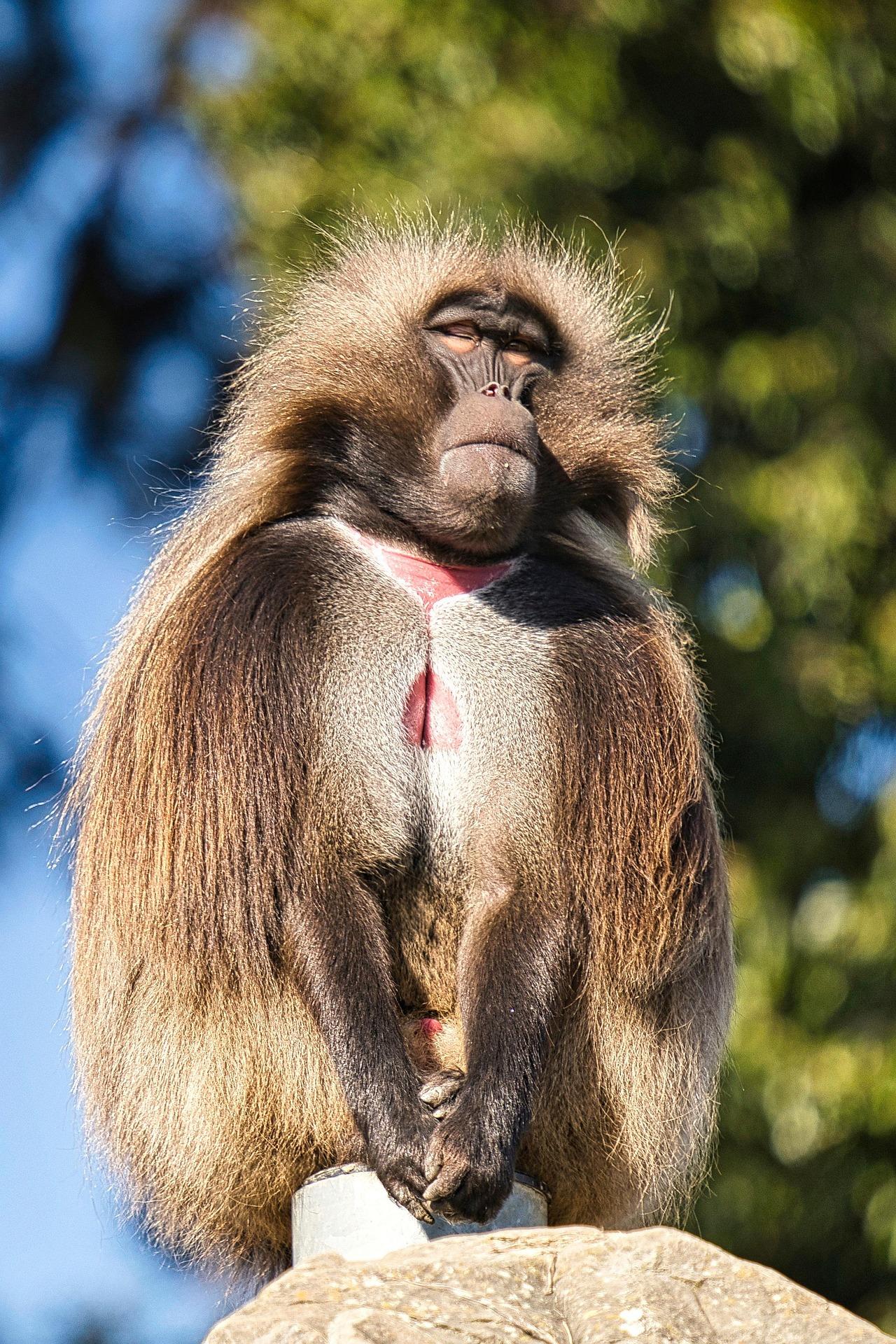
Gelada Monkey (Pixabay)
Gelada society has a hierarchical, multilayered structure. The fundamental social unit is the one-male unit or harem, consisting of a single breeding male, two to eight females, and their offspring. Social cohesion within the harem is maintained not by the male’s aggressive dominance but by strong bonds among females, who often act as the true leaders of the group and can expel unwanted males. These units aggregate to form bands and larger temporary groups called troops. Troop size varies seasonally, with aggregations exceeding a thousand individuals observed. Play behavior, an important component of social interaction, is used especially among females to reinforce social bonds and assess individual social competence. Group fission and fusion correlate more strongly with the spatial patchiness of food resources than with overall food abundance.
There is no specific breeding season, but birth rates are observed to increase during rainy periods. Gestation lasts approximately five to six months, and females typically give birth to a single infant. Lactation lasts 12 to 18 months, with maternal care being the primary responsibility of females. Females reach sexual maturity at around four to five years of age, while males reach it between five and seven years. In captivity, individuals have been recorded to live over 30 years.
Major natural predators of geladas include leopards, hyenas, and jackals; raptors may also pose a threat to infants. Their primary defenses against predation are fleeing to cliff ledges and increasing group size to reduce individual risk of capture. Alarm calls and escape responses become significantly more pronounced in habitats where visibility drops below 10 meters.
Although classified as "Lower Risk" on the IUCN Red List, their high degree of ecological specialization places them on CITES Appendix II. Major threats to the species include expansion of agricultural land and conflicts with local farmers. They are fully protected within Simien Mountains National Park, the only area under formal conservation.
Angela. "maymun gelada gelada maymunu primat." *Pixabay*. Accessed March 30, 2026. https://pixabay.com/tr/photos/maymun-gelada-gelada-maymunu-primat-8338310/
Clavadetscher, Andreas. "gelada babun primat zürih maymun." Pixabay. Accessed March 30, 2026. https://pixabay.com/tr/photos/gelada-babun-primat-z%c3%bcrih-maymun-7042773/
Dunbar, R. I. M. "Demographic and Life History Variables of a Population of Gelada Baboons (Theropithecus gelada)." Journal of Animal Ecology 49, no. 2 (1980): 485–506. Accessed March 30, 2026. https://doi.org/10.2307/4259
Gippoliti, S. "Theropithecus gelada distribution and variations related to taxonomy: history, challenges and implications for conservation." Primates 51 (2010): 291–97. Accessed March 30, 2026. https://doi.org/10.1007/s10329-010-0202-x
Hiller, C. "Theropithecus gelada." *Animal Diversity Web*. 2000. Accessed March 30, 2026. https://animaldiversity.org/accounts/Theropithecus_gelada/
Hunter, Chadden Piers. "Ecological Determinants of Gelada Ranging Patterns (Theropithecus gelada)." PhD thesis, The University of Liverpool (United Kingdom), 2001. Accessed March 30, 2026. https://www.proquest.com/dissertations-theses/ecological-determinants-gelada-ranging-patterns/docview/2925384222/se-2
Mancini, Giada, and Elisabetta Palagi. "Play and social dynamics in a captive herd of gelada baboons (Theropithecus gelada)." *Behavioural Processes* 82, no. 3 (2009): 286–92. Accessed March 30, 2026. https://doi.org/10.1016/j.beproc.2009.07.007
Pixabay. "gelada kanayan kalpli maymun." Accessed March 30, 2026. https://pixabay.com/tr/photos/gelada-kanayan-kalpli-maymun-8403660/
Pixabay. "maymun gelada meraklı çimen cook." Accessed March 30, 2026. https://pixabay.com/tr/photos/maymun-gelada-merakl%c4%b1-%c3%a7imen-cook-4354815/
[1]
C. Hiller, "Theropithecus gelada," Animal Diversity Web, 2000, access date: 30 March 2026, https://animaldiversity.org/accounts/Theropithecus_gelada/
[2]
Chadden Piers Hunter, "Ecological Determinants of Gelada Ranging Patterns (Theropithecus gelada)" (PhD thesis, The University of Liverpool (United Kingdom), 2001), access date: 30 March 2026, https://www.proquest.com/dissertations-theses/ecological-determinants-gelada-ranging-patterns/docview/2925384222/se-2

Team(s) | Primates | ||||||||
|---|---|---|---|---|---|---|---|---|---|
Family | Cercopithecidae | ||||||||
Conservation Status | IUCN: Least Concern | ||||||||
Specie(s) | Theropithecus gelada | ||||||||
Genus | Theropithecus | ||||||||
Class | Mammalia | ||||||||
Geographic Distribution | Eritrea Ethiopia | ||||||||
No Discussion Added Yet
Start discussion for "Gelada Monkey (Theropithecus gelada)" article
Physical Characteristics and Morphological Structure
C地理分布与栖息地偏好
Feeding Ecology and Strategies
Social Organization and Group Dynamics
Reproduction and Life Cycle
Predation Pressure and Conservation Status