This article was automatically translated from the original Turkish version.
+1 More
Team(s) | Primates | ||||||||
|---|---|---|---|---|---|---|---|---|---|
Family | Cercopithecidae | ||||||||
Conservation Status | IUCN: Least Concern | ||||||||
Specie(s) | Papio hamadryas | ||||||||
Geographic Distribution | Yemen Saudi Arabia Somalia Eritrea Ethiopia | ||||||||
Habitat | Mountainous regions Savanna areas Grasslands Semi-desert areas | ||||||||
Feeding Type | Omnivore | ||||||||
Genus | Papio | ||||||||
Class | Mammalia | ||||||||
The hamadryas baboon (Papio hamadryas) is a mammalian species classified within the order Primates, the family Cercopithecidae (Old World monkeys), and the genus Papio (baboons). This species belongs to the phylum Chordata and class Mammalia of the animal kingdom and is a prominent member of the African baboon species complex. Historically, due to its deep association with ancient Egyptian culture, it is also known as the “sacred baboon.” In modern biological classification, it is recognized as one of the rare primate species represented in both the Afrotropical and Palearctic biogeographic regions.
Papio hamadryas is naturally distributed across the Horn of Africa, including Ethiopia, Somalia, Eritrea, and Djibouti. Populations also exist on the opposite shore of the Red Sea, in southwestern Arabia, specifically in Saudi Arabia and Yemen. In Saudi Arabia, its distribution is restricted to the Sarawat and southern Hijaz mountain ranges, extending northward as far as the Al Akhal region. It is believed that the Arabian populations were introduced to the region during the time of the ancient Egyptian Empire, either accidentally or deliberately by humans. Today, the African and Arabian populations are completely separated by the Red Sea.
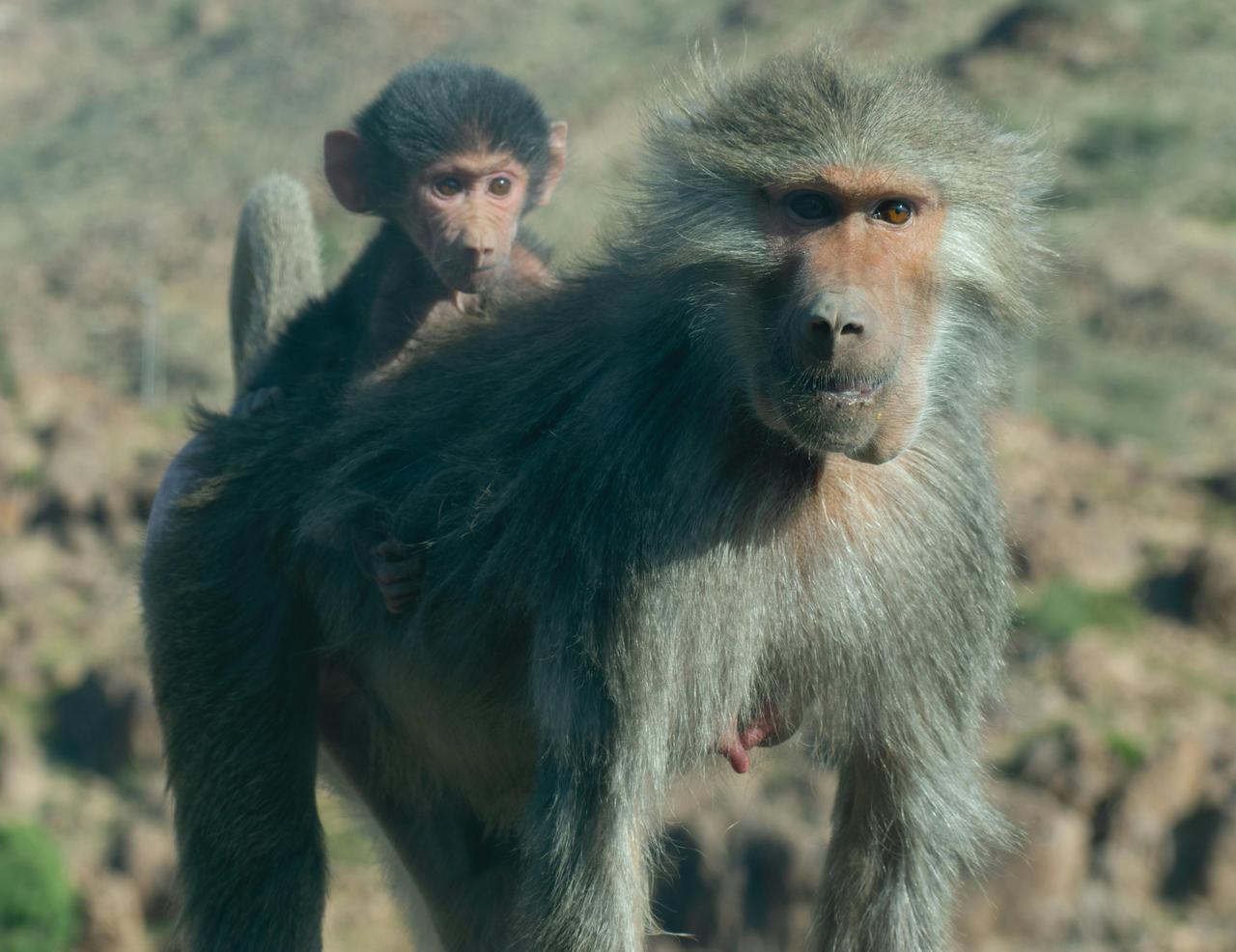
Hamadryas Baboon Carrying Its Infant on Its Back (Pexels)
This primate species exhibits high adaptability to arid and semi-arid ecosystems such as semi-deserts, grasslands (steppe), alpine meadows, plateaus, and short-grass savannas. Two key ecological factors determine their habitat selection: the availability of drinkable water sources and the presence of vertical cliffs or steep rock faces that provide safe sleeping sites at night. They can be found across a wide altitudinal range from sea level up to 3,000 meters, enabling them to tolerate temperatures exceeding 40°C as well as near-freezing conditions. Their distribution is limited to areas where annual rainfall is below 100 mm.
Papio hamadryas exhibits one of the most pronounced examples of sexual dimorphism among primates in terms of body size and pelage structure. Adult males average 21.5 kg in weight, while females weigh approximately 9.4 kg, less than half the mass of males. Males have a grayish-brown coat with prominent, long, wavy, silver-colored guard hairs forming a distinctive mane over the shoulders. Females lack this mane and have a smooth, olive-brown pelage. In both sexes, the skin around the ischial callosities is pink or bright red. Newborn infants are born with black fur, which easily distinguishes them from adults; this color gradually changes to the adult female coat color by about six months of age.
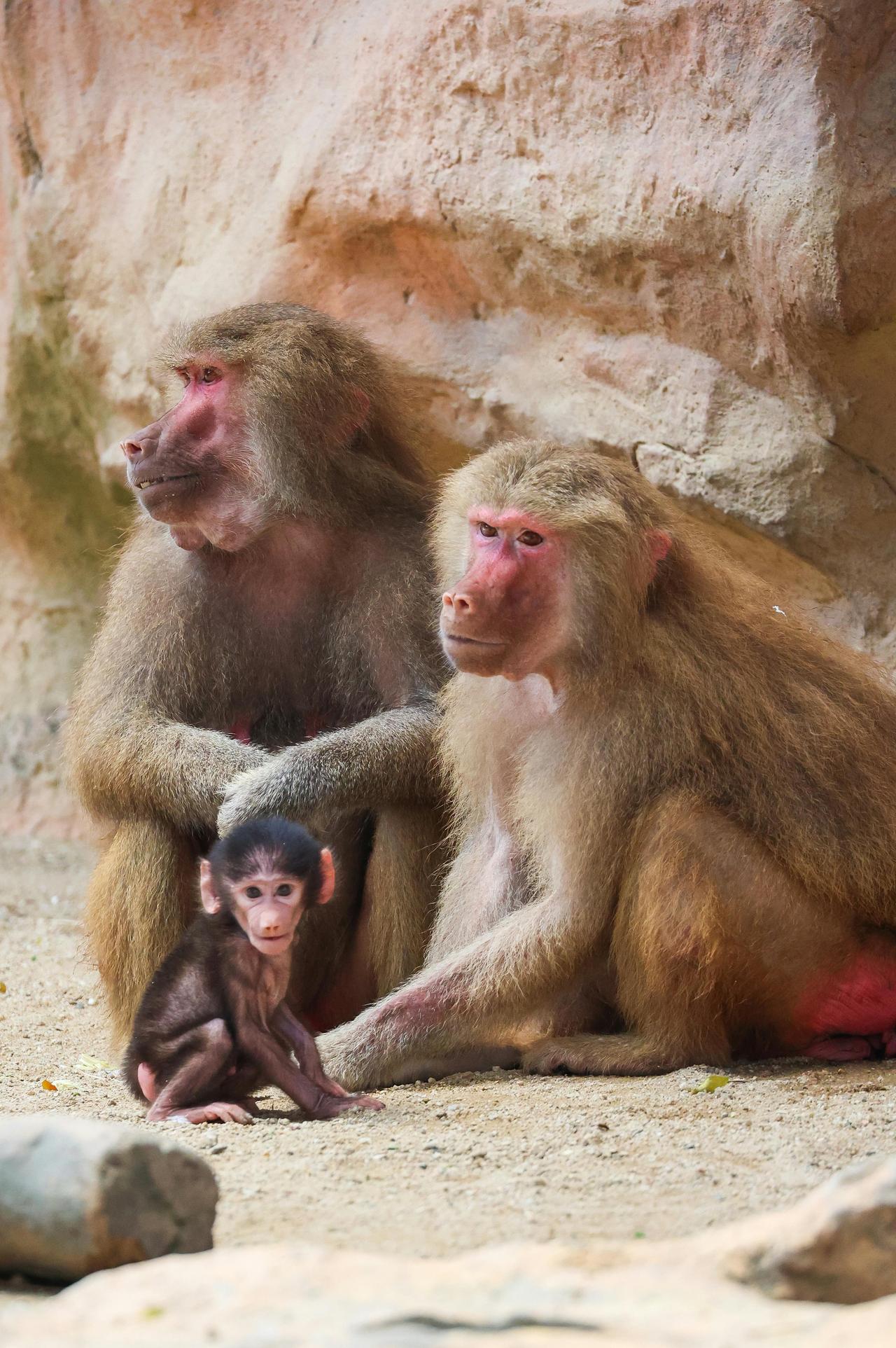
Baboon Family (Pexels)
Hamadryas baboons display a complex, multilevel social structure based on fission-fusion dynamics. The foundational unit of this social system is the “One-Male Unit” (OMU), consisting of a dominant adult male, one or several females (typically 1 to 9), and their offspring. The higher levels of the social hierarchy are as follows:
Clans: Formed by two or three genetically related OMUs whose members coordinate movements during the day.
Groups (Bands): The primary functional unit of social organization; members forage together and visit water sources as a group.
Troops: The largest social aggregation, composed of several groups that share the same sleeping cliffs and sometimes numbering in the hundreds of individuals.
Within the OMU, the dominant male exhibits aggressive “herding” behavior to prevent females from moving away or interacting with other males; this involves gently biting or chasing the female by the neck. Males typically remain in their natal clans, maintaining strong bonds with male relatives (philopatry), while females usually transfer to new units upon reaching reproductive maturity.
Reproduction in this species is not seasonally restricted and can occur throughout the year; however, in Ethiopian populations, births are observed to peak during spring and autumn. The female estrous cycle lasts approximately 31 to 35 days, and during ovulation, the perineal skin swells significantly, providing a visual signal to males. Gestation lasts an average of 172 days, and births typically result in a single infant.
Infant care is primarily the responsibility of the mother; however, the OMU’s dominant male contributes to parental investment by protecting and sometimes carrying the infants. Testicular development in males is completed rapidly between 3.8 and 6 years of age, while full adult body size and secondary sexual characteristics such as the silver mane are attained between 7 and 10 years. Females reach sexual maturity at approximately 4.3 years of age. Individuals in captivity have been recorded to live up to 37.6 years.【1】
Papio hamadryas has an omnivorous diet and behaves opportunistically to exploit limited resources in arid environments. Its diet includes fruits, tree bark, insects, eggs, seeds, roots, tubers, and small vertebrates such as the Abyssinian hare. In populations from the Filoha region of Ethiopia, consumption of doum palm fruits is particularly significant due to their high fat and caloric content. Baboons are capable of digging up to 20 centimeters deep with their tails to access water and can survive for extended periods on low-quality diets.
Maintenance of social structure relies on an advanced system of visual, vocal, and tactile communication. Visual signals include “gazing,” “eyebrow raising,” and “bared-teeth grimacing.” Tactile communication through social grooming serves not only for parasite removal but also for reinforcing social bonds within the OMU and reducing tension; this activity is predominantly directed toward the dominant male by females. Vocal communication includes a two-stage “wahoo” call used to alert others to predators or rivals, and rhythmic grunts indicating approach or submission.

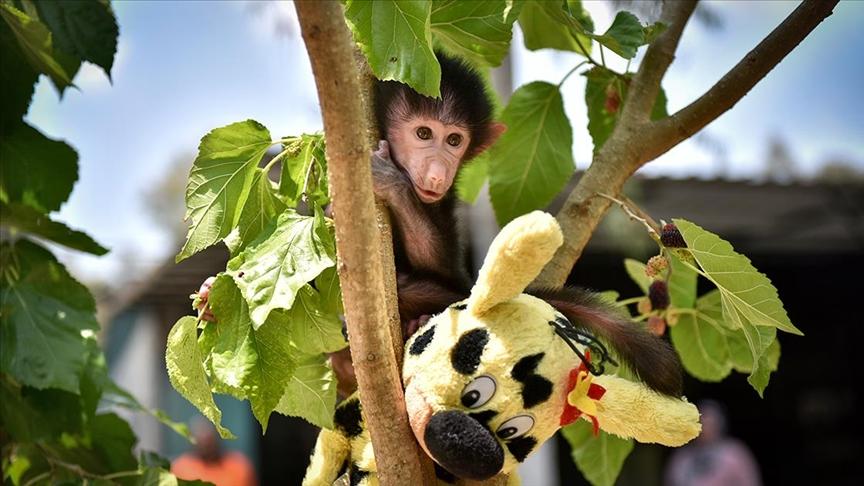
Juvenile Hamadryas Baboon (Anadolu Ajansı)
Hamadryas baboons face predation pressure from carnivores such as leopards, Verreaux’s eagles, hyenas, and wolves. Their complex social organization and habit of sleeping on high cliffs are thought to be evolutionary adaptations to this predation pressure. An interesting biological phenomenon occurs along the Awash River valley in Ethiopia, where natural hybridization takes place between Papio hamadryas and the anubis baboon (Papio anubis). Hybrid individuals in these zones exhibit behavioral traits that are a mixture of both parental species.
Although listed as Least Concern on the IUCN Red List, populations face various threats. Agricultural expansion, habitat loss, and hunting for research purposes are primary concerns. Particularly in the Arabian Peninsula, urbanization and road construction have led some groups to adopt a “commensal” lifestyle, feeding on human waste. They are sometimes directly persecuted by local communities as crop pests. Nevertheless, they contribute to ecological balance by acting as seed dispersers and soil aerators within their ecosystems.
Avcı, Serkan. “Annesi kabullenmeyince kuvözde büyütülen yavru maymun ‘Nisan’ doğal ortamına alıştırılıyor.” Haber fotoğrafı. Anadolu Ajansı. Accessed February 7, 2026. https://www.aa.com.tr/tr/yasam/annesi-kabullenmeyince-kuvozde-buyutulen-yavru-maymun-nisan-dogal-ortamina-alistiriliyor/2266081
Biquand, Sylvain, Véronique Biquand-Guyot, Ahmed Boug, and Jean-Pierre Gautier. “The Distribution of Papio hamadryas in Saudi Arabia: Ecological Correlates and Human Influence.” International Journal of Primatology 13, no. 3 (1992): 395–406. Accessed February 7, 2026. https://d1wqtxts1xzle7.cloudfront.net/106679948/bf0254781520231017-1-d9l2xc-libre.pdf
Choon Hun Ng. “Oturmak, Yaban Hayatı, Vahşi Yaşam, Hayvan Fotoğrafçılığı.” Photograph. Pexels. Accessed February 7, 2026. https://www.pexels.com/tr-tr/fotograf/oturmak-yaban-hayati-vahsi-yasam-hayvan-fotografciligi-7731113/
Olarinmoye, A. O., B. O. Olugasa, H. Niphuis, R. V. Herwijnеn, E. Verschoor, A. Boug, O. O. Ishola, H. Buitendijk, Z. Fagrouch, and K. Al-Hezaimi. “Serological Evidence of Coronavirus Infections in Native Hamadryas Baboons (Papio hamadryas hamadryas) of the Kingdom of Saudi Arabia.” Epidemiology and Infection 145, no. 10 (2017): 2030–37. Accessed February 7, 2026. https://doi.org/10.1017/S0950268817000905
Pfefferle, Dana, and Julia Fischer. “Sounds and Size: Identification of Acoustic Variables That Reflect Body Size in Hamadryas Baboons, Papio hamadryas.” Animal Behaviour (2006). Accessed February 7, 2026. https://d1wqtxts1xzle7.cloudfront.net/41408001/Sounds_and_size_identification_of_acoust20160122-26165-18i3u1q-libre.pdf
Ralph. “Beyaz Babun.” Photograph. Pexels. Accessed February 7, 2026. https://www.pexels.com/tr-tr/fotograf/beyaz-babun-2270936/
Shefferly, Nancy. “Papio hamadryas.” Animal Diversity Web. Accessed February 7, 2026. https://animaldiversity.org/accounts/Papio_hamadryas/
Swedell, Larissa. “Ranging Behavior, Group Size and Behavioral Flexibility in Ethiopian Hamadryas Baboons (Papio hamadryas hamadryas).” Folia Primatologica 73 (2002): 95–103. Accessed February 7, 2026. https://d1wqtxts1xzle7.cloudfront.net/3443761/Swedell_2002b-libre.pdf
Ziad Gomaa. “Hayvanlar, Maymunlar, Genç, Küçük.” Photograph. Pexels. Accessed February 7, 2026. https://www.pexels.com/tr-tr/fotograf/hayvanlar-maymunlar-genc-kucuk-5722758/
Čaljan, V. G., N. V. Meišvili, and M. A. Vančatová. “Sexual Behaviour of Hamadryas Baboons.” Anthropologie 25, no. 2 (1987): 183–87. Accessed February 7, 2026. http://www.jstor.org/stable/26294876
[1]
Shefferly, Nancy. “Papio hamadryas.” Animal Diversity Web. Accessed 7 February 2026. https://animaldiversity.org/accounts/Papio_hamadryas/

Team(s) | Primates | ||||||||
|---|---|---|---|---|---|---|---|---|---|
Family | Cercopithecidae | ||||||||
Conservation Status | IUCN: Least Concern | ||||||||
Specie(s) | Papio hamadryas | ||||||||
Geographic Distribution | Yemen Saudi Arabia Somalia Eritrea Ethiopia | ||||||||
Habitat | Mountainous regions Savanna areas Grasslands Semi-desert areas | ||||||||
Feeding Type | Omnivore | ||||||||
Genus | Papio | ||||||||
Class | Mammalia | ||||||||
No Discussion Added Yet
Start discussion for "Hamadryas Baboon (Papio hamadryas)" article
Geographic Distribution and Biogeographic Boundaries
Habitat Preferences and Ecological Limiting Factors
Morphological Characteristics and Pronounced Sexual Dimorphism
Multilevel Social Organization and Hierarchical Structure
Reproductive Biology and Ontogenetic Development
Feeding Ecology and Opportunistic Foraging Strategies
Communication Channels and Social Interaction Patterns
Interspecific Interactions and Hybridization
Anthropogenic Impacts and Conservation Status