


This article was automatically translated from the original Turkish version.
+2 More
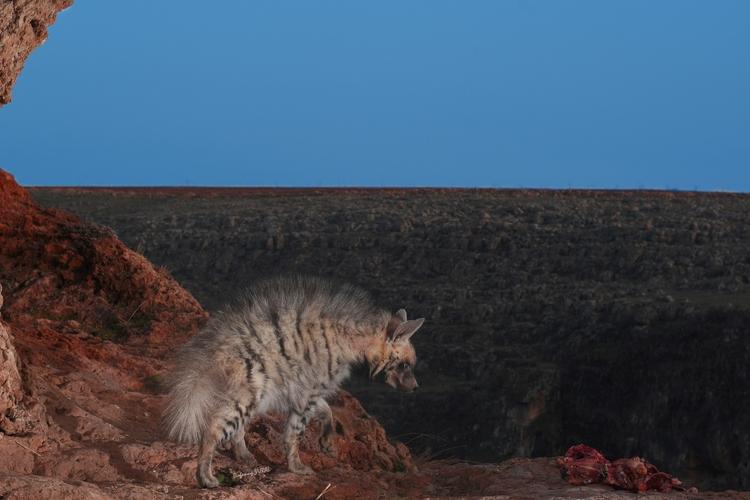
Striped Hyena
Team(s) | Carnivora | ||||||||
|---|---|---|---|---|---|---|---|---|---|
Family | Hyaenidae | ||||||||
Specie(s) | Hyaena hyaena | ||||||||
Habitat | Türkiye: Mediterranean with small numbers in Marmara and Central Anatolia Southeastern and Eastern Anatolia Aegean | ||||||||
Conservation Status | Hunting is prohibited in Türkiye | ||||||||
The striped hyena is one of the four living species of the family Hyaenidae (hyenas) and is classified by the International Union for Conservation of Nature (IUCN) as “Near Threatened” (NT), meaning it is among the species at risk of extinction. This species has a wide but fragmented distribution, ranging from Africa to India. In Türkiye, it is more commonly observed in the southern regions.
The striped hyena is found across regions including North and East Africa, the Middle East, the Caucasus, Central Asia, and India. In Türkiye, it primarily inhabits the Mediterranean, Aegean, Southeastern Anatolia, and Eastern Anatolia regions. Occasional sightings have also been recorded in specific areas of Marmara and Central Anatolia. Although there have been no official records in recent years, it is known to still persist in southern Marmara and the Aegean.
Its natural habitats include scrubland, dry forested areas, mountainous terrain, semi-desert steppes, and sparsely wooded slopes. Rocky, fissured areas, deep valleys, and caves are preferred for denning.
Although the striped hyena resembles a dog in appearance, it is genetically closer to the cat family. Its most distinctive feature is the vertical black stripes on a dirty pale yellow-white coat. The mane along its back, which can be raised when the animal is excited, frightened, or defending itself, makes its body appear up to 38% larger than its actual size. The tips of the mane are black.
Adult individuals reach a height of 65–80 cm and weigh between 25–45 kg. Some individuals may exceed one meter in length. The forelegs are longer than the hind legs, and both front and hind feet are four-toed. Its large, robust head, long tufted ears, and distinctive coloration draw attention. The inner edges and rims of the ears are white, while the throat and underside of the jaw are black.
Striped hyenas exhibit both carnivorous and omnivorous feeding behavior. In the natural cycle, they play a vital role by scavenging and cleaning up carcasses of dead animals. Their diet includes carrion, weak or sick animals, insects, small mammals, fruits (particularly watermelon, melon, and grapes), and certain vegetables. In cases where food is scarce, they have been observed attacking domestic animals.
Striped hyenas are generally solitary but may form small groups in denning areas. They are non-migratory. This species becomes sexually mature at three years of age and cares for its young for approximately one year. Their average lifespan is around 15 years.
The striped hyena is one of the protected species in Türkiye, where hunting is prohibited. As of 2025, fines of 19,830 TL are imposed on individuals who harm or hunt this animal. In this context, the General Directorate of Nature Conservation and National Parks took significant steps to protect the species by declaring the Hatay Altınözü Wildlife Development Area in 2005. Conservation and population enhancement activities continue in this area.
Striped Hyena (TÜBİTAK Science Young
The striped hyena is an extremely elusive species in the wild. In observance of World Wildlife Day on March 3, the General Directorate of Nature Conservation and National Parks shared footage of this rare animal on social media. The footage, recorded by director and documentary filmmaker Burak Doğansoysal, sheds light on the hyena’s mysterious life. In the Directorate’s post, it was stated: “Cameras remained filming for countless hours, days, and even weeks just to catch a glimpse of you. Witnessing the elusive presence of this species, whose role in the natural cycle is irreplaceable, is a great joy.”
Tarım ve Orman Dergisi. "Kırmızı Listedeki Tür: Çizgili Sırtlan." Tarım ve Orman Dergisi, Accessed May 14, 2025. https://www.turktarim.gov.tr/Haber/332/kirmizi-listedeki-tur-cizgili-sirtlan-.
Tarım ve Orman Ekranı. "Çizgili Sırtlan Gözlemleri Sürüyor." TarımTV, Accessed May 14, 2025. https://www.tarimtv.gov.tr/tr/video-detay/cizgili-sirtlan-gozlemleri-suruyor-18032.
TÜBİTAK Bilim Genç. “Türkiye’nin Çizgili Sırtlanı.” *Bilim Genç*, Accessed May 14, 2025. https://bilimgenc.tubitak.gov.tr/yerbilim-gokbilim/turkiyenin-cizgili-sirtlani.

Striped Hyena
Team(s) | Carnivora | ||||||||
|---|---|---|---|---|---|---|---|---|---|
Family | Hyaenidae | ||||||||
Specie(s) | Hyaena hyaena | ||||||||
Habitat | Türkiye: Mediterranean with small numbers in Marmara and Central Anatolia Southeastern and Eastern Anatolia Aegean | ||||||||
Conservation Status | Hunting is prohibited in Türkiye | ||||||||
Distribution and Habitat
Physical Characteristics
Diet and Feeding Habits
Behavior and Reproduction
Conservation Status
Observations and Documentaries