This article was automatically translated from the original Turkish version.
Official Name(s) | Gelina (Bridal Face Painting Ritual) | ||||||||
|---|---|---|---|---|---|---|---|---|---|
Origin(s) | Paganism Ancient Persian and Mycenaean Civilization (2000 BCE) | ||||||||
UNESCO Status | Candidate for Intangible Cultural Heritage | ||||||||
Materials Used | White base cream, Sequins, Gold leaf, Colored scales | ||||||||
Practitioner Profile | Elder women in the family (Mother-in-law tradition) | ||||||||
Duration of Implementation | Average 2 Hours | ||||||||
Primary Purpose | Protection from the evil eye, Rebirth, Purity | ||||||||
Central Locations | Donje Ljubinje, Gornje Ljubinje, Ribnovo, Manastrica | ||||||||
Applying Communities | Bosniak and Pomak Muslim communities | ||||||||
Geographical Region | Balkans (Southern Kosovo and Southern Bulgaria) | ||||||||
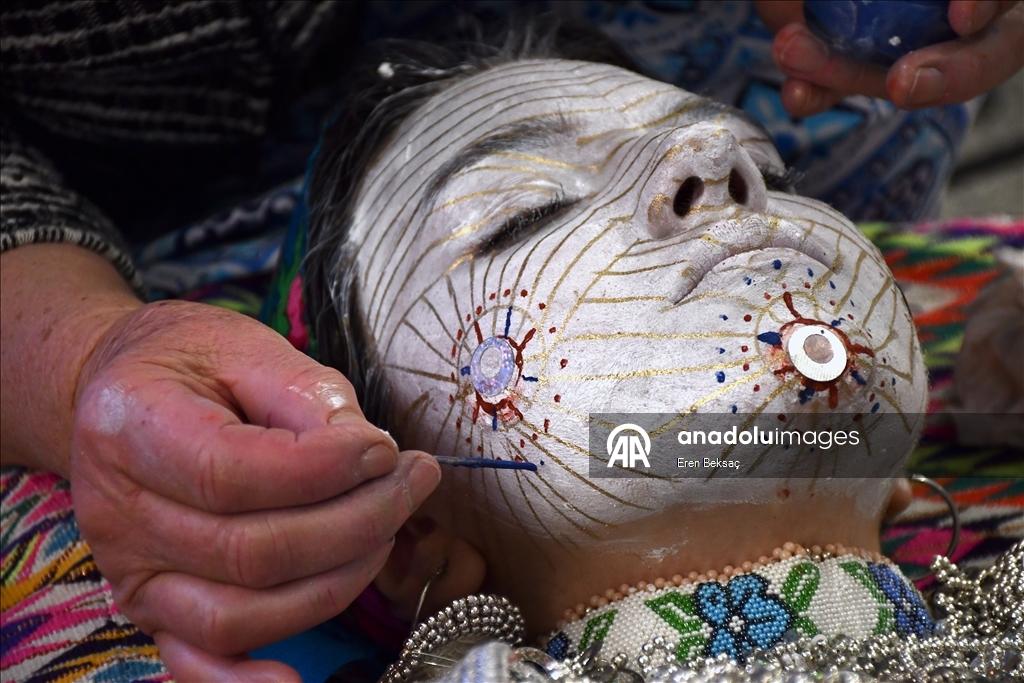
Gelina is a traditional bride adornment ritual practiced in Muslim Bosniak and Pomak villages within the Balkan region, particularly in the Prizren area of Kosovo and along the foothills of the Rhodope Mountains in Bulgaria. Its origins trace back to antiquity. This tradition remains alive in villages such as Donje Ljubinje, Gornje Ljubinje, Manastrica, Musnikovo, and Planjan under Prizren’s jurisdiction, as well as in the Bulgarian villages of Ribnovo, Skrebatino, and Osikovo. The core of the ritual involves completely covering the bride’s face with special paints and sequins.
Ethnologists and local researchers have proposed various hypotheses regarding the origins of the Gelina tradition. It is believed that the roots of this ritual extend as far back as approximately 4,000 years, to the pagan era.【1】 Legends suggest that the practice may have been inherited from ancient Persian culture or from the earliest communities of the Balkans.【2】 Notably, archaeological finds from the Mycenaean civilization dating to the second millennium BCE include female bride masks that exhibit a morphological similarity to the white facial painting technique still practiced today in villages like Ribnovo. This is regarded as concrete evidence of the ritual’s continuity over thousands of years.【3】
The survival of this cultural heritage over centuries has been made possible through the master-apprentice relationships at the heart of the social structure and oral transmission mechanisms. The tradition is regarded within families as a legacy passed down from mother-in-law to bride, with techniques and symbolic meanings meticulously preserved. Spanning from the Prizren region of Kosovo to the Rhodope Mountains of Bulgaria, this practice is defined by local communities as an integral part of their cultural identity and is also recognized as a component of the world’s cultural heritage. Indeed, today this historical element is the subject of comprehensive academic research and promotional efforts on international platforms with the aim of its inclusion in UNESCO’s Intangible Cultural Heritage List.
Gelina Tradition (Anadolu Ajansı)
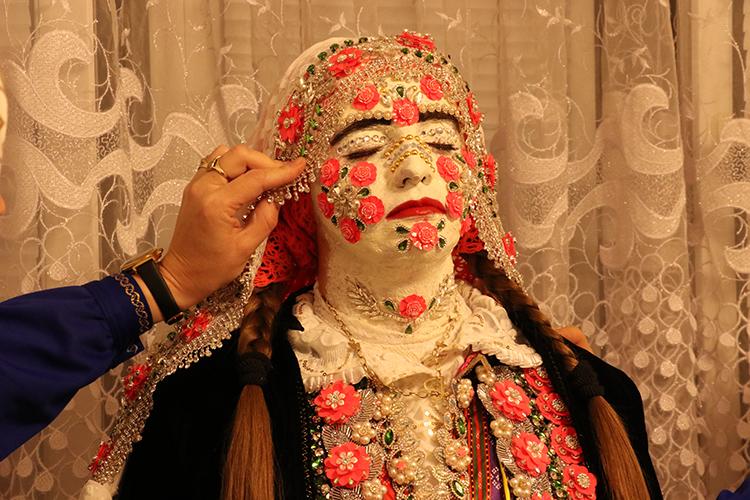
Each layer, color, and motif applied in the Gelina ritual carries meanings and social wishes symbolizing the bride’s transition from maidenhood to married life. The white paint, applied as a mask across the entire face, serves not only as a symbol of purity and cleanliness but also as a symbolic starting point representing the bride’s “rebirth” as a married woman. This white layer is a visual declaration that the bride has bid farewell to her former life as a young girl and has taken her first step into a new social status.
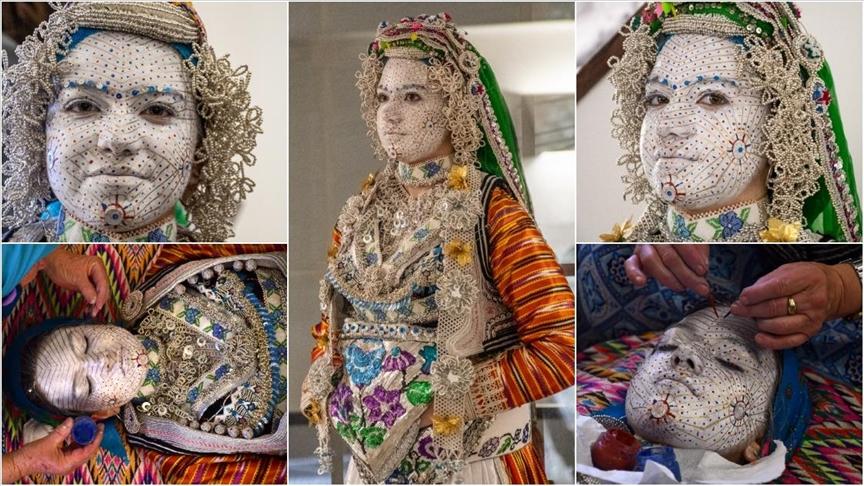
The three golden circles etched onto the face represent the three fundamental phases of life, interconnected by golden paths. The red circles surrounding these figures are directly associated with fertility and the energy of life. The red and blue dots that form the details of the makeup are regarded as symbolic codes representing happiness and peace within the family, and the continuity of a healthy generation. The dots placed around the geometric circles allude to the cyclical nature of life, signifying “core” and “new beginnings.”
The Gelina ritual is typically performed during the third day of wedding celebrations, in the evening, as a critical and symbolic phase of the ceremony. The process begins with the bride attending a “last breakfast” at her father’s home, a meal that symbolizes her final moments with her family before marriage. Following the breakfast, elderly women—those who have preserved this art across generations and embody the community’s collective memory—apply the facial paint. Over the course of approximately two hours, a white cream is applied to the bride’s face, followed by intricate patterns of colorful sequins and beads. Once the painting is complete, a piece of sugar is placed in the bride’s mouth, and her father enters the room to dress her in the traditional upper garment known as “ferece” or “manta.” This moment marks the legal and spiritual threshold at which the bride is formally recognized as married and now belongs to her new household.
The successful completion of the ritual depends on the bride’s strict discipline and patience throughout the process. From the moment the painting is finished until her arrival at the groom’s home, the bride must remain silent, refrain from eating, and keep her facial muscles completely still. During this time, family members and friends sing melancholic farewell songs, and the bride must not shed a single tear. Preventing tears serves both as an aesthetic necessity to preserve the makeup and, according to belief, as a means of warding off bad fortune in her future life. The bride is transported to the groom’s home either on horseback or on foot, with her eyes covered. Upon arrival, her face is unveiled in the presence of the community. If the paint and sequins remain intact, it is interpreted as an omen that she will become a strong, resilient, and hardworking woman in her new life.【4】
Application of the Gelina Tradition (Anadolu Ajansı)
The sociological and anthropological foundation of the Gelina tradition lies in the phenomenon of “protection from the evil eye,” whose roots extend into ancient belief systems. In traditional social structures, the wedding day is considered a vulnerable and conspicuous moment in a young woman’s life. It is believed that the bride’s natural beauty and potential for happiness may attract envy and negative energies (the evil eye). In this context, completely concealing the bride’s face under a white layer and dense motifs functions as a spiritual armor, shielding her from harmful gazes. By creating this standardized appearance, all brides are symbolically rendered “identical,” thereby concealing individual beauty and elevating the sacredness and inviolability of the “bride” status itself above personal identity.
The ritual also serves as a collective act reinforcing social hierarchy and belonging. The bride, seated motionless and visibly exposed in a prominent location in the village square with her painted face, is presented under the community’s watchful gaze, and her new status is formally acknowledged by all villagers. The patience and composure displayed during this process are interpreted as evidence of the bride’s loyalty to social norms and her new family. Additionally, during winter weddings, the village effectively transforms into an open-air museum. Customs such as the exchange of hundreds of trays of börek between engaged couples along the journey represent social solidarity and the communal sharing of prosperity.

Centuries-Old "Bride Makeup" Tradition in the Bosniak Villages of Kosovo (Anadolu Ajansı)
Despite globalization and the standardization of wedding formats worldwide, the Gelina tradition persists among Muslim Bosniak and Pomak communities in the Balkans as a vital element of cultural preservation. Although wedding celebrations, once lasting a week, have shortened to two days in recent times and have even begun to fade in some villages, the facial painting ritual continues to be practiced as a cultural necessity and a social heritage.
These ceremonies, concentrated especially in winter months, emphasize the local community’s identity as “hardworking and hospitable.” The economic gains generated are reinvested into the village, contributing to regional prosperity and the preservation of traditional culture.
The sustainability of this heritage today is made possible by the dedication of its last practitioners. With institutional support from bodies such as the Ministry of Foreign Affairs of Kosovo, the tradition has been promoted in international centers such as Brussels. It is now the focus of interactive workshops organized by local administrations and development associations such as EDUCO. The Gelina ritual aims to strengthen its place in global cultural memory through the process of inclusion in UNESCO’s Intangible Cultural Heritage List.
Anadolu Ajansı. "Bulgaristan'ın Müslüman Ribnovo köyünde binlerce yıllık 'Gelina' düğün geleneği sürdürülüyor." Accessed February 5, 2026. https://www.aa.com.tr/tr/yasam/bulgaristanin-musluman-ribnovo-koyunde-binlerce-yillik-gelina-dugun-gelenegi-surduruluyor/3809465
Anadolu Ajansı. "Kosova'nın Boşnak köylerinde asırlık 'gelin makyajı' geleneği yaşatılıyor." Accessed February 5, 2026. https://www.aa.com.tr/tr/kultur/kosovanin-bosnak-koylerinde-asirlik-gelin-makyaji-gelenegi-yasatiliyor/3818525
Hüdaverdi, Esin. "KOSOVA TÜRKLERİNDE RİTÜELLER BAĞLAMINDA EVLENME GELENEĞİ İLE İLGİLİ KİMİ UYGULAMA VE ÂDETLER." *TÜRÜK Uluslararası Dil Edebiyat Ve Halk Bilimi Araştırmaları Dergisi* 1, no. 15 (2026): 319-326. Accessed February 5, 2026. https://dergipark.org.tr/en/pub/turuk/article/516238
Kirenci, Hatice Sena. "Kosova Boşnak köylerinde yüzyıllık gelin makyaj geleneği sürdürülüyor." *GZT*. Accessed February 5, 2026. https://www.gzt.com/kultur/kosova-bosnak-koylerinde-yuzyillardir-suren-gelin-makyaji-4007229
TRT Haber. "Kosovalı gelinlerin asırlık makyaj geleneği." Accessed February 5, 2026. https://www.trthaber.com/haber/yasam/kosovali-gelinlerin-asirlik-makyaj-gelenegi-330880.html
[1]
Anadolu Ajansı, "Bulgaristan'ın Müslüman Ribnovo köyünde binlerce yıllık "Gelina" düğün geleneği sürdürülüyor." Anadolu Ajansı, Erişim 5 Şubat 2026, https://www.aa.com.tr/tr/yasam/bulgaristanin-musluman-ribnovo-koyunde-binlerce-yillik-gelina-dugun-gelenegi-surduruluyor/3809465.
[2]
Anadolu Ajansı, "Kosova'nın Boşnak köylerinde asırlık "gelin makyajı" geleneği yaşatılıyor." Anadolu Ajansı, Erişim 5 Şubat 2026, https://www.aa.com.tr/tr/kultur/kosovanin-bosnak-koylerinde-asirlik-gelin-makyaji-gelenegi-yasatiliyor/3818525.
[3]
Anadolu Ajansı, "Bulgaristan'ın Müslüman Ribnovo köyünde binlerce yıllık "Gelina" düğün geleneği sürdürülüyor." Anadolu Ajansı, Erişim 5 Şubat 2026, https://www.aa.com.tr/tr/yasam/bulgaristanin-musluman-ribnovo-koyunde-binlerce-yillik-gelina-dugun-gelenegi-surduruluyor/3809465.
[4]
Anadolu Ajansı, "Kosova'nın Boşnak köylerinde asırlık "gelin makyajı" geleneği yaşatılıyor." Anadolu Ajansı, Erişim 5 Şubat 2026, https://www.aa.com.tr/tr/kultur/kosovanin-bosnak-koylerinde-asirlik-gelin-makyaji-gelenegi-yasatiliyor/3818525.


Official Name(s) | Gelina (Bridal Face Painting Ritual) | ||||||||
|---|---|---|---|---|---|---|---|---|---|
Origin(s) | Paganism Ancient Persian and Mycenaean Civilization (2000 BCE) | ||||||||
UNESCO Status | Candidate for Intangible Cultural Heritage | ||||||||
Materials Used | White base cream, Sequins, Gold leaf, Colored scales | ||||||||
Practitioner Profile | Elder women in the family (Mother-in-law tradition) | ||||||||
Duration of Implementation | Average 2 Hours | ||||||||
Primary Purpose | Protection from the evil eye, Rebirth, Purity | ||||||||
Central Locations | Donje Ljubinje, Gornje Ljubinje, Ribnovo, Manastrica | ||||||||
Applying Communities | Bosniak and Pomak Muslim communities | ||||||||
Geographical Region | Balkans (Southern Kosovo and Southern Bulgaria) | ||||||||
Historical Origins and Ethnological Foundations
Symbolism and the Meaning of Colors
Implementation and Traditional Rules
Social Function and the Belief in Protection from the Evil Eye
The Modern Era and Sustainability