

 Recently Added:
This article was automatically translated from the original Turkish version.
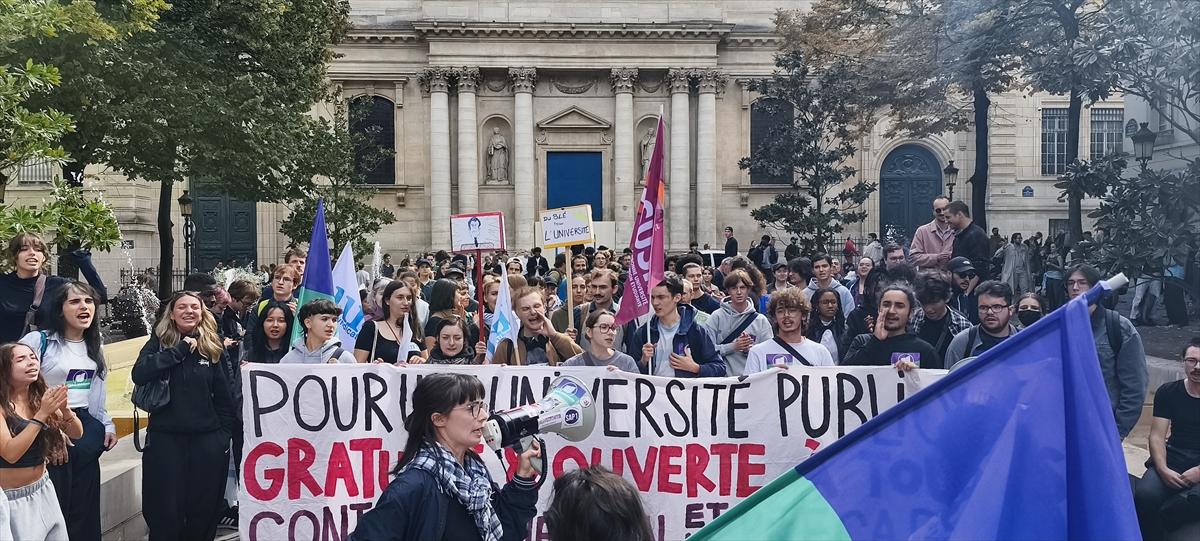
General Strike and Protests Against Budget Cuts in France (September 2025), mass demonstrations organized nationwide on 18 September 2025 at the call of trade unions. The protests were staged in response to the government’s austerity plan of 44 billion euros, justified as necessary to reduce public debt, and involved broad participation from numerous sectors including education, health, transport and energy.
General strike and protests against budget cuts in France, 18 September 2025 – (Associated Press)
The foundation of the general strike and protests in France lies in the austerity plan of approximately 44 billion euros drafted by the François Bayrou government. This plan envisages major cuts in public spending, particularly targeting health care, education and social assistance. The Bayrou government encountered significant public backlash during the process of seeking approval for the plan.
On 8 September 2025, the Bayrou government failed to secure a parliamentary majority in a vote of confidence and was subsequently ousted. Following the vote of no confidence, President Emmanuel Macron appointed Sébastien Lecornu, previously Minister of Defense, as the new Prime Minister.
In September 2025, France’s public debt reached 3.3 trillion euros, equivalent to 113.9 percent of gross domestic product. The budget deficit rose to 5.8 percent, nearly double the European Union’s 3 percent limit. The International Monetary Fund has projected that this debt ratio is likely to continue rising in the coming years.
In September 2025, the international credit rating agency Fitch downgraded France’s credit rating from “AA-” to “A+”. No single party holds a majority in parliament. The country’s legislature remains deeply divided among competing political factions.
The general strike and protests began on 10 September 2025 with the “Block Everything” movement. In this initial action, approximately 4.5 percent of public sector workers went on strike. Students and certain labor groups joined these early demonstrations, leading to road blockades and disruptions across the country.
On 10 September 2025, prior to the general strike on 18 September, a movement called “Block Everything” emerged in France. The movement spread via social media and was initially organized by right-leaning groups, later expanding to include participation from left-wing and far-left factions.
During nationwide actions, roads were blocked, barricades erected, and vehicle tires and garbage bins set on fire at various locations. In Paris, hundreds of young people gathered in front of Gare du Nord station and chanted anti-government slogans. Students and secondary school youth also joined the protests, with entrances to several high schools in the capital blocked by barricades.
Security forces intervened during the demonstrations, and pepper spray was used at times in Paris. Clashes erupted between police and protesters. Approximately 500 people were arrested nationwide, with around 200 of these arrests recorded in Paris. In Rennes, a bus was set on fire; in Nantes, highways were blocked with tires and garbage bins; in Montpellier, barricades at intersections were dismantled by authorities. In Paris, a building fire near the Châtelet shopping center was extinguished by firefighters during a confrontation.
It is estimated that around 200,000 people participated in the actions. Interior Minister Bruno Retailleau described the movement as “a significant mobilization” but stated that “the goal of paralyzing the country had not been achieved.” The core demands expressed during the protests included the resignation of President Emmanuel Macron, the cancellation of the budget cuts, and the establishment of a more equitable political system.
On 18 September 2025, mass protests were held at the call of trade unions. On that day, approximately 250 to 260 separate demonstrations were organized across the country. In the capital Paris, a march took place from Place de la Bastille to Place de la Nation; similar marches involving tens of thousands of people occurred in cities including Marseille, Lyon, Lille, Rennes, Nantes and Bordeaux.
Different figures were reported regarding participation. The French Ministry of the Interior stated that between 600,000 and 900,000 people participated nationwide. According to union estimates, approximately 100,000 people joined the marches in Paris alone, with over 400,000 participating across the country.
The protests were not confined to mainland France but also took place in overseas territories. On the island of Martinique, a water cutoff affecting 150,000 people was linked to the protests and interpreted as part of the broader anti-government movement. The scope of the protests expanded further as workers from multiple sectors—including education, health, transport and energy—joined the strike action.
During the protests, demonstrators blocked traffic at major intersections and highways in cities such as Marseille, Lyon, Toulon and Chambéry. Among these actions were “slowdown operations” (operation escargot), in which convoys of vehicles moved at low speeds along highways, bringing traffic flow to a halt.
The Eurolinks arms factory in Marseille was blocked by protesters. Activists gathered in front of the facility, successfully halting production and displaying union banners to voice their demands.
In the capital Paris, hundreds of activists entered the Ministry of Finance building in Bercy. According to union sources, a group of approximately 300 people composed of railway workers, RATP employees and students entered the building; footage shared on social media showed protesters chanting slogans inside the ministry.
Some bank branches and businesses along the protest route in Paris were closed off with barricades. Businesses, following warnings from security forces, took precautions against possible outbreaks of violence during the demonstrations.
On 18 September, the actions expanded to encompass numerous sectors across France. Strikes were carried out in many areas of public services, notably education, health, transport and energy.
According to data from the Ministry of Education, approximately 17 percent of teachers participated in the strike. The SNES-FSU union representing secondary education staff reported a participation rate of 45 percent. In primary education the rate was recorded at 17.5 percent and in secondary education at 16.7 percent. In some cities schools were fully closed; in Paris particularly, 23 high schools were completely blocked and 52 others suspended classes due to partial blockades.
Ninety percent of the approximately 20,000 pharmacies in the country were closed. According to the French Pharmacists Union (FSPF), 18,000 pharmacies joined the strike. Health workers also protested against restrictions on medical spending and measures related to drug price cuts.
Public transport in Paris experienced disruptions. All four major RATP unions participated in the strike; only the automated metro lines (lines 1, 4 and 14) operated normally. On other lines, services were limited to peak hours, and many bus and tram routes were cancelled. Significant disruptions were recorded on regional rail lines (RER), particularly on lines D and E. According to the national railway company SNCF, 90 percent of high-speed trains (TGV) ran while only 50 to 60 percent of regional trains operated.
According to data from the energy company EDF, production was reduced at the Flamanville 1 reactor due to the strike, resulting in a nationwide decrease in nuclear power generation of 1.1 gigawatts. Hydroelectric production showed no significant impact.
A total of 11 percent of public sector workers participated in the strike. This figure corresponds to approximately 270,000 of the country’s 2.5 million state employees leaving their posts. Among local government employees, 5.6 percent joined the strike, as did 5.6 percent of hospital staff.
On 18 September 2025, security forces were deployed nationwide during the protests. According to data from the Ministry of the Interior, more than 80,000 police officers and gendarmes were stationed on the ground. These forces were supported by armored vehicles, TOMA riot control vehicles and unmanned aerial vehicles. Intensive security measures were implemented in major cities such as Paris, Lyon and Marseille.
Tensions arose between police and protesters in Paris from early morning hours. Pepper spray and sound bombs were used in various locations, and baton charges were carried out. Bank branches and shops along the protest route closed their shutters following police warnings.
Intense clashes occurred during demonstrations in Lyon during midday hours. After masked groups threw fireworks and various objects at police, security forces responded with heavy use of pepper spray and plastic bullets. During this time, a journalist suffered burns and hearing loss, and a police officer had a tooth broken as a result of an impact.
In Marseille, violent confrontations took place between police and protesters, among whom were activists who had participated in factory blockades and were subsequently detained.
A total of 99 detentions were reported across the country. Of these, 15 occurred in Paris and 22 in Marseille. Additional detentions also took place in Rennes and other cities during interventions against student blockades.
During the protests, union leaders and political figures made various statements to the public.
Sophie Binet, leader of the General Confederation of Labour (CGT), stated that the strikes and marches on 18 September were “a success.” Binet noted that over 260 demonstrations were held nationwide and that thousands of workplaces were abandoned. Marylise Léon, leader of the French Democratic Confederation of Labour (CFDT), said they had sent “a very clear warning” to the government. Léon explained that they were demanding financial, social, and environmental justice in the new budget.
Sophie Vénétitay, general secretary of the SNES-FSU teachers’ union, drew attention to the anger among educators and highlighted the worsening working conditions. According to the union’s statement, participation rates in secondary education reached 45 percent.
Police unions also expressed support for the actions. Grégory Jouron, general secretary of the Unité SGP Police union, emphasized that due to the suspension of maintenance and renewal plans for police vehicles, many vehicles were rendered unusable across various regions.
Jean-Luc Mélenchon, leader of France Unbowed (LFI), stated that the new Prime Minister Sébastien Lecornu must also face a vote of confidence. Mélenchon announced that if he did not, the opposition would submit a motion of censure. Olivier Faure, leader of the Socialist Party, said the people now demanded to be heard and that unions would use their strength as a pressure tool against the government. Fabien Roussel, leader of the Communist Party, emphasized that the protests must remain peaceful and opposed the government’s cutback plans.
Jean-François, a retired teacher, said during the protests that President Macron was guilty of failing to keep his promises and added that Lecornu’s policies would not differ from Macron’s line.
Al Jazeera. “France Braces for Mass Protests as Austerity Plan Deepens Anti-Macron Anger.” Accessed September 18, 2025. https://www.aljazeera.com/news/2025/9/18/france-braces-for-mass-protests-as-austerity-plan-deepens-anti-macron-anger
Anadolu Ajansı. “Ağır Borç Yükü Altındaki Fransa’da Sosyal Huzursuzluk Artıyor.” Accessed September 18, 2025. https://www.aa.com.tr/tr/dunya/agir-borc-yuku-altindaki-fransa-da-sosyal-huzursuzluk-artiyor/3691254#
Anadolu Ajansı. “Fransa’da Kemer Sıkma Politikaları Karşıtı Eylemler Düzenleniyor.” Accessed September 18, 2025. https://www.aa.com.tr/tr/dunya/fransada-kemer-sikma-politikalari-karsiti-eylemler-duzenleniyor/3691262#
Anadolu Ajansı. “Nearly 100 Arrested during France’s Nationwide Protests, with 2 Injured in Lyon Clashes.” Accessed September 18, 2025. https://www.aa.com.tr/en/europe/nearly-100-arrested-during-frances-nationwide-protests-with-2-injured-in-lyon-clashes/3691533#
BBC News. “Workers across France strike over budget cut plans.” Accessed September 18, 2025. https://www.bbc.com/news/articles/cj9zvg03elzo
France 24. “Live: Union leaders hail 'success' as France stages mass protests over budget cuts.” France 24. Accessed September 18, 2025. https://www.france24.com/en/france/20250918-live-france-protests-strikes-budget-cuts-macron-lecornu
Le Monde. “French unions lead strikes over budget policies and anti-Macron anger.” Accessed September 18, 2025. https://www.lemonde.fr/en/france/article/2025/09/18/france-sees-day-of-nationwide-strikes-over-budget-policies-and-anti-macron-protests_6745510_7.html
RTL. “En Direct: Grève du 18 Septembre – Jusqu’à 900.000 Personnes Attendues, Journée Noire dans les Transports.” RTL. Accessed September 18, 2025. https://www.rtl.fr/actu/justice-faits-divers/en-direct-greve-du-18-septembre-jusqu-a-900-000-personnes-attendues-journee-noire-dans-les-transports-suivez-les-manifestations-et-les-perturbations-7900542622
Reuters. "French Unions Strike against Austerity, Pressuring Macron." Reuters. Accessed September 18, 2025. https://www.reuters.com/world/europe/french-unions-strike-against-austerity-pressuring-macron-2025-09-18/
Reuters. “‘Block Everything’ Protests Sweep across France, Scores Arrested.” Reuters. Accessed September 10, 2025. https://www.reuters.com/world/europe/block-everything-protests-sweep-across-france-scores-arrested-2025-09-10/
The Guardian. “France’s biggest strike in years under way amid political crisis.” Accessed September 18, 2025. https://www.theguardian.com/world/2025/sep/18/france-strikes-day-sebastien-lecornu-emmanuel-macron-politics

On 18 September 2025, mass protests organized by trade unions across France took place against budget cuts. More than 250 demonstrations occurred, including in Paris, Marseille and Lyon. Strikes occurred in the education, health, transport and energy sectors, and most pharmacies closed. Police implemented extensive security measures during the protests, clashes broke out in some cities and numerous people were arrested.
No Discussion Added Yet
Start discussion for "General Strike and Protests Against Budget Cuts in France (September 2025)" article
September 18, 2025
Background
September 18, 2025
Origins and Scope of the Protests
September 18, 2025
Sectors Participating in the Protests and Strikes
September 18, 2025
Police Interventions and Security Measures
September 18, 2025
Statements by Trade Unions and Political Actors