


This article was automatically translated from the original Turkish version.
+1 More
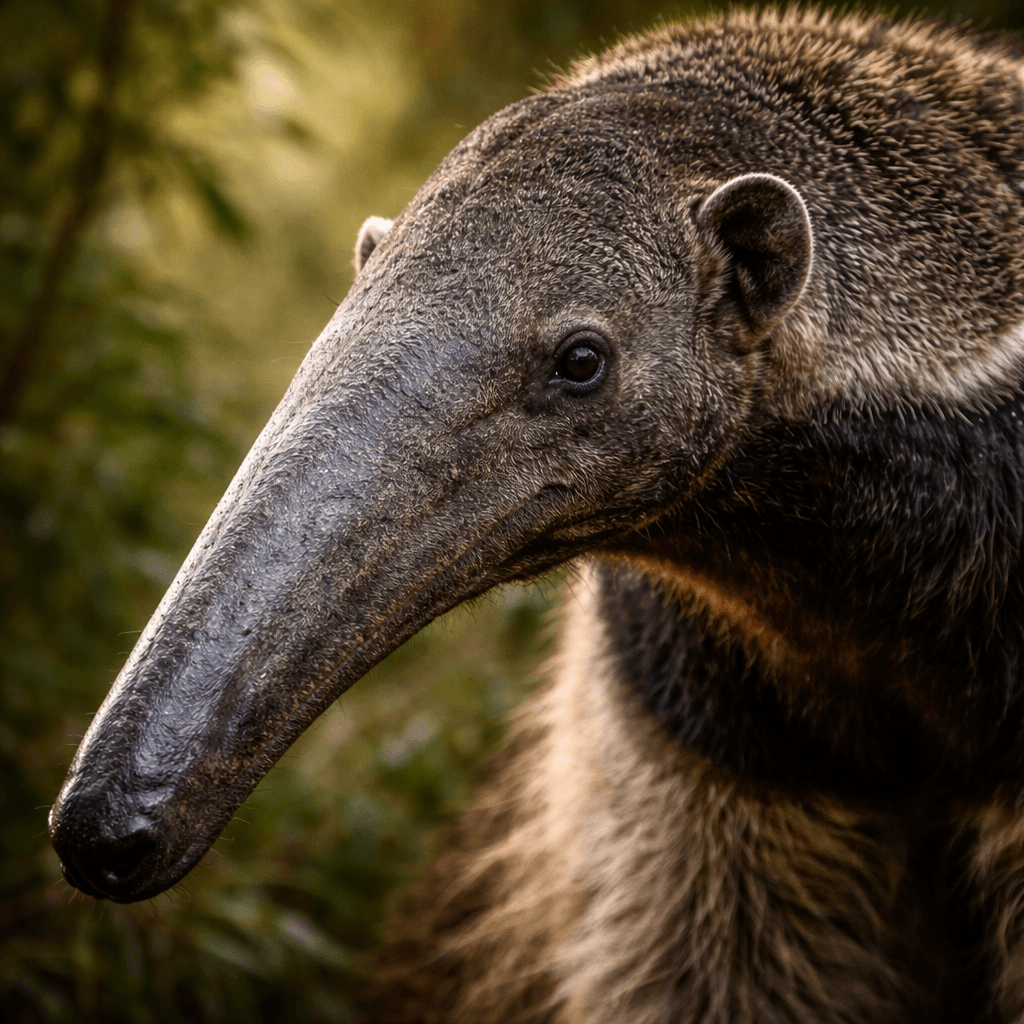
Dev karıncayiyen
(Görsel Yapay Zeka ile Oluşturulmuştur)
Giant Anteater(Myrmecophaga tridactyla) is a insectivorous mammal species endemic to Central and South America belonging to the family Myrmecophagidae within the order Pilosa. It is the largest of the four living anteater species and the only member of the genus Myrmecophaga.
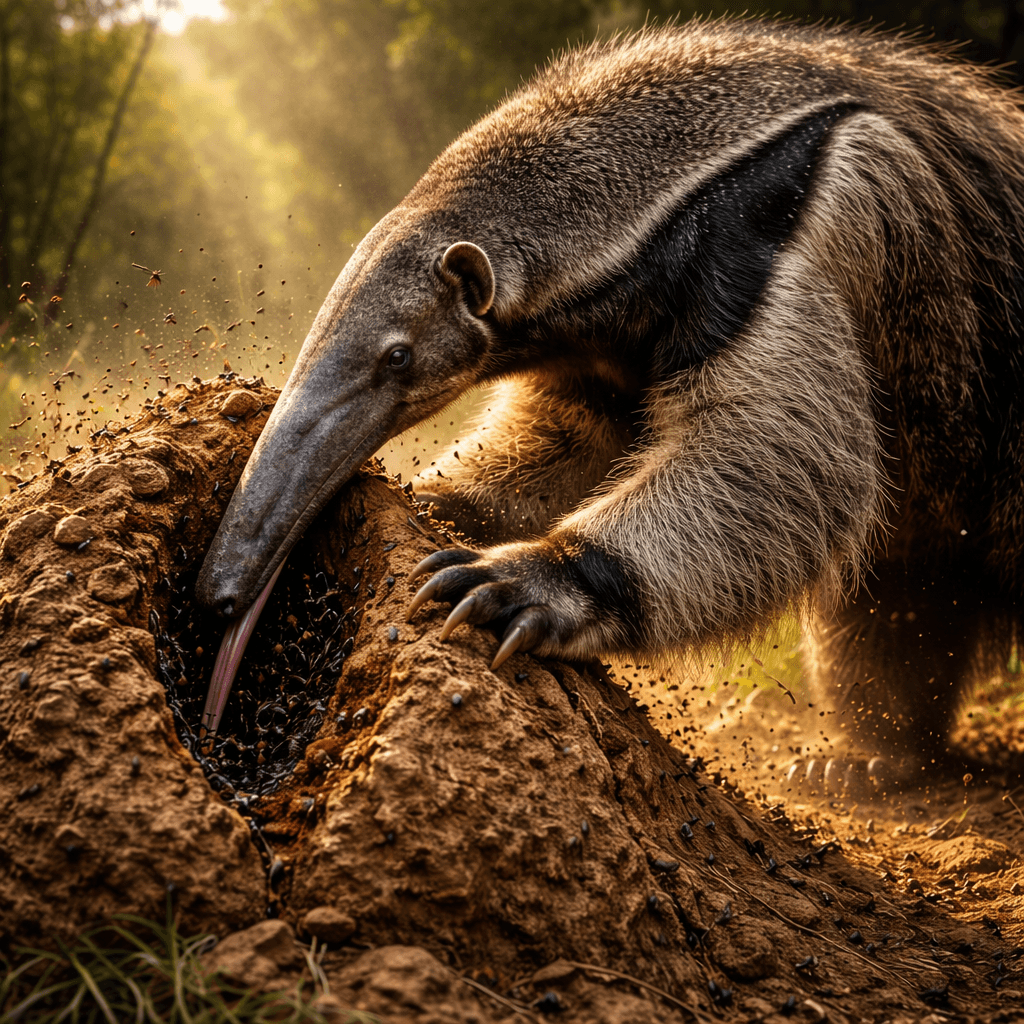
Giant Anteater (Myrmecophaga tridactyla)
(Image Generated by Artificial Intelligence)
The giant anteater measures between 1.8 and 2.4 metres from snout to tail tip and weighs between 18 and 45.5 kilograms. Males are typically larger than females. The head is slender and conical with a tubular mouth opening and very small eyes and ears. Its fur is thick, stiff and grey-brown in colour; a distinctive black band bordered by white runs from the neck and chest toward the middle of the back.
It possesses a long, bushy tail nearly as long as its body. It has no teeth; instead it uses a slender tongue up to 60–61 centimetres in length covered in backward-facing spines and sticky saliva to capture insects. Although all five toes on the front feet are present, two or three are notably elongated up to 10 centimetres and end in sharp claws. To prevent damage and maintain the sharpness of these claws, it walks on its knuckles and wrists rather than its soles.
The diet of this species consists almost entirely of social insects such as ants and termites, and individuals can consume between 30,000 and 35,000 insects per day. Compensating for their weak vision and hearing with an olfactory sense 40 times stronger than that of humans, they locate underground nests. After rapidly breaking open the nest with their front claws, they feed by flicking their tongues up to 150 times per minute. To avoid the defensive bites of soldier ants, they spend only about one minute at each nest and never completely destroy a colony.
Lacking teeth, they crush insects against a hard palate. Their stomachs lack hydrochloric acid; instead they rely on powerful stomach muscles that use formic acid from the ants they consume and ingested sand and soil particles to grind their food. They obtain water primarily by licking moisture from plants.
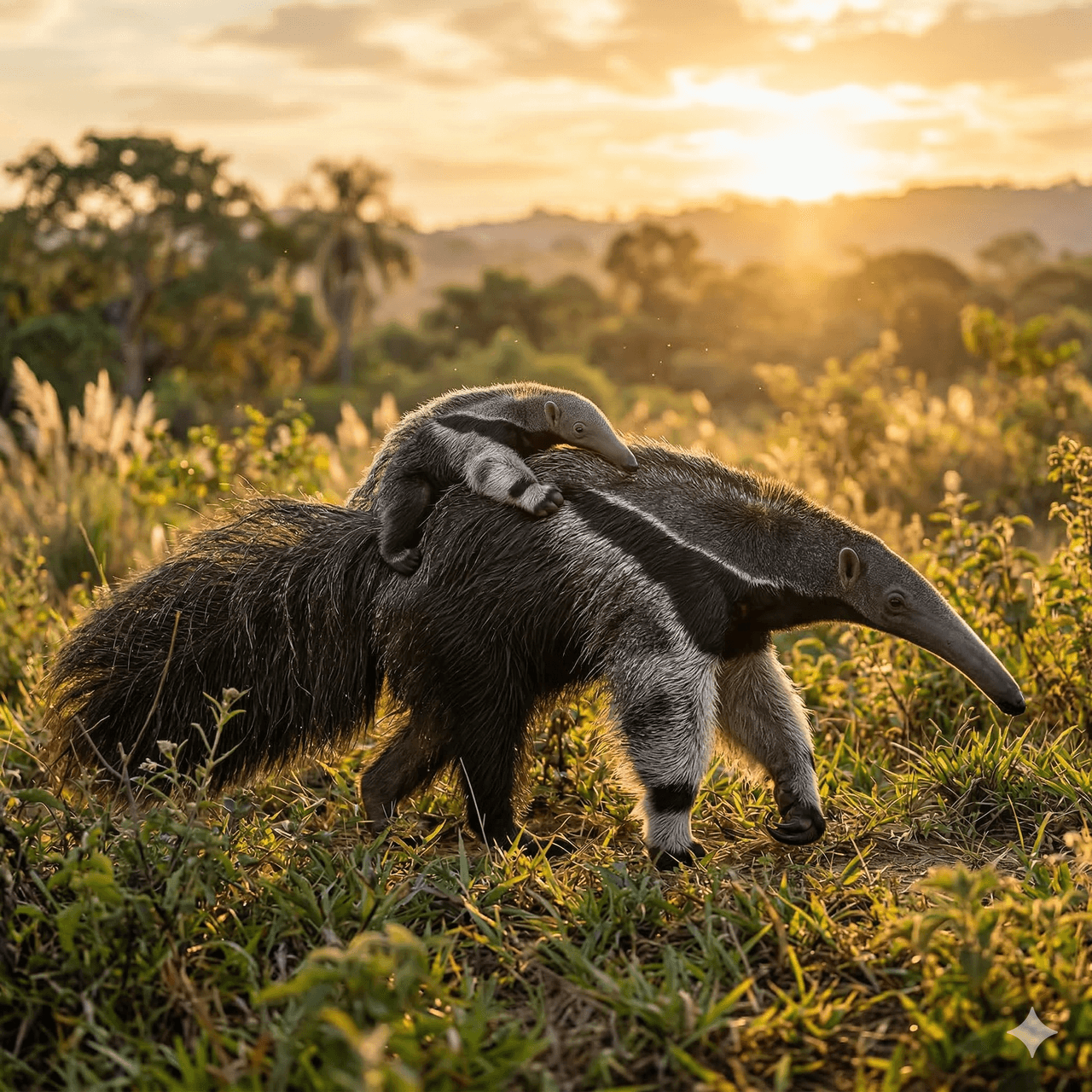
Giant Anteater and Young
(Image Generated by Artificial Intelligence)
Giant anteaters are terrestrial animals that live solitary lives except for mother-offspring pairs or during brief mating periods. In areas with low human activity they are diurnal, but in regions with human pressure or disturbance they become nocturnal. They sleep an average of 15 hours per day and during sleep cover their bodies with their large tails for insulation and protection.
This species has one of the lowest body temperatures among placental mammals at 32.7°C (90.9°F), a result of the low energy intake from their insect-based diet and slow metabolism. They are strong swimmers and can cross wide rivers by holding their long snouts above water like snorkels and using a freestyle swimming motion. They require large home ranges, which vary from 1.5 to 9,000 hectares depending on environmental conditions.
When threatened, they usually attempt to flee, but if cornered they stand on their hind legs, use their tail for balance, and deliver lethal blows with their powerful front claws against predators such as pumas and jaguars. They play an important ecological role by controlling insect populations and, during dry periods, dig into the soil to create water sources for other animals.
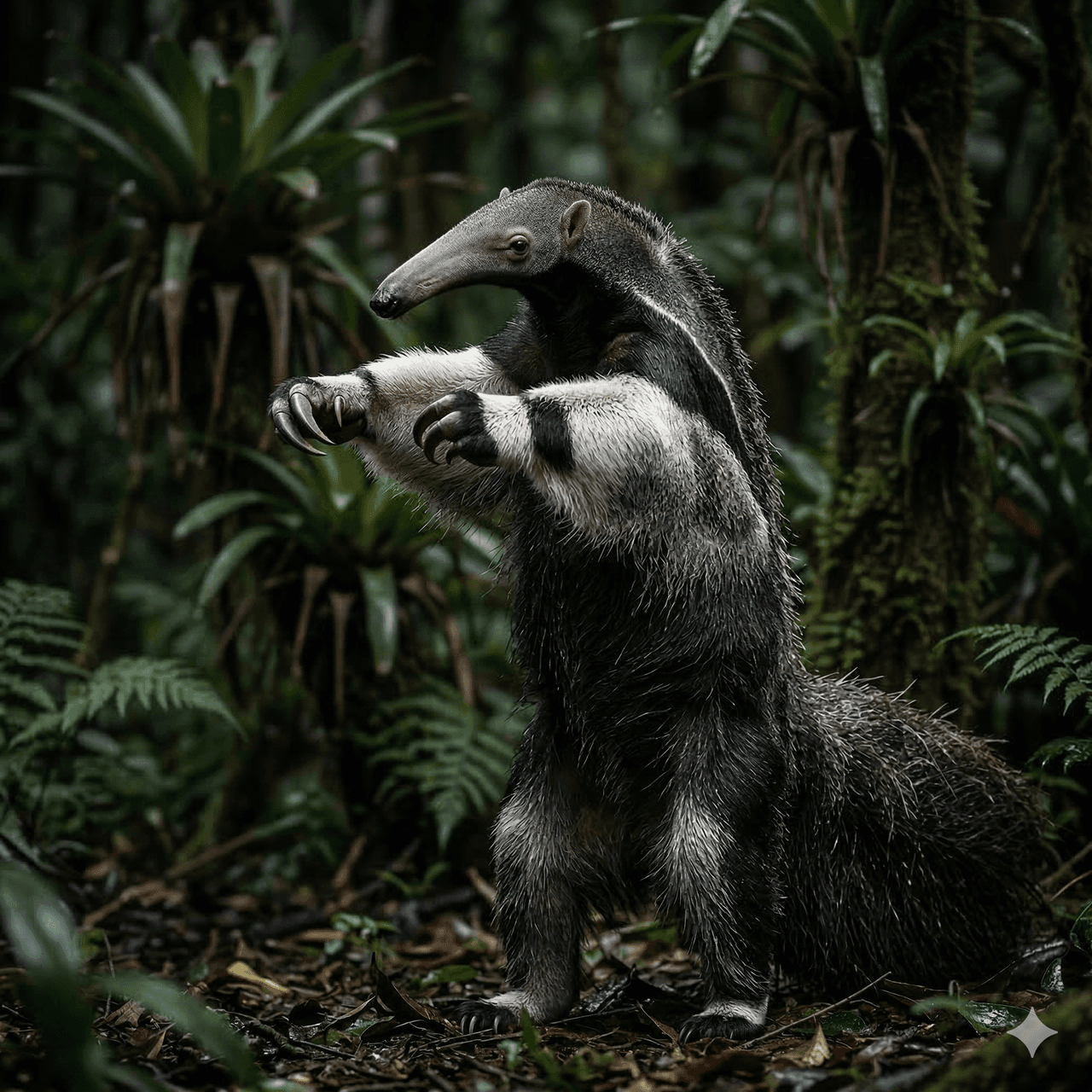
Giant Anteater (Myrmecophaga tridactyla)
(Image Generated by Artificial Intelligence)
They reach sexual maturity between 2.5 and 4 years of age. In most regions there is no specific breeding season and mating can occur year-round. Gestation lasts between 180 and 190 days, and females give birth to a single offspring while standing upright (twins are extremely rare). Newborns weigh 1.3–1.4 kilograms and are born fully furred with the adult colouration and coat pattern.
Immediately after birth, the young climbs onto its mother’s back where, due to its similar colouration, it blends into her fur and gains protection from predators. The young is nursed for the first six months and begins weaning between six and nine months of age. It remains with its mother until about two years old when it becomes independent. Lifespan in the wild is not precisely known, but individuals in captivity can live up to 25–26 years.
Its geographic range extends from southern Honduras, Guatemala and Belize in Central America, through eastern South America along the Andes to northern Argentina and Uruguay. It inhabits savannas, wetlands, grasslands and open tropical forests. It is currently estimated that only around 5,000 individuals remain in the wild, and the International Union for Conservation of Nature (IUCN) lists it as Vulnerable.【1】
It is also listed on Appendix II of the Convention on International Trade in Endangered Species of Wild Fauna and Flora (CITES). The most serious threats to its population include habitat loss due to deliberate fires for agricultural expansion, vehicle collisions, hunting for meat or trophies, attacks by feral dogs, and illegal pet trade. Populations in Guatemala, El Salvador, Belize and Uruguay have been regionally extirpated due to these factors.
Global Conservation. "Giant Anteater." Accessed March 13, 2026. https://globalconservation.org/endangered-species/giant-anteater
Miranda, Flávia R., Diogo Braga, and José A. F. Diniz-Filho. “Distribution and Conservation Status of the Giant Anteater (Myrmecophaga tridactyla) in South America.” Edentata 15 (2014): 1–10. Accessed March 13, 2026. https://doi.org/10.5537/020.015.0101
San Diego Zoo Wildlife Alliance. “Giant Anteater.” *San Diego Zoo Animals & Plants.* Accessed March 13, 2026. https://animals.sandiegozoo.org/animals/giant-anteater
Shaw, John H., Jorge Machado-Neto, and T. S. Carter. “Behavior and Ecology of the Giant Anteater (*Myrmecophaga tridactyla*) in Serra da Canastra National Park, Brazil.” *Biotropica* 19, no. 3 (1987): 255–259. Accessed March 13, 2026. https://doi.org/10.2307/2388344
United Parks & Resorts. “Giant Anteater Facts and Information.” Accessed March 13, 2026. https://seaworld.org/animals/facts/mammals/giant-anteater/
Woltanski, Amy. “Myrmecophaga tridactyla (Giant Anteater).” *Animal Diversity Web.* Accessed March 13, 2026. https://animaldiversity.org/accounts/Myrmecophaga_tridactyla/
Zoo New England. “Giant Anteater.” Franklin Park Zoo. Accessed March 13, 2026. https://www.zoonewengland.org/franklin-park-zoo/our-animals/mammals/giant-anteater
[1]
Global Conservation, “Giant Anteater,” Global Conservation, accessed 13 March 2026, https://globalconservation.org/endangered-species/giant-anteater

Dev karıncayiyen
(Görsel Yapay Zeka ile Oluşturulmuştur)
No Discussion Added Yet
Start discussion for "Giant Anteater (Myrmecophaga tridactyla)" article
Physical Characteristics
Feeding and Digestion
Behavior and Ecology
Reproduction and Life Cycle
Distribution and Conservation Status