


This article was automatically translated from the original Turkish version.
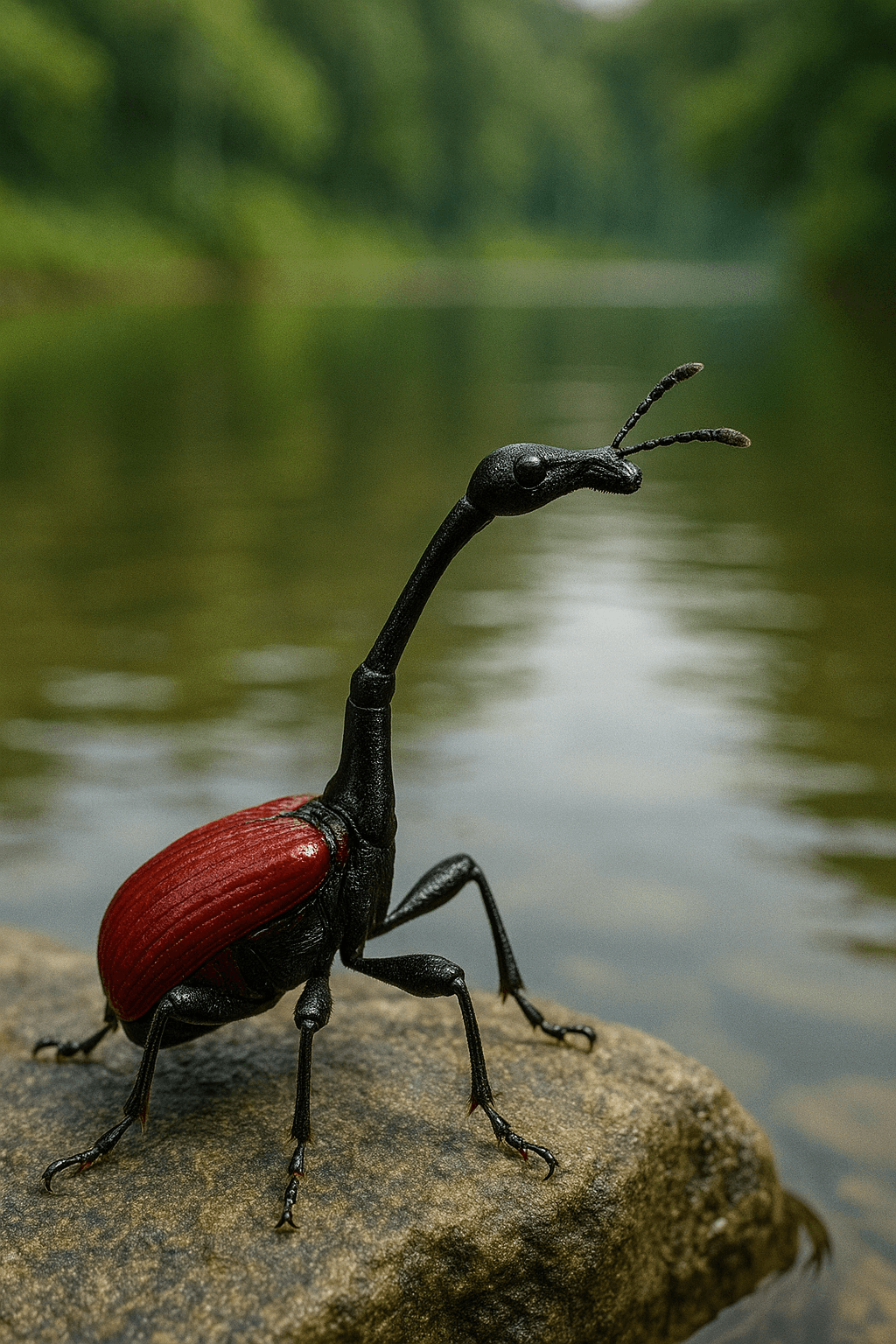
Giraffe Beetle (Trachelophorus giraffa)
Latin Name | Trachelophorus giraffa | ||||||||
|---|---|---|---|---|---|---|---|---|---|
Family | Curculionidae (Sünekkâfiller) | ||||||||
Habitat | Madagaskar forests | ||||||||
Giraffe weevil (Trachelophorus giraffa) is a beetle species endemic to Madagascar, named for the elongated neck that is particularly prominent in males. This extended neck provides additional leverage during competition among males for mating rights and when rolling leaves to construct nests.

Representative image of the giraffe weevil. (Generated by artificial intelligence.)
The most striking feature of the giraffe weevil is the elongated neck, which is significantly more pronounced in males than in females. Male necks are approximately two to three times longer than those of females. This elongation provides a competitive advantage during mating contests.
Their bodies are black and glossy, with reddish elytra—the hardened forewings. This color contrast makes the species easily recognizable. Their average body length is about 2.5 cm.
Thanks to their long necks and strong legs, they are capable of performing complex behaviors such as rolling leaves into nests. These traits play a crucial role both in mating competition and in nest construction. Additionally, the elongated neck helps males gain physical dominance over rivals during contests for access to females.
The giraffe weevil is found only on the island of Madagascar and is therefore an endemic species. It typically inhabits tropical forests, especially areas with specific tree species that provide the leaves necessary for both feeding and reproduction.
Giraffe weevils are generally solitary and have limited social structures. Males compete with one another for access to females by using their necks in displays of dominance. These contests rarely involve direct physical contact; instead, males attempt to establish superiority by showcasing their necks.
Females are highly selective when choosing leaves in which to lay their eggs and do not receive assistance from males during this process. The female carefully rolls the leaf into a tube, deposits her egg inside, and then severs the leaf from the branch so that it falls to the ground. This method helps protect the eggs from predators.
Giraffe weevils feed on plant material, particularly the leaves of specific tree species. During feeding, they pierce the leaf veins and suck out the sap. This feeding behavior satisfies their energy needs and also facilitates the female’s ability to roll leaves for egg-laying. The consumption of leaf sap is critical for the survival and reproduction of the species.
Female giraffe weevils select large leaves in which to lay their eggs. The egg-laying process is highly complex: the female carefully rolls the leaf into a tube, deposits her egg inside, and then severs the leaf from the branch so that it falls to the ground. This method protects the eggs from predators. The larvae develop within the leaf tube and emerge at the appropriate time to begin feeding. This process is vital for the survival of the species.
Males also compete with one another for access to females by displaying their necks. These contests typically do not involve physical contact; instead, males attempt to establish dominance through visual displays.
The greatest threat to the giraffe weevil is habitat loss. Deforestation in Madagascar is reducing the species’ available habitat. Climate change and human activities also pose significant threats to its future. Conservation efforts include protecting existing habitats, reforestation initiatives, and increased research into the species’ biology.
The giraffe weevil poses no direct threat to humans. However, the conversion of forests in Madagascar for agriculture and settlement is shrinking its habitat. Additionally, its unusual appearance may attract collectors, increasing the risk of illegal harvesting. Therefore, raising awareness among local communities and implementing educational programs for its protection are essential.
Animalia.bio. "Giraffe Weevil (Trachelophorus giraffa)." Accessed May 25, 2025. https://animalia.bio/giraffe-weevil Madagascar Biodiversity Partnership. _Conservation Efforts for Endemic Species in Madagascar._ 2020. Accessed May 25, 2025. https://www.madagascarpartnership.org Rakotondranaivo, Vincent H., Owen P. Jenkins, Brian L. Fisher, and Steven M. Goodman. "The Invertebrate Communities of Forest Fragments in Madagascar." _New Zealand Journal of Zoology_ 41, no. 4 (2013): 249–266. Accessed May 25, 2025. https://www.tandfonline.com/doi/full/10.1080/03014223.2013.854816 San Francisco Zoo & Gardens. "Giraffe Weevil." Accessed May 25, 2025. https://www.sfzoo.org/giraffe-weevil/ WildMadagascar.org. "Wildlife of Madagascar." Accessed May 25, 2025. https://www-wildmadagascar-org.translate.goog/wildlife/animals.html?_x_tr_sl=en&_x_tr_tl=tr&_x_tr_hl=tr&_x_tr_pto=tc

Giraffe Beetle (Trachelophorus giraffa)
Latin Name | Trachelophorus giraffa | ||||||||
|---|---|---|---|---|---|---|---|---|---|
Family | Curculionidae (Sünekkâfiller) | ||||||||
Habitat | Madagaskar forests | ||||||||
Physical Characteristics
Habitat and Behavior
Feeding Habits
Reproduction and Larvae
Threats and Conservation Efforts