


This article was automatically translated from the original Turkish version.
+2 More
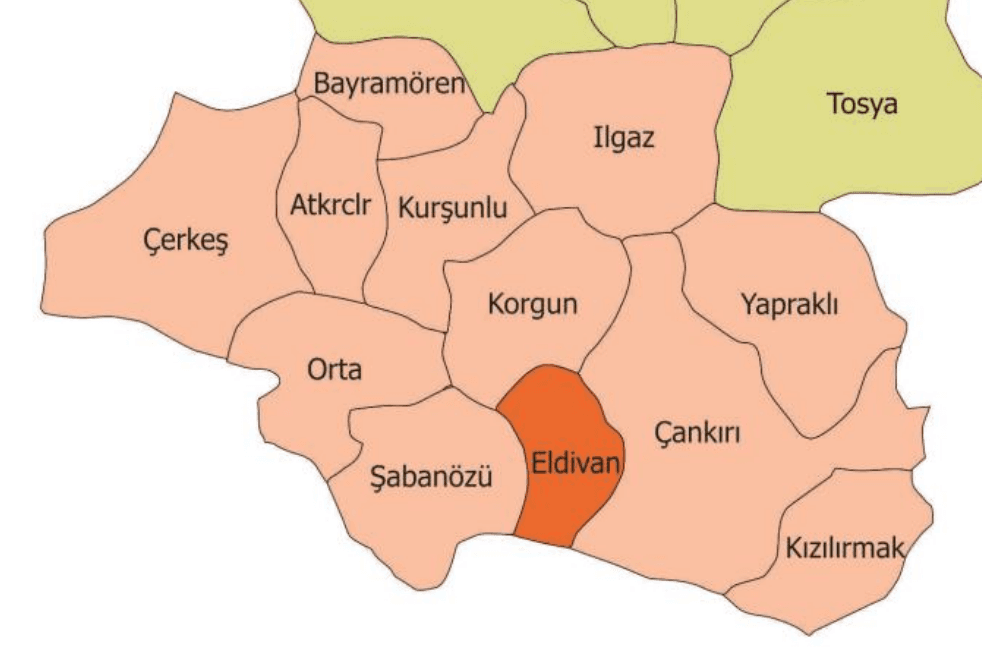
Eldivan, a district affiliated with Çankırı, is located in the Central Anatolia Region. With a population among the smaller settlements of Çankırı, Eldivan attracts attention for its agricultural production, natural beauty, and historical heritage. The district is regarded as one of the regional examples of rural settlement, both in terms of its geographical structure and social characteristics.
Eldivan lies southwest of the Çankırı provincial center, approximately 20 kilometers from the city center. To the east lies the central district, to the west Şabanözü, to the north Korgun, and to the south the border of Ankara Province. The area is surrounded by the Eldivan Mountains and features a rolling terrain. A continental climate prevails in the district, with cold, snowy winters and hot, dry summers. These climatic conditions are decisive for the development of agriculture and animal husbandry.

Eldivan drone view (Eldivan Municipal Mayorship
The history of Eldivan extends back to ancient times. Remnants of various civilizations including the Hittites, Phrygians, Persians, Romans, and Byzantines have been found in the region. Although the origin of the name Eldivan is not definitively known, gravestones and architectural elements dating from the Seljuk and Ottoman periods remain. During the Ottoman era, Eldivan was a village; after the proclamation of the Republic, it first became a subdistrict and later attained district status in 1954.
According to data from the Turkish Statistical Institute, Eldivan’s population is approximately 6,400 (2024). The population is dispersed across the district center and surrounding villages. Agriculture and animal husbandry are the main sources of livelihood. Wheat, barley, chickpea, sunflower, and fruit cultivation are widespread. Apple and cherry production hold significant importance in Eldivan’s economy. Small-scale industrial activities and local handicrafts are also present in the district.
Eldivan has institutions providing education at primary, middle, and high school levels. Additionally, the Eldivan Health Services Vocational School, affiliated with Çankırı Karatekin University, operates in the district. Cultural life reflects traces of traditional Anatolian village life. Local cuisine, folk dances, and wedding traditions reflect the cultural fabric. Annual traditional festivals and fairs held in Eldivan serve as social gathering spaces for both local residents and neighboring districts.
Access to Eldivan is provided by road networks. Due to its proximity to the Çankırı center, transportation facilities are relatively developed. The district center features asphalt roads, a health center, municipal service buildings, and small-scale commercial centers. Basic infrastructure services such as drinking water, sewage, and electricity have been largely completed. Rural settlement areas periodically undergo upgrades to village roads and drinking water projects.

District Center (Source: Çankırı Governorship)
Eldivan is one of the greenest and most tranquil settlements in Çankırı Province. Its mountainous regions and forested areas provide opportunities for outdoor activities such as hiking and photography.
The Eldivan Mountains, which give their name to the district, are among the most prominent geographical features of the region. These mountainous areas are notable for their rich vegetation and wildlife. During spring and summer, the mountains take on various shades of green and are favored by locals for picnics and highland activities.

Eldivan Bülbül Spring (Source: Provincial Directorate of Culture and Tourism)
The highland pastures within Eldivan’s boundaries are especially preferred during summer months due to their cool climate. These pastures, which serve as grazing lands for villagers engaged in animal husbandry, are also cultural living spaces. Natural water sources, floral cover, and their unspoiled structure make the highlands environmentally valuable.
Eldivan is known for its high-quality cherry production, recognized both within Çankırı and at the regional level. The district’s high elevation and semi-arid climate make its soils suitable for cherry cultivation. Eldivan cherries, harvested primarily from late May to mid-June, are noted for their large size, glossy skin, and sweet aroma. Cherries produced in the district reach consumers both in local markets and in neighboring provinces.
Cherry cultivation leads the agricultural activities in Eldivan based on fruit farming. In collaboration with provincial agricultural directorates and local producers, cherry festivals are occasionally organized; these events play an important role in both product promotion and cultural interaction.

Eldivan Cherries (Source: Eldivan Subdistrict Governorship)

Geographical Location and Natural Structure
History
Population and Socioeconomic Structure
Education and Cultural Structure
Transportation and Infrastructure
Natural Beauties and Agricultural Products
Eldivan Mountains
Eldivan Highland Pastures
Eldivan Cherries