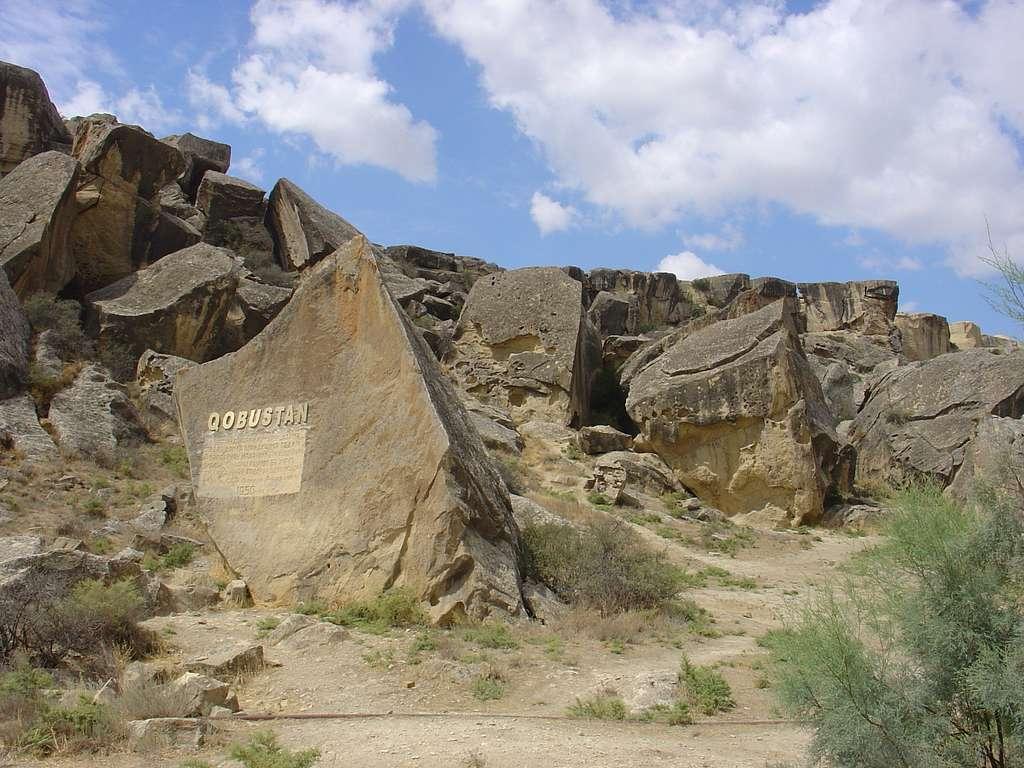
This article was automatically translated from the original Turkish version.
+2 More
Location | Azerbaijan | ||||||||
|---|---|---|---|---|---|---|---|---|---|
Area(s) | 537 hectares (UNESCO protected area) 096 hectares (buffer zone) 3 | ||||||||
Protection Status | UNESCO World Heritage Site (2007) | ||||||||
Period(s) | Upper Paleolithic Period – Middle Ages | ||||||||
Prominent Features | ancient Alban traces group dance depictions hunting scenes shaman figure Gavaldash ceramics graves settlement remains 000 rock carvings More than 6 | ||||||||
Important Areas | Jinghirdagh-Yazylytepe (rich in religious symbols) Kichikdaş Boyukdaş | ||||||||
Gobustan National Park is a historically and archaeologically significant area located approximately 60 kilometers southeast of Baku, on the southern tip of the Absheron Peninsula in Azerbaijan. Covering an area of 537 hectares, the region lies within a semi-arid landscape. Gobustan was inscribed on the UNESCO World Heritage List in 2007.
Around 6,000 rock carvings have been identified in Gobustan. These petroglyphs span a 40,000-year period from the Upper Paleolithic to the Middle Ages. The drawings depict hunting scenes, group activities, animal figures, geometric motifs, and representations of religious rituals. The area is also defined as a site of continuous human settlement throughout history, evidenced by caves, habitation areas, burial sites, and various archaeological finds.
The three main rock complexes—Boyukdaş, Kichikdaş, and Jinghirdagh-Yazylytepe—constitute the core archaeological centers of the region. Particularly on stones from the Jinghirdagh-Yazylytepe collection, figures symbolizing various religious practices are prominently featured.
The museum building affiliated with the Gobustan National Historical-Artistic Reserve opened in 2011 using modern exhibition techniques. The museum presents historical data through audio narratives, reconstructions, and digital visuals. Interactive methods are employed to help visitors better understand the historical process. Within the exhibition halls, displays cover the region’s natural environment, the processes involved in creating rock art, and artifacts characteristic of specific historical periods.
Additionally, the museum operates an educational program known as “live interpretation.” This program conveys historical content to visitors, especially children, through hands-on activities. Practices such as hunting demonstrations, pottery making, stone tool production, and the reenactment of shamanic figures aim to transmit historical knowledge. Educational tours incorporate period-specific clothing, primitive tools, and various audiovisual elements.
The rock formation known as Gavaldash in the Gobustan region attracts attention due to its ability to produce sound when struck. It is understood that this formation was used in prehistoric dance and ritual activities. Furthermore, some of the rock cupules (small depressions) have been associated with food preparation or liquid collection functions.
Norwegian researcher Thor Heyerdahl noted in his studies of Gobustan that the ship figures found there bear resemblance to ship depictions from prehistoric Scandinavia. Common visual elements, such as solar symbols located at the prows of these vessels, have drawn archaeological attention. Heyerdahl suggested the possibility of cultural interactions between Gobustan and certain prehistoric drawings in Northern Europe.
Various academic perspectives have also proposed historical and cultural similarities between the ancient Alban community of the Caucasus, the local population of Gobustan, and the people of Norway. These views are supported by ethnographic and archaeological studies conducted at Alban churches and burial sites in the Sheki region.
Gobustan constitutes an important archaeological site that reflects continuous human habitation, cultural production, and artistic expression from prehistoric times to the present. Ongoing research in the region reveals layered historical and cultural heritage from multiple eras in Azerbaijan’s past. Designated for protection by UNESCO, Gobustan holds international significance in terms of scientific research and cultural preservation policies.
Akdaş, Gürbüz. “GOBUSTAN’DA VİKİNG İZLERİ: NORVEÇ VE AZERBAYCAN’IN ORTAK TARİHİ.” *MOTİF AKADEMİ HALK BİLİMİ DERGİSİ*, no. 16 (2007): 96–107. Accessed July 15, 2025. https://dergipark.org.tr/tr/download/article-file/445338
Picryl. "Qobustan." Picryl. Accessed July 15, 2025. https://picryl.com/media/qobustan-b13f18
UNESCO. "Gobustan Rock Art Cultural Landscape." UNESCO World Heritage Centre. Accessed July 15, 2025. https://whc.unesco.org/en/list/1076/
Yusifova, Shabnam Basharat, and Gunay Loghman Verdiyeva. “Gobustan: Live Interpretation and Interactivity.” *Elmi İş* 16, no. 12 (2022): 53–59. Accessed July 15, 2025. https://aem.az/uploads/files/2022-12/1671535459_1671468973_elmi-is-16-full-53-59.pdf

Location | Azerbaijan | ||||||||
|---|---|---|---|---|---|---|---|---|---|
Area(s) | 537 hectares (UNESCO protected area) 096 hectares (buffer zone) 3 | ||||||||
Protection Status | UNESCO World Heritage Site (2007) | ||||||||
Period(s) | Upper Paleolithic Period – Middle Ages | ||||||||
Prominent Features | ancient Alban traces group dance depictions hunting scenes shaman figure Gavaldash ceramics graves settlement remains 000 rock carvings More than 6 | ||||||||
Important Areas | Jinghirdagh-Yazylytepe (rich in religious symbols) Kichikdaş Boyukdaş | ||||||||
No Discussion Added Yet
Start discussion for "Gobustan National Park" article
Historical and Cultural Features
Museum and Interpretation Programs
International Interest and Research