This article was automatically translated from the original Turkish version.
+2 More
Location | Kazakhstan | ||||||||
|---|---|---|---|---|---|---|---|---|---|
Period(s) | 1500 BCE – early 20th century CE | ||||||||
Turkic Period | 6th–13th centuries | ||||||||
Number of Petroglyphs | 5000+ | ||||||||
Theme(s) | Göktürk inscription Hunting scenes Bow Flag Equestrian warriors | ||||||||
Technique | Schematic figures Carving-engraving (3–5 mm depth) | ||||||||
Tamgalı Petroglyphs are among the most significant rock art sites in Central Asia, located near the village of Karabastau in the Cambul District of Almaty Region, Kazakhstan, and feature approximately 5,000 rock carvings. More than 5,000 petroglyphs are found within the valley, spanning a period of about 3,500 years from the Middle Bronze Age to the early 20th century. Tamgalı was inscribed on the UNESCO World Heritage List in 2004 and is among Kazakhstan’s first internationally recognized cultural heritage sites.
The rock paintings of the Tamgalı Valley first attracted attention in the mid-19th century from Şokan Valikhanov. They were scientifically documented during the South Kazakhstan Archaeological Expedition led by A. Maksimova in 1957, and the discovery was announced in the first scientific article published in 1958. In the 1970s, a team under A.N. Maryaşev revealed that the petroglyphs were not confined to narrow passes but extended across a broad geographic area. Since 2001, UNESCO and the Ministry of Culture of Kazakhstan have been conducting conservation efforts.

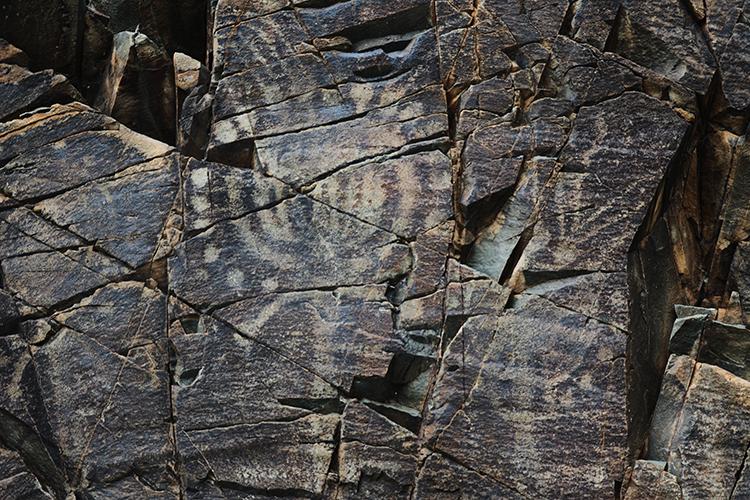
Tamgalı Valley (Anadolu Agency)
The rock images at Tamgalı have been classified into more than 50 groups. The most numerous and striking examples are found in Groups 1 to 5. The majority of the petroglyphs date to the Bronze and Iron Ages, with approximately 300 attributed to the Middle Ages. Particularly, depictions from the Göktürk period exhibit distinct stylistic features and thematic differences characteristic of their era. Among these figures, mounted warriors carrying flags and spears, hunting scenes, and various animal forms stand out.
Göktürk-period petroglyphs are considered part of the broader “Turkic Period,” which extends from the 6th century to the early 13th century, when the Mongol invasions began. Details such as composite bows, tuğ (standard with a wolf’s head), armor, and helmets are prominent in warrior depictions. During this period, banner-carrying mounted figures were not only artistic expressions but also symbols of political authority. Additionally, a text written in the Göktürk alphabet has been found at Tamgalı. The inscription, carved on a rock surface measuring 50×70 cm, is believed to date to the 8th century. Its location approximately 3,200 km west of the Orkhon Inscriptions makes it particularly noteworthy.
The techniques used in the petroglyphs include incision, pecking, and carving to depths of 3–5 mm. In Göktürk-period images, figures are rendered in a more schematic and static manner, with the composition centered on warriors and the symbols they carry. The rough and narrow surfaces of the rock faces suggest that the transmission of meaning took precedence over artistic refinement. In hunting scenes, archers are depicted facing animals such as deer, mountain goats, and camels. Göktürk-period deer figures are slender and finely detailed, exhibiting characteristics that may be identified as maral deer.

Tamgalı Petroglyphs (Anadolu Agency)
Figures of banner-carrying mounted warriors are concentrated in the Chu-Ili Valley and Yedisu region and are rarely found in areas such as the Altai Mountains and Mongolia. These figures are more commonly encountered within the territories of the Western Göktürks, Türgesh, and Karluk Khaganates. It has also been suggested that the Göktürk inscription at Tamgalı may belong to the Karluks.
Religious symbolism is limited in Göktürk and medieval petroglyphs, with themes of warfare, heroism, and daily life dominating. Individual action is central to the compositions. Elements such as hunters measuring themselves against animals and warriors fully armed with armor and banners provide insight into the social structure and ideological outlook of the period. In these rock images, symbolic meaning and message transmission were prioritized over aesthetic refinement.
The Tamgalı Petroglyphs are tangible records of Turkish history and art. With their warrior and inscribed examples from the Göktürk period, they hold a unique place within the Central Asian rock art tradition. These petroglyphs constitute an important source of historical and sociological information, not only artistic. The subjects, drawing techniques, and stylistic features of the rock images reflect the political and cultural structure of their time. This art form experienced a disruption with the Mongol invasions of the 13th century, leading to a long period of stagnation in the Tamgalı Valley. From the 17th century onward, the area was revitalized under Kazakh culture and has been preserved to the present day.
Anadolu Ajansı. “Kazakistan’da Göktürkler Dönemine Ait Tamgalı Petroglifleri Halen Korunuyor – Foto Galeri.” Accessed July 16, 2025. https://www.aa.com.tr/tr/pg/foto-galeri/kazakistan-da-gokturkler-donemine-ait-tamgali-petroglifleri-halen-korunuyor/0
Anadolu Ajansı. “Kazakistan’da Göktürkler Dönemine Ait Tamgalı Petroglifleri Halen Korunuyor.” Accessed July 16, 2025. https://www.aa.com.tr/tr/kultur/kazakistan-da-gokturkler-donemine-ait-tamgali-petroglifleri-halen-korunuyor/3251781
Kutlu, Mehmet. “TAMGALI’DA GÖKTÜRK DÖNEMİ VE ORTAÇAĞ PETROGLİFLERİ”. *Stratejik ve Sosyal Araştırmalar Dergisi* 4, no. 3 (2020): 503–524. Accessed July 16, 2025. https://dergipark.org.tr/tr/download/article-file/985761

Location | Kazakhstan | ||||||||
|---|---|---|---|---|---|---|---|---|---|
Period(s) | 1500 BCE – early 20th century CE | ||||||||
Turkic Period | 6th–13th centuries | ||||||||
Number of Petroglyphs | 5000+ | ||||||||
Theme(s) | Göktürk inscription Hunting scenes Bow Flag Equestrian warriors | ||||||||
Technique | Schematic figures Carving-engraving (3–5 mm depth) | ||||||||
No Discussion Added Yet
Start discussion for "Petroglyphs with Tamga Symbols" article
History of Research and Conservation
Chronological Characteristics of the Petroglyphs
The Göktürk Period and Beyond
Themes and Technical Features
Iconography and Geographic Distribution
Transformation of Artistic Expression