


This article was automatically translated from the original Turkish version.
+2 More
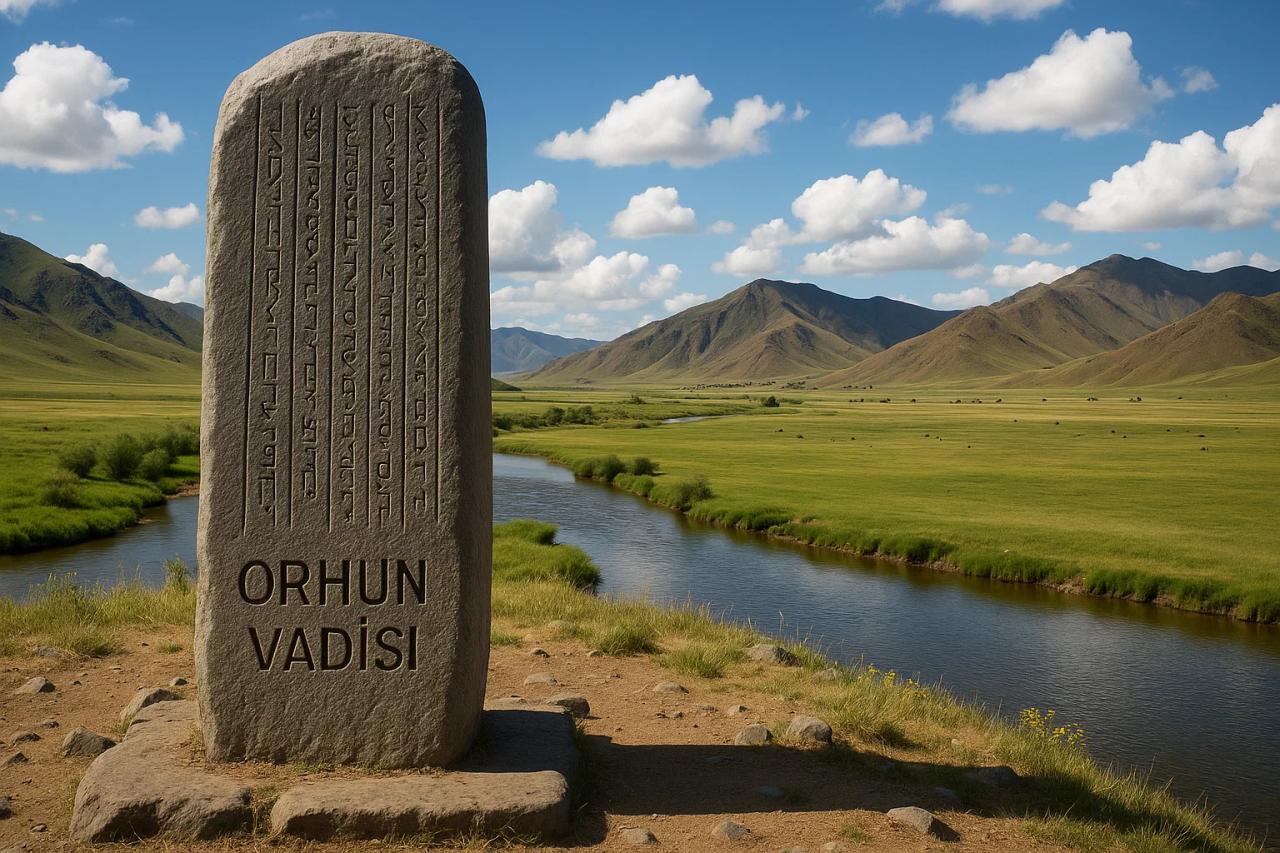
Generated with Visual Artificial Intelligence.
Orkhon Valley
Country | Mongolia | ||||||||
|---|---|---|---|---|---|---|---|---|---|
River Length | 1,124 km | ||||||||
Historical Significance | Serving as the center of important Turkish states | ||||||||
UNESCO Status | World Heritage Site | ||||||||
Orkhon Valley is a geographical region located in the Mongolian area of Central Asia that has held central political, cultural, and socio-economic significance for the Turkic peoples throughout history. The valley is best known for the presence of the Orkhon Inscriptions, which date back to the Göktürk period. These inscriptions are of great importance for the study of the Turkic language and history as the oldest known written records of the Turkic peoples.

Visual Representing the Orkhon Valley and River (Generated by Artificial Intelligence)
The historical significance of the Orkhon Valley increased notably during the Göktürk period. From the late 6th century to the mid-8th century, the Göktürks established a major state structure in this region. During this time, the Orkhon Valley became a political center and the cultural hub for other Turkic communities in the area.
After the collapse of the Göktürk Khaganate, the center of the Uyghur Khaganate was also located here, and the region remained the focal point of Turkic political and cultural life for many centuries. With the Uyghurs’ presence, the Orkhon Valley developed further in terms of religious and architectural structures. The discovery of the Orkhon Inscriptions marked a pivotal moment in documenting the region’s history. The inscriptions were erected in memory of the rulers Bilge Khagan, Kül Tigin, and the minister Tonyukuk, and provide information on the founding of the state, its achievements, and its social structure.
The Orkhon Valley extends along the Orkhon River in northern Mongolia. The region is surrounded by vast steppes, and the fertile and moist lands of the river valley have provided a suitable environment for settlement and agricultural activity throughout history. The climate exhibits harsh continental characteristics, with short and mild summers and long, cold winters. The valley’s natural structure is significant for both biological diversity and ecological balance. The local flora and fauna reflect the typical steppe ecosystem of Central Asia. The morphological features created by the Orkhon River in the valley enabled human settlement and agriculture, thereby contributing to the region’s cultural and economic development.

Visual Representing the Orkhon Inscriptions (Generated by Artificial Intelligence)
The Orkhon Valley is the site where the Orkhon Inscriptions, the oldest known written records of the Turkic peoples, were discovered. Deciphered in 1889 by the Danish linguist Vilhelm Thomsen, these inscriptions not only revealed the political and social structure of the Göktürks but also became a foundational source for understanding the historical development of the Turkic language.
The inscriptions are written in the Orkhon script (also known as the Göktürk alphabet) and are recognized as the earliest written texts in the Turkic language. They consist of three main monuments: the Bilge Khagan Inscription, the Kül Tigin Inscription, and the Tonyukuk Inscription. These texts not only provide information on state administration and warfare but also address spiritual beliefs, concepts of social justice, and the purpose of state existence. The Orkhon Inscriptions are documents that shed light on the early stages of the Turkic people’s written culture and national consciousness.
Throughout history, the Orkhon Valley has played a critical role in shaping and spreading Turkic culture as the center of numerous Turkic states. In addition to the Orkhon Inscriptions, archaeological excavations and research conducted in the valley have provided comprehensive information about the religious beliefs, social lives, governance systems, and daily activities of the ancient Turkic peoples. The findings from this region not only document the early presence of the Turkic peoples on the historical stage but also make significant contributions to the history of Central Asia.
The Orkhon Valley has functioned both as a settlement area and as a center of economic activity throughout its historical development. The region’s geographical structure provided favorable conditions for agriculture, animal husbandry, and trade. The water resources offered by the Orkhon River enabled the continuity of settlements in the valley. The socio-economic structure shaped the social organization and modes of production of the communities living in the valley. Economic activities during the Göktürk and Uyghur periods were supported by state policies, and the region acquired a strategic position along the trade routes of Central Asia.
UNESCO designated the Orkhon Valley as part of the World Heritage List in 2011, recognizing it as a site requiring protection for both cultural and historical reasons. This World Heritage status has increased the region’s international visibility and supported conservation efforts.

Visual Representing the Orkhon Valley (Generated by Artificial Intelligence)
(No content to translate — the provided text contains only empty HTML span elements with no meaningful text.)
Ercilasun, Ahmet B. *Atâ Melik Cüveynî Neler Gördü?* Türk Dil Kurumu Yayınları, 2020. Accessed June 30, 2025.
Ortaylı, İlber. “Türklerin Tarihi”. Timaş Yayınları, 2015. Accessed June 30, 2025.
TRT Avaz YouTube Channel. "Orhun Vadisi Episode - Türkiye in the World." Accessed June 30, 2025.
UNESCO Dünya Heritage Centre. "Orhun Vadisi Cultural Landscape." Accessed June 30, 2025.
Çakmar, Merve. “Bir Amazon Güncesi: Orhun Vadisi.” Folklor Akademi Dergisi, Volume 30, no. 120, 2024. Accessed June 30, 2025.

Generated with Visual Artificial Intelligence.
Orkhon Valley
Country | Mongolia | ||||||||
|---|---|---|---|---|---|---|---|---|---|
River Length | 1,124 km | ||||||||
Historical Significance | Serving as the center of important Turkish states | ||||||||
UNESCO Status | World Heritage Site | ||||||||
History
Geographical Location and Natural Features
Orkhon Inscriptions and Written Culture
Cultural and Historical Significance