


This article was automatically translated from the original Turkish version.
Bilge Kağan, who lived in the 8th century, was one of the most important rulers of the Second Turkic (Kutluk) Khaganate. His name means “wise,” that is, “knowledgeable and intelligent.” The period of his reign is regarded as one of the brightest in Turkish history. Through his military and administrative successes, he laid the foundational stones of the Turkish state concept. Bilge Kağan’s rule was a time when the unity and solidarity of the Turkish nation reached their highest level, and when significant cultural and economic development took place.
Bilge Kağan was born in 683. His father was Ilteriş Kağan, who revived the Turkic State, and his mother was Ilbilge Hatun. From an early age, he received education in state administration and military strategy. He held important positions especially during the reign of his uncle, Kapgan Kağan. The experience he gained during this period played a crucial role in his emergence as a great leader.
Following the death of Kapgan Kağan in 716, Bilge Kağan, together with his brother Kül Tigin, entered the struggle for the throne and soon became ruler. However, he shared the actual governance of the state with his brother Kül Tigin and his vizier Tonyukuk. Bilge Kağan implemented various reforms to ensure internal and external stability of the state. This tripartite system of governance was a rare phenomenon in Turkish history and played a major role in the state’s success.
Bilge Kağan demonstrated his devotion to his people through the famous words: “I did not sleep at night nor sit during the day.” Under his rule:
Bilge Kağan’s governance philosophy aimed to encourage the Turkish nation to assert its own core values and progress in accordance with them. To this end, he took several steps to preserve and develop Turkish culture.
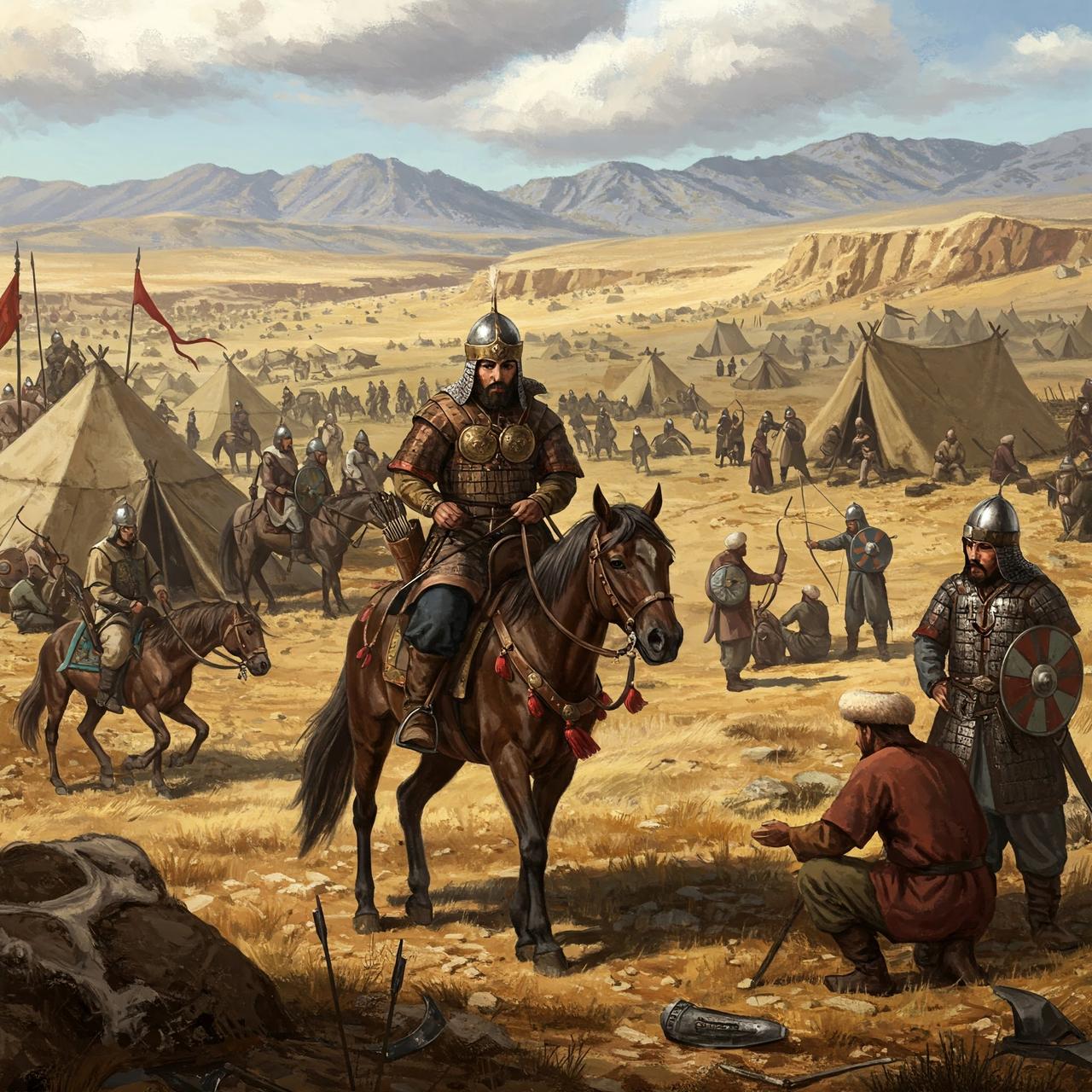
Bilge Kağan (generated by artificial intelligence)
Bilge Kağan was poisoned and killed in 734. After his death, the Orkhon Inscriptions were erected in his honor. These inscriptions are among the most important documents preserving his governance philosophy and the political philosophy of the Turkic state for posterity. The Orkhon Inscriptions represent Bilge Kağan’s most valuable legacy to the Turkish nation. They contain essential information about the past, present, and future of the Turkish people. Bilge Kağan’s legacy played a vital role in the formation and preservation of the Turkish national identity.
Akar, Ali. Bilge Kağan Yazıtı. İstanbul: Ötüken Neşriyat, 2024. Accessed May 19, 2025.
Altuntaş, Şevket. “Büyük Göktürk Hükümdarı Bilge Kağan ve Eski Türk Orta-Asya Kamu Hukuku’ndaki Yeri.” Jurix. Erişim tarihi: 19 Mayıs 2025. https://jurix.com.tr/article/18356.
Kafesoğlu, İbrahim. Türk Millî Kültürü. İstanbul: Ötüken Neşriyat, 1992. Accessed May 19, 2025.
Sinor, Denis, ed. *The Cambridge History of Early Inner Asia*. Cambridge: Cambridge University Press, 1990. Accessed May 19, 2025. https://www.cambridge.org/core/books/cambridge-history-of-early-inner-asia/90634C2E365B2AE442EDCA51E5335033.
Tekin, Talât. Orhon Yazıtları. Ankara: Türk Dil Kurumu Yayınları, 2014. Accessed May 19, 2025.
Şimşirgil, Ahmet. “Bilge Kağan.” *Ahmet Şimşirgil Resmî Web Sitesi*. Accessed May 19, 2025. https://www.ahmetsimsirgil.com/bilge-kagan/.
Birth and Youth
Accession to the Throne and Reign
Governance Philosophy and Reforms
Death and Legacy
