



Bilge Vezir Tonyukuk
Birth Year | Approximately 648 AD | ||||||||
|---|---|---|---|---|---|---|---|---|---|
Place of Birth | Yulin and Datong regions) around the great bend of the Yellow River (modern-day Ordos Northern China | ||||||||
Title(s) | Apa Tarkan Boila Baga Tarkan Tonyukuk Bilge | ||||||||
Khagans Served | Bilge Kağan Kapgan Kağan Ilteriş Kağan | ||||||||
Work | Tonyukuk Inscription | ||||||||
Tonyukuk was a statesman and military strategist who played a pivotal role in the restoration and rise of the Köktürk Khaganate and left profound marks on Turkish history and state tradition. His life, political activities, and the inscription he personally authored confirm his significance as a key historical figure.
Although historians differ on the exact date of Tonyukuk’s birth, it is widely accepted that he was born around 648 or earlier in northern China, near the great bend of the Yellow River, in the regions corresponding to today’s Ordos, Yulin, and Datong.
His designation as Ashihte Yüan-zhen in Chinese sources suggests his presence in China and possibly indicates that he received education there. This period coincided with the time when the Köktürk Khaganate was under the influence of China’s Tang Dynasty and Turkish tribes were politically fragmented.
Spending his youth in China provided Tonyukuk with an insider’s perspective on China’s administrative, military, and cultural structures. This accumulated knowledge later became a significant advantage in serving the Turkish state.
The meanings of Tonyukuk’s name and titles offer clues about his identity and social standing. One interpretation holds that “Tonyukuk” derives from “tun” (first, ancient) and “yugruş” (from the people, from the tribe), meaning “first minister from the people” or “minister emerged from among the people.” This suggests he rose to prominence not through noble birth but through merit and ability.
An alternative view proposes that his name may have originated from a geographical feature such as “cliff” or “ravine.” His titles—Bilge, Boyla Baga Tarkan, and Apa Tarkan—demonstrate his high rank in both administrative (vizier) and military (commander) domains, as well as his deep expertise. The title “Bilge,” meaning “wise, judicious, learned, scholar,” underscores not only his role as a statesman but also as a thinker and strategist.
After his experiences in China, Tonyukuk’s return to the steppe to join the Turkish struggle for independence marked a radical turning point in his life and symbolized his unwavering commitment to the ideal of Turkish sovereignty.

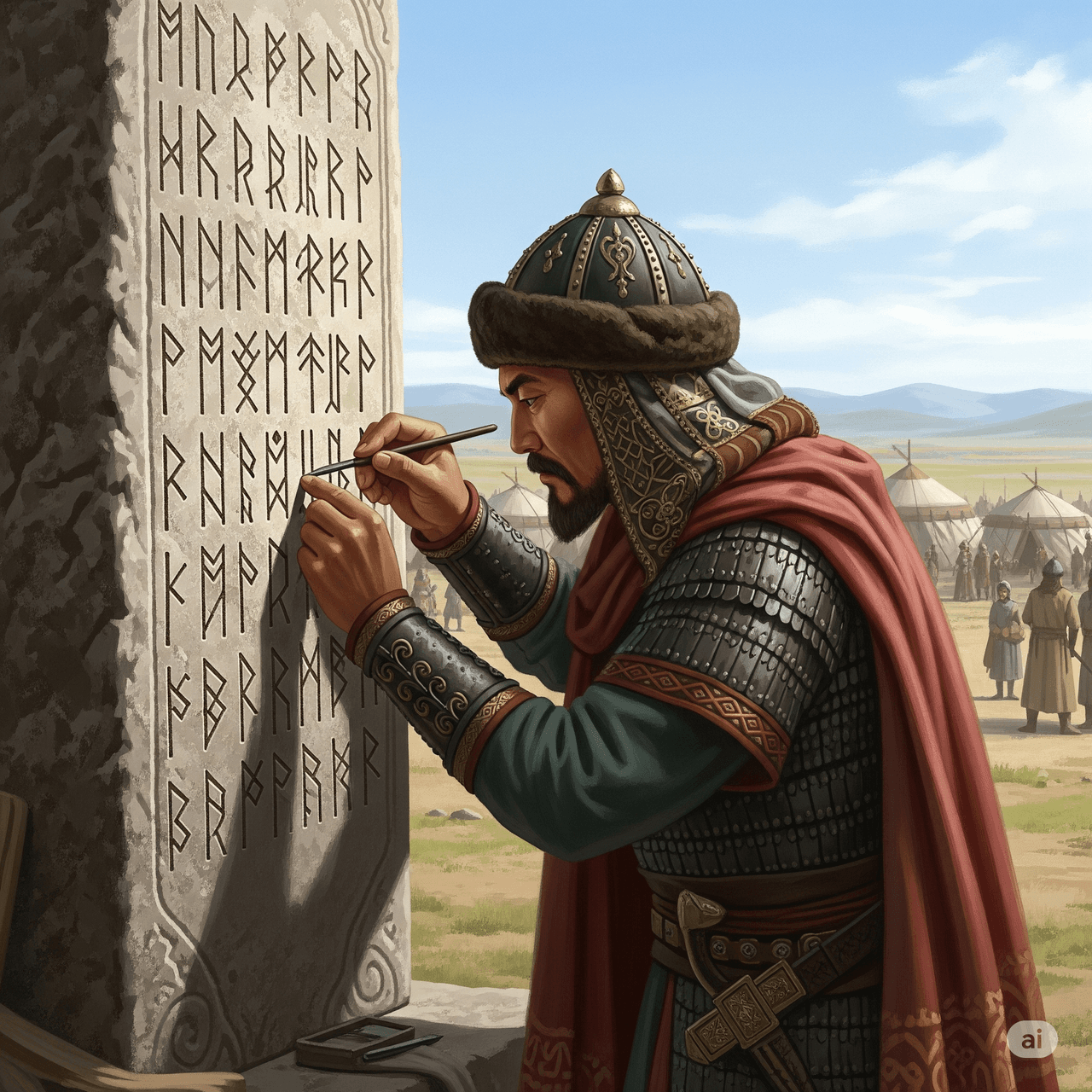
Representative Image of Vizier Tonyukuk (Generated by Artificial Intelligence)
Bilge Tonyukuk served as vizier to three successive khagans of the Köktürk Khaganate: Ilteriş Khagan, Kapgan Khagan, and Bilge Khagan. During their reigns, he emerged as a decisive figure in both domestic and foreign policy, led military campaigns, and played a critical role in shaping the strategic direction of the state.
One of Tonyukuk’s most important services was assisting Ilteriş Khagan in uniting the fragmented Turkish tribes and restoring the Köktürk Khaganate. As he himself recorded in the Tonyukuk Inscription: “Had Ilteriş Khagan not succeeded, had he not existed; had I, Bilge Tonyukuk, not succeeded, had I not existed... the state would not have become a state, the people would not have become a people...” These words emphasize his indispensable partnership with Ilteriş Khagan in establishing and strengthening the foundations of the state. During this period, Tonyukuk did not merely command military operations; he also undertook complex diplomatic and administrative tasks, including fostering unity among tribes, forging political alliances, and reducing Chinese influence in the region. His strategic genius enabled successful campaigns against China and other adversaries despite the limited size of Turkish forces. His use of the “sudden attack” strategy against China exemplifies his tactical mastery.

Representative Image of Vizier Tonyukuk (Generated by Artificial Intelligence)
After the death of Ilteriş Khagan, his brother Kapgan Khagan ascended the throne, and Tonyukuk continued to serve as vizier. In alignment with Kapgan Khagan’s aggressive foreign policy and territorial expansion goals, Tonyukuk played an active role in formulating and implementing military strategies. During this period, the boundaries of the Köktürk Khaganate extended from the Khitans in the east to the Türgesh in the west, and the state’s political power and influence reached their peak.
References in the Tonyukuk Inscription to Kapgan Khagan “developing the Türk Sir people” may indicate Tonyukuk’s indirect contribution to these achievements. Chinese sources specifically note that Tonyukuk commanded the Köktürk army in a major battle against the Türgesh and secured significant victories. The inscription records his words: “...üküş tiyin neke korkur biz az tiyin ne basınalım tegelim tedim...” (“Why fear because we are many? Why underestimate because we are few? Let us attack!”). These words reflect his determination and offensive spirit in military operations and illustrate one of the fundamental principles of Turkish military strategy: courage and the initiative to act.
Following the succession struggles after Kapgan Khagan’s death, Bilge Khagan ascended the throne, and despite his advanced age, Tonyukuk continued to serve as vizier. During this period, internal stability became the priority, and progress was made in cultural and administrative affairs. Tonyukuk’s experience and wisdom served as a vital source of counsel for the young Bilge Khagan. It is believed that Tonyukuk advised Bilge Khagan not only on military matters but also on cultural and administrative issues. The inscription includes his reflection: “I have grown old and aged. If in any land, under any ruler, among any people, there were a vizier like me, what troubles would he have?” These words express his profound loyalty to his state and the depth of his accumulated knowledge. They also highlight the universal value of Tonyukuk’s personal experience and understanding of statecraft.

Tonyukuk Inscriptions (AA)
The most important legacy Bilge Tonyukuk left to Turkish history is the monument inscription in which he narrated his own life, his services to the state, and the foundation and rise of the Köktürk Khaganate in his own words. This inscription, composed of two stones with eight faces and sixty-two lines, is a unique primary source explicitly stated to have been authored by Tonyukuk himself. Like the other Orkhon Inscriptions, it holds invaluable importance for the study of the Turkish language and history.
The content of the inscription reflects Tonyukuk’s strategic thinking, military genius, political foresight, and sense of responsibility toward the Turkish people. Decisions made in battle, tactics employed against enemies, inter-tribal relations, and advice for the survival of the state form its central themes. For example, descriptions such as “We marched by night, rested by day... We rode on horseback... and surprised our enemies” reveal his meticulous planning and mastery of surprise attack strategies. Likewise, statements like “I gathered the people of Türk Sir who suffered hunger and went barefoot” demonstrate his sense of responsibility toward his people and his social consciousness.

Tonyukuk Inscriptions (AA)
The Tonyukuk Inscription is an exemplary demonstration of the richness, expressive power, and literary depth of the Turkish language during that period. The style, literary devices, and narrative techniques used in the inscription confirm Tonyukuk’s identity not only as a statesman but also as a writer and thinker.
The inscription itself functions as both a manual of advice and a political manifesto, serving as a guide for future generations on state governance, military strategy, and relations with the people. Commemorative events marking the 1300th anniversary of its erection underscore the enduring cultural significance of his legacy.

Tonyukuk Inscriptions (AA)
Legacy and Position in the Turkish State Tradition
Bilge Tonyukuk is regarded as the most concrete and compelling embodiment of the “wise vizier” archetype in Turkish state tradition. His experience functioned as a balancing, guiding, and complementary force alongside powerful rulers such as Ilteriş, Kapgan, and Bilge Khagans. Tonyukuk defended Turkish interests not only on the battlefield but also in the arenas of politics and diplomacy.
While the Turkish concept of “kut”—divine authority granted by heaven—forms the foundation of the Turkish state tradition, viziers like Tonyukuk ensured that this divine power was realized on earth through wisdom and strategy. His ideas on founding the state, sustaining it, and transmitting it to future generations echoed in later Turkish states and became an integral part of the state tradition.
Today, the Tonyukuk Inscription is preserved at the Orkhon Inscriptions Museum in Mongolia, and ongoing research by the Turkish Historical Society and other scholarly institutions continues to illuminate his legacy. Bilge Tonyukuk remains an indispensable source for understanding Turkish history and analyzing the Turkish state tradition.
Akcan, Ayten. "II. Türk kağanlığı devlet ideolojisi içerisinde bilge tonyukuk." *Akademik Sosyal Araştırmalar / Academic Social Studies* 8, no. 30 (Winter 2024): 203–216. Accessed June 12, 2025. https://dergipark.org.tr/tr/download/article-file/4387677
Anadolu Ajansı. "Türk tarihininin ışığı tonyukuk yazıtları." Anadolu Ajansı, August 19, 2018. Accessed June 12, 2025. https://www.aa.com.tr/tr/pg/foto-galeri/turk-tarihininin-isigi-tonyukuk-yazitlari
Azılı, Kenan. Erhan Aydın’s *Türklerin bilge atası tonyukuk*. *Türkbilig*, no. 38 (2019): 231–233. Accessed June 12, 2025. https://dergipark.org.tr/en/download/article-file/1100508
Buyar, Cengiz. "Türk devlet geleneğinde bir bilge vezir: Bilge tonyukuk." *İpekyolu Dergisi* (July-August 2020). Accessed June 12, 2025. https://www.academia.edu/44033529/T%C3%BCrk_Devlet_Gelene%C4%9Finde_Bir_Bilge_Vezir_Bilge_Tonyukuk
Durmuş, İlhami. "Bilge tonyukuk." *Asya Araştırmaları Dergisi* 3, no. 1. Accessed June 12, 2025. https://dergipark.org.tr/tr/download/article-file/778006
Gülensoy, Tuncer. "Köktürkler’in büyük veziri “tonyukuk boyla baga tarkan”ın adı üzerine yazılanlar ve yeni bir görüş." Accessed June 12, 2025.
Sprengling, Martin. "Tonyukuk Kitabesi: Eski Bir Türk Şaheseri." Trans. Mehmet İlhan. Accessed June 12, 2025. https://dergipark.org.tr/tr/download/article-file/693653
Tansü, Yunus Emre, and Nuri Öztürk. "Bilge tonyukuk’un gök-türk devleti’ne katkısı." İksad Yayınevi, 2021. Accessed June 12, 2025. https://iksadyayinevi.com/wp-content/uploads/2021/03/BILGE-TONYUKUKUN-GOK-TURK-DEVLETINE-KATKISI.pdf
Uyan, Selen Kaya. "Erhan Aydın'ın Türklerin bilge atası tonyukuk adlı eserinin incelenmesi." *Uluslararası Türk Lehçe Araştırmaları Dergisi (Türklad)* 4, no. 1 (2020): 146-152. Accessed June 12, 2025. https://dergipark.org.tr/en/download/article-file/1152517

Bilge Vezir Tonyukuk
Birth Year | Approximately 648 AD | ||||||||
|---|---|---|---|---|---|---|---|---|---|
Place of Birth | Yulin and Datong regions) around the great bend of the Yellow River (modern-day Ordos Northern China | ||||||||
Title(s) | Apa Tarkan Boila Baga Tarkan Tonyukuk Bilge | ||||||||
Khagans Served | Bilge Kağan Kapgan Kağan Ilteriş Kağan | ||||||||
Work | Tonyukuk Inscription | ||||||||
Birth, Origins, and Early Years: The Chinese Experience and Identity Formation
Vizierate in Three Phases of the Köktürk Khaganate: Political and Military Advisory Role
Ilteriş Khagan Era (682–692): Laying the Foundations of Revival and Tonyukuk’s Strategic Contribution
Kapgan Khagan Era (692–716): Advocate of Expansion and Power Politics
Bilge Khagan Era (716–734): Guardian of Stability and Continuation of Wisdom
Tonyukuk Inscription