This article was automatically translated from the original Turkish version.
Type of Geographical İndication | Origin Name | ||||||||
|---|---|---|---|---|---|---|---|---|---|
Application Date | 09.02.2018 | ||||||||
Registration Number | 412 | ||||||||
Registration Date | 04.02.2019 | ||||||||
Product / Product Group(s) | Other products | ||||||||
Province(s) | Ankara | ||||||||
Applicant/Registrant(s) | Gölbaşı Municipality | ||||||||
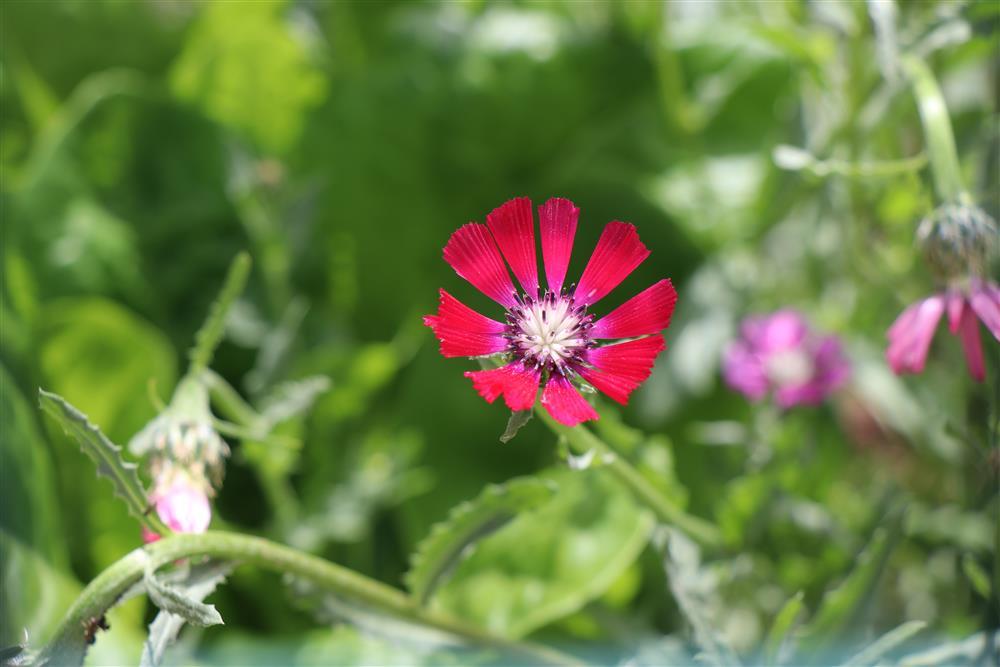
Gölbaşı Sevgi Çiçeği, scientifically known as Centaurea tchihatcheffii, is an endemic ornamental plant that grows naturally only in the Gölbaşı district of Ankara. This species attracts attention with its vibrant red, pink and purple flowers that bloom in spring and holds a special place both for the conservation of biological diversity and for symbolizing regional identity. Among the public, it is also known as the “prophet flower” or “yanardöner çiçek” due to its color-changing structure in response to light.

Gölbaşı Sevgi Çiçeği (Ankara Provincial Directorate of Culture and Tourism)
The Gölbaşı Sevgi Çiçeği has been registered as a geographical indication under Law No. 6769 on Industrial Property. The registration was carried out by the Gölbaşı Municipality and has been under protection since 4 February 2019. The use of the geographical indication label is mandatory in all promotional and sales activities. Production is restricted exclusively to a designated area of 1,750 m² within the boundaries of Gölbaşı district in Ankara province, particularly in Eymir Neighborhood.
The Gölbaşı Sevgi Çiçeği (Centaurea tchihatcheffii) is an annual, endemic ornamental plant belonging to the Asteraceae family. It is classified under the division Magnoliophyta (Angiosperms), class Magnoliopsida (Dicotyledons), and order Asterales. The International Union for Conservation of Nature (IUCN) has classified it as “Critically Endangered.” This classification highlights the species’ vulnerability due to its limited distribution and environmental threats.
The plant reaches heights of 4–50 cm and has striated and hairy stems. The lower portions of the stem are purplish while the upper portions are greenish; it may grow prostrate or upright. The stem bears 5–50 capitula (flower heads). The lower parts are floccose-tomentose (woolly), while the upper parts are pilose (finely hairy).
Leaf morphology is highly variable and differs across regions of the stem:
Basal leaves: Varying from ovate to lirate in shape, they have a petiole-like structure 2–5 cm long. The lamina measures 2–2.5 x 2.5–11 cm and has margins ranging from dentate to pinnatifid.
Mid-stem leaves: Ranging from oblong to lobate in form, they are 7.5–11 cm long with rounded to acute tips and broad lobes. Some leaves are pinnatifid.
Upper leaves: Smaller and narrower, varying from linear to lirate in shape, measuring 0.4–3.5 cm x 2–7.5 cm. Margins may be entire, dentate or lobate.
The upper leaf surfaces are generally less hairy, with wrinkled lamina and only the midrib clearly visible. The lamina margins are thickened and appear fleshy. Leaves extend along the stem down to the base of the capitula, numbering between 8 and 16.
The flower head is broadly campanulate, measuring 12–18 x 7–20 mm. The peduncle is distinctly widened and hollow. Bracts are arranged in 5–8 rows, with 7 veins and brown claw-like (appendaged) structures. These claws have 9–11 white cilia along their margins.
The flowers exhibit considerable variation in color and pattern:
Peripheral flowers: Pale or dark red, pink, purplish or whitish in tone. Near the base, they display ring-shaped spots. In pale purple flowers, spots are dark purple; in red flowers, they appear blackish or as fine white stripes. The flowers are tubular, 12–22 mm long, with 7–12 per capitulum. From above, they appear longitudinally striped like an open fan; usually open but sometimes closed. These flowers are neutral in terms of sex.
Central flowers: Small, in red-pink tones, numbering 25–55. They are hermaphroditic with straight anther tubes.
The fruits (achenes) are 2–4 mm long, brown and covered with long plumose (hairy) structures. The hilum is located laterally at the base, shiny, yellowish and glabrous. The number of achenes per capitulum ranges from 7 to 37. The pappus at the apex of the achene is barbellate, arranged in two rows, with the inner row longer and measuring 0.2–3.5 mm in length.
Flowering occurs from the last week of April to the first week of July. The plant reaches peak maturity between late May and early June. Depending on climatic conditions, this period may shift by one to two weeks earlier or later. After flowering, the plant enters the seed phase and remains in this stage for the remaining nine months of the year.

Gölbaşı Sevgi Çiçeği (Ankara Provincial Directorate of Culture and Tourism)
Production of the Gölbaşı Sevgi Çiçeği is carried out using two distinct methods: open-field cultivation and greenhouse cultivation.
Monitoring is conducted annually under the coordination of the Gölbaşı Municipality, with participation of experts from the Municipal Police Directorate, Gölbaşı Chamber of Agriculture and District Directorate of Agriculture.
The following aspects are evaluated during inspections:
Kültür ve Turizm Bakanlığı Ankara İl Kültür ve Turizm Müdürlüğü. "Gölbaşı Sevgi Çiçeği." Accessed August 16, 2025. https://ankara.ktb.gov.tr/TR-153099/golbasi-sevgi-cicegi.html.
Turkish Patent and Trademark Office. "Gölbaşı Sevgi Çiçeği." Accessed August 16, 2025. https://ci.turkpatent.gov.tr/cografi-isaretler/detay/38499.
Turkish Patent and Trademark Office. "No: 412 – Geographic Indication Gölbaşı Sevgi Çiçeği." Accessed August 16, 2025. https://ci.turkpatent.gov.tr/Files/GeographicalSigns/08c97bda-c075-49ba-95cb-afb07bda3134.pdf.


Type of Geographical İndication | Origin Name | ||||||||
|---|---|---|---|---|---|---|---|---|---|
Application Date | 09.02.2018 | ||||||||
Registration Number | 412 | ||||||||
Registration Date | 04.02.2019 | ||||||||
Product / Product Group(s) | Other products | ||||||||
Province(s) | Ankara | ||||||||
Applicant/Registrant(s) | Gölbaşı Municipality | ||||||||
No Discussion Added Yet
Start discussion for "Gölbaşı Sevgi Çiçeği (Centaurea Tchihatcheffii)" article
Geographical Indication and Protection Status
Biological and Morphological Characteristics
Production Area and Methods
Open-Air Production
Greenhouse Production
Monitoring and Implementation Process