


This article was automatically translated from the original Turkish version.
+2 More
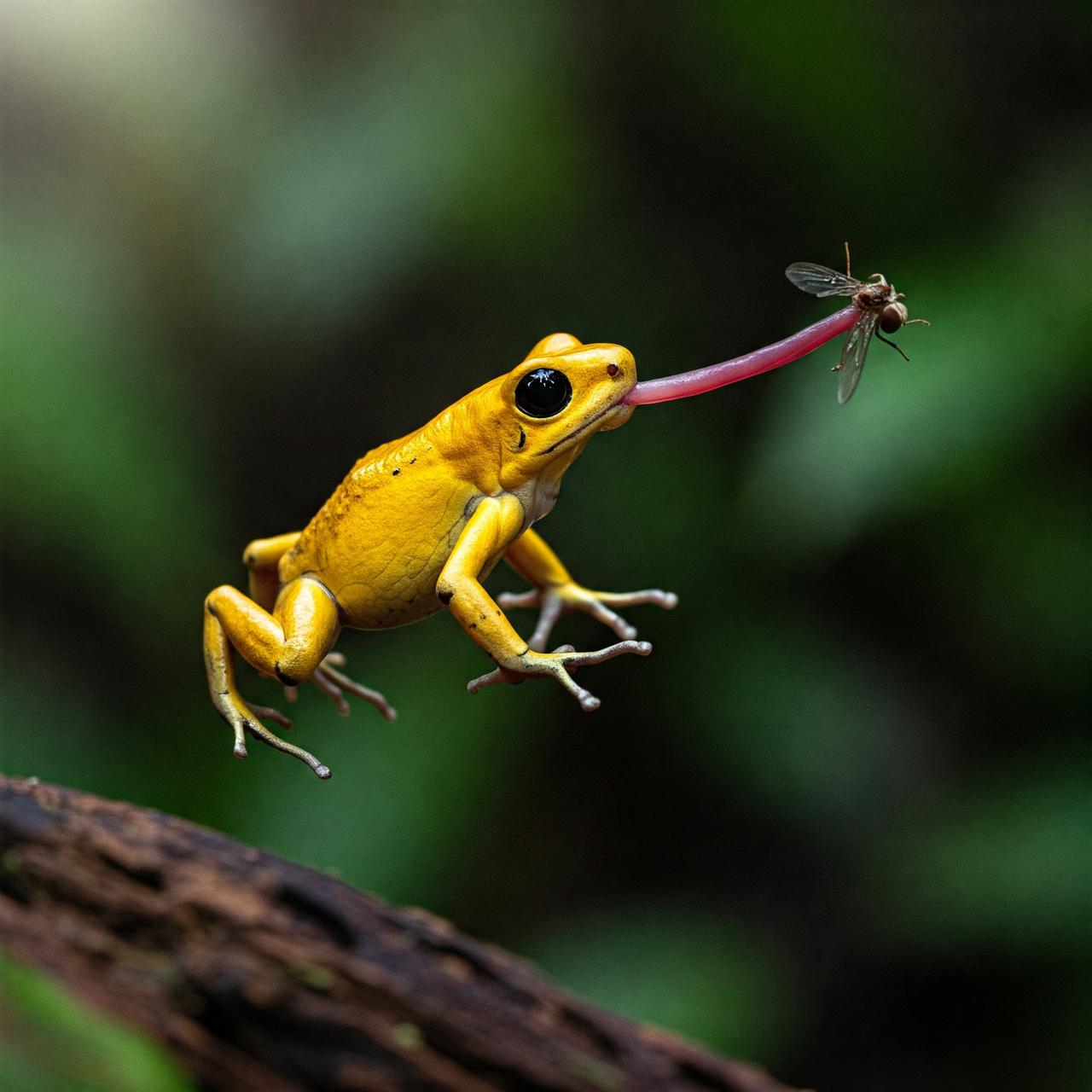
Golden Poison Dart Frog
Name(s) | Golden Poison Frog | ||||||||
|---|---|---|---|---|---|---|---|---|---|
Scientific Name(s) | Phyllobates terribilis | ||||||||
Family | Dendrobatidae | ||||||||
Order | Anura | ||||||||
Size(s) | 47–55 mm | ||||||||
Color | Greenish Yellow Orange Golden Yellow | ||||||||
Habitat | Tropical rainforests | ||||||||
Diet(s) | Termite Mite Ant | ||||||||
Toxin | Batrachotoxin (an extremely potent neurotoxin) | ||||||||
Importance | Toxicology Research Use of Toxin in Hunting The Most Poisonous Frog in the World | ||||||||
Conservation Status | Endangered (IUCN) | ||||||||
The Golden Poison Frog (Phyllobates terribilis) is a venomous species of frog belonging to the family Dendrobatidae and has attracted attention in both scientific research and popular culture due to its toxicity. This species has a highly restricted habitat limited to moist tropical forests along the Pacific coast of Colombia. Known for its striking golden-yellow coloration, it produces batrachotoxin, a potent biotoxin used as a defense mechanism. These frogs are a significant subject of study in herpetology, toxicology, and conservation biology due to their toxin biochemistry and ecological importance. Below, the morphology, distribution, ecology, toxin properties, and conservation status of the Golden Poison Frog are presented systematically.
The Golden Poison Frog is one of the largest and most toxic species within the family Dendrobatidae. Adult individuals typically measure 47–55 mm in length, with females slightly larger than males. Their skin is smooth and may exhibit bright golden-yellow, orange, or greenish-yellow coloration. These colors have evolved as a form of aposematism to warn potential predators of their toxicity. The eyes are prominent with dark irises, and the body is generally compact in structure.
The species Phyllobates terribilis is notable for distinct color variations observed across different geographic populations. Golden-yellow individuals are commonly found in the La Brea region, while greenish-yellow individuals occur in the Quebrada Guangui region. These morphs exhibit evolutionary differences in pigmentation and adaptation to local ecological conditions.
The Golden Poison Frog belongs to the phylum Chordata, class Amphibia, and order Anura. Within the family Dendrobatidae, the genus Phyllobates includes species with high toxicity. Phyllobates terribilis is the most toxic species in the genus, and intraspecific genetic variations remain a focus of ongoing phylogenetic research.

Physical Structure of the Golden Poison Frog (Generated by Artificial Intelligence)
Phyllobates terribilis occurs naturally only in western Colombia, specifically in the Cauca and Valle del Cauca regions. This species inhabits tropical rainforests at elevations of approximately 100–200 meters above sea level. Annual rainfall can reach up to 5,000 mm, making its habitat an ecosystem characterized by high humidity and dense vegetation.
This species is found in lowland forest areas characterized by moist leaf litter, moss-covered rocks, and short shrub formations. Frogs are active throughout the day, with peak activity occurring in the early morning. They live on the ground and typically hide beneath broad leaves or around moist stones. The narrow range of their natural habitat renders the species highly vulnerable to environmental changes.
The Golden Poison Frog primarily feeds on small ant species, mites, and termites. These low-level invertebrates in the food chain are directly linked to the frogs’ ability to synthesize toxins. These frogs do not produce batrachotoxin directly; instead, they sequester it from specific insect species found in their natural environment. Females lay eggs beneath leaves, and after hatching, the tadpoles are carried by males to small water pools. Once development is complete, juveniles transition to a terrestrial lifestyle.
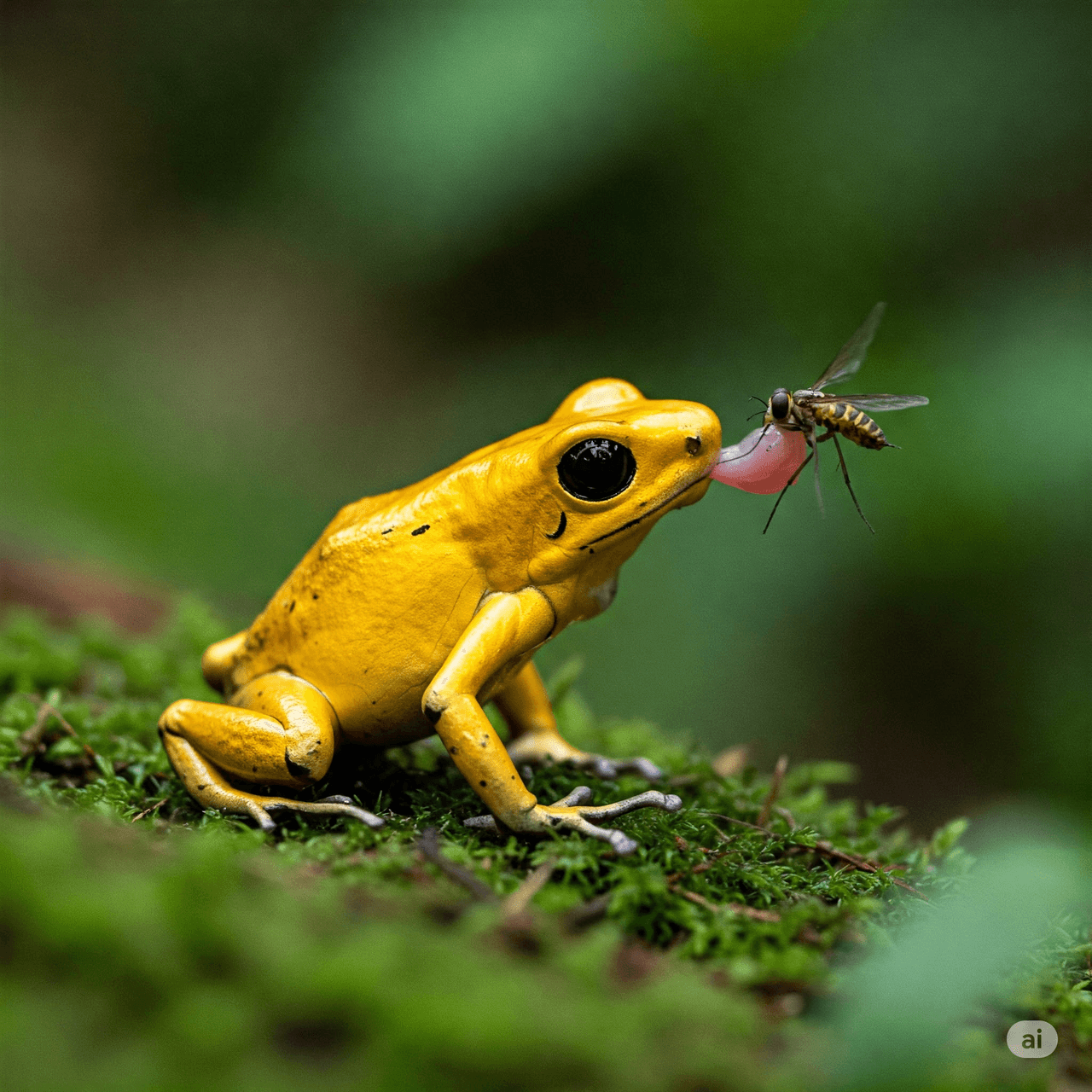
Feeding Behavior of the Golden Poison Frog (Generated by Artificial Intelligence)
The primary defense mechanism of Phyllobates terribilis is batrachotoxin, an extremely toxic alkaloid. This neurotoxin permanently keeps sodium ion channels open, disrupting the function of nerve and muscle cells. As a result, exposed organisms suffer severe physiological effects including cardiac arrest, paralysis, and death. Batrachotoxin was discovered in the 1960s by John W. Daly, and its molecular structure has been thoroughly characterized.
The amount of toxin secreted by a single individual of Phyllobates terribilis is approximately 700 micrograms, sufficient to kill 20,000 mice. It can be potentially lethal to humans. These toxins are found only in frogs living in their natural environment; captive individuals do not produce them because the dietary components required for toxin synthesis are not provided.
Indigenous peoples of Colombia have historically used the toxins of these frogs for hunting. The Embera and Choco peoples, in particular, applied toxin collected from the frogs’ backs to the tips of arrows to immobilize prey. This practice is the origin of the common name “poison dart frog.” However, this method does not involve direct physical contact; instead, the toxin is extracted by heating the frogs or rubbing their skin.
The natural populations of the Golden Poison Frog are at risk due to their limited habitat range and habitat destruction. Factors such as agricultural expansion, deforestation, illegal pet trade, and climate change threaten the species’ habitat. The widespread expansion of oil palm plantations has led to the large-scale loss of tropical rainforests.
This species is classified as “Endangered” by the International Union for Conservation of Nature (IUCN) and is also protected at the national level in Colombia. Its inclusion under CITES Appendix II means that international trade is permitted only under specific regulations. However, collection of individuals from the wild is largely prohibited.
Various conservation programs are being implemented at both local and international levels. These include habitat protection, collaboration with indigenous communities, and scientific research. Additionally, some zoos and research centers have established captive breeding programs. Ongoing efforts aim to preserve genetic diversity and reintroduce the species into its natural habitat.
Boros, C. A., & Stermitz, F. R. (1990). Iridoids. An Updated Review. Part I. *Journal of Natural Products*, *53*(5), 1055–1147. https://doi.org/10.1021/np50071a001.
Goldfarb, L. G., Petersen, R. B., Tabaton, M., Brown, P., LeBlanc, A. C., Montagna, P., Cortelli, P., Julien, J., Vital, C., Pendelbury, W. W., Haltia, M., Wills, P. R., Hauw, J. J., McKeever, P. E., Monari, L., Schrank, B., Swergold, G. D., Autilio-Gambetti, L., Gajdusek, D. C., ... Gambetti, P. (1992). Fatal familial insomnia and familial Creutzfeldt-Jakob disease: disease phenotype determined by a DNA polymorphism. *Science*, *258*(5083), 806–808. https://doi.org/10.1126/science.1439789.
Summers, K., & Clough, M. E. (2001). The evolution of coloration and toxicity in the poison frog family (Dendrobatidae). *Proceedings of the National Academy of Sciences*, *98*(11), 6227–6232. https://doi.org/10.1073/pnas.101134898.
Twomey, E., Yeager, J., Brown, J. L., Morales, V., Cummings, M., & Summers, K. (2013). Phenotypic and Genetic Divergence among Poison Frog Populations in a Mimetic Radiation. *PLoS ONE*, *8*(2), e55443. https://doi.org/10.1371/journal.pone.0055443.

Golden Poison Dart Frog
Name(s) | Golden Poison Frog | ||||||||
|---|---|---|---|---|---|---|---|---|---|
Scientific Name(s) | Phyllobates terribilis | ||||||||
Family | Dendrobatidae | ||||||||
Order | Anura | ||||||||
Size(s) | 47–55 mm | ||||||||
Color | Greenish Yellow Orange Golden Yellow | ||||||||
Habitat | Tropical rainforests | ||||||||
Diet(s) | Termite Mite Ant | ||||||||
Toxin | Batrachotoxin (an extremely potent neurotoxin) | ||||||||
Importance | Toxicology Research Use of Toxin in Hunting The Most Poisonous Frog in the World | ||||||||
Conservation Status | Endangered (IUCN) | ||||||||
No Discussion Added Yet
Start discussion for "Golden Poison Dart Frog" article
Morphological Characteristics and Taxonomic Position
Physical Structure
Color Morphs
Taxonomic Classification
Ecology, Habitat, and Life Cycle
Geographic Distribution
Habitat Characteristics
Diet and Larval Development
Toxic Properties and Batrachotoxin
Definition of Batrachotoxin
Level of Toxicity
Ethnobotanical Uses
Conservation Status and Threats
Natural Populations
Conservation Status
Conservation Efforts