


This article was automatically translated from the original Turkish version.
In recent years, advancements in computer vision and artificial intelligence have enabled machines to perceive their surroundings more effectively. In this context, MediaPipe, developed by Google, stands out as an open-source framework that enables real-time analysis of visual and auditory data. This building, known for its ease of use, cross-platform compatibility, and strong GPU support, has found broad application in both academic research and industrial projects.
MediaPipe allows developers to practically perform tasks such as hand gesture tracking and body pose estimation without being constrained by hardware limitations. This makes it significantly more accessible to create interactive content, recognize movements, or develop augmented reality applications.
The MediaPipe project, developed by Google, emerged in 2012 as an internal tool for video analysis. The initial version was designed to classify and summarize videos. In 2018, it was adapted for mobile devices, increasing its accessibility. By 2020, it was released as an open-source platform and began to be integrated into projects by a large number of developers worldwide.
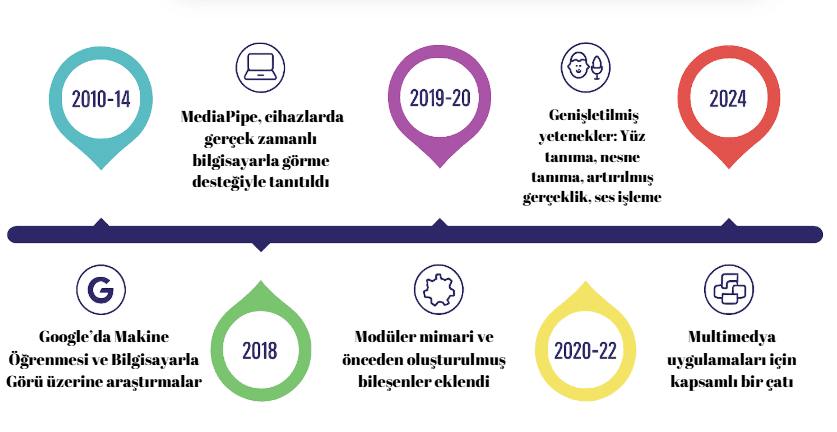
MediaPipe Historical Development (Credit: Roboflow & Editor: Enes Yılmaz)
Unlike traditional coding approaches, MediaPipe features a graph-based architecture that manages data flow. In this system, data is transferred along predefined pathways between processing nodes. Within this architecture, data is transmitted as units called “packets” through interconnected processing nodes (calculators). The overall purpose of this structure is to create a pipeline that transforms raw visual data into processed output. Each “calculator” performs a specific task—for example, capturing an image, correcting it without distortion, and then analyzing it using a machine learning model. All these operations are defined within a graph and can be modularly arranged.
MediaPipe is compatible with numerous devices and programming languages. Some key supported platforms include:
MediaPipe operates seamlessly on multiple platforms including Android, iOS, Linux, macOS, and Windows.
Python code for detecting both hands using MediaPipe (Prepared and Edited by: Enes Yılmaz)
One of MediaPipe’s most prominent features is its real-time analysis capability. Thanks especially to GPU acceleration, images can be processed within seconds. This capability is crucial in numerous applications such as tracking user faces during video conferences, analyzing body posture during exercise, or enabling interactive augmented reality experiences.
Some pre-trained and optimized solutions integrated into MediaPipe by Google include:
Thanks to these ready-made solutions, developers no longer need to train their own models from scratch; integration and customization are sufficient.

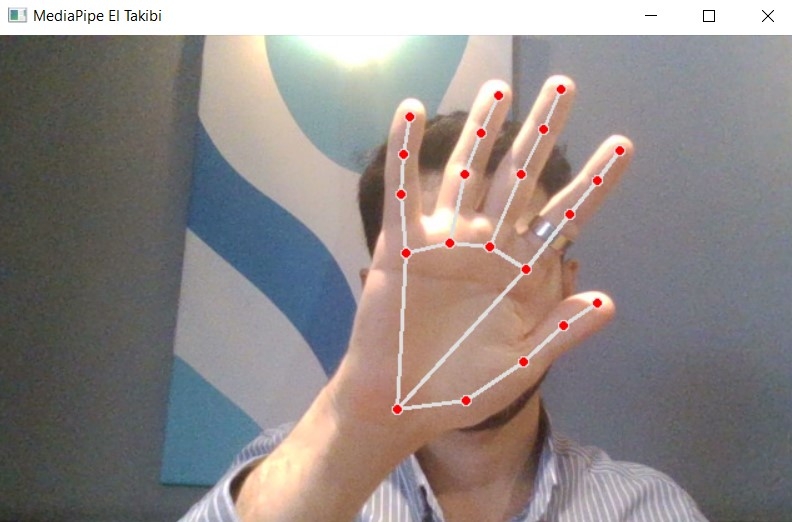
Real-time tracking of both hands using MediaPipe Hand Tracking algorithm (Prepared and Edited by: Enes Yılmaz)
MediaPipe can be applied across a wide range of fields. Some examples include:
The collection and processing of image data carry ethical responsibilities regarding user privacy. MediaPipe users must:
Google aims to integrate MediaPipe into multimodal artificial intelligence systems that can process not only visual but also audio and textual data. Additionally, MediaPipe, designed to operate efficiently on low-power devices, is emerging as a core component of Edge AI systems.

Historical Development
Core Architecture and Working Principle
Platforms and Language Support
Real-Time Performance
MediaPipe Solutions
Application Areas
Ethical Considerations
Future Vision: Multimodal Intelligence and Edge AI