

This article was automatically translated from the original Turkish version.
+1 More
Artificial Intelligence-Assisted Imaging and Diagnosis
Application Area(s) | Skin Cancer Detection Breast Cancer Screening Lung Cancer Diagnosis | ||||||||
|---|---|---|---|---|---|---|---|---|---|
Used Technology | Artificial Neural Networks Image Processing Algorithms Deep Learning | ||||||||
Benefits | Early Diagnosis Improving Patient Care Quality Timely Intervention | ||||||||
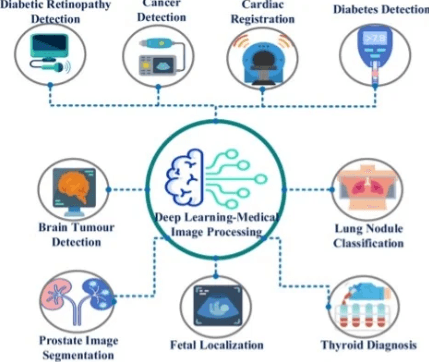
Artificial Intelligence is increasingly being used in medical imaging and diagnostic processes. Algorithms developed using deep learning and machine learning such as methods can analyze abnormalities in medical images with high accuracy and enable early diagnosis. These systems contribute significantly to more effective detection of diseases in fields such as radiology pathology and dermatology.
Artificial Intelligence based imaging systems function within clinical decision support systems by analyzing digital images obtained from medical devices. They are particularly used in the diagnosis of high-risk conditions such as cancer screenings (breast lung prostate and skin etc.). Artificial Intelligence algorithms can analyze medical images in detail detecting even small abnormalities invisible to the human eye.
In radiology Artificial Intelligence is used to analyze data from imaging methods such as MRI CT and X-ray. These systems provide high accuracy in identifying structures such as lung nodules brain tumors and liver lesions at a millimeter level.

Medical Imaging (Source: Medium)
In pathology Artificial Intelligence based systems analyze digitized microscope images of tissue samples to detect cancer cells. Digital pathology and Artificial Intelligence are used together in the diagnosis of breast prostate and skin cancers.
Artificial Intelligence systems evaluate the risk of malignancy by analyzing skin lesions and moles. These systems play an important role in the early diagnosis of serious skin conditions such as melanoma.
Artificial Intelligence assisted imaging systems rely largely on technologies such as image processing deep learning and convolutional neural networks (CNN).
Image segmentation is used to isolate specific structures in medical images. For example a tumor can be separated from surrounding tissue to enable more precise analysis.

Example of 3D MRI image merging and processing operations (Source: Medium)
Convolutional neural networks automate the diagnostic process by learning patterns in images. These models are trained on large volumes of data and can produce results with accuracy approaching that of human experts.

Deep learning models (Source: Medium)

CNN Architecture and Layers (Source: Medium)
Using the transfer learning method a model previously trained on one dataset can be retrained on a new data set to be applied in different clinical scenarios.
The clinical benefits of Artificial Intelligence supported systems are evident in key parameters such as speed accuracy and accessibility.
Since medical images often contain patient information data security is paramount. These data must be collected and processed in accordance with ethical and legal regulations.
Deep learning models are often described as “black box” systems. It is not always easy to understand why these models arrive at specific decisions.
For Artificial Intelligence systems to be used in clinical practice they must be approved by regulatory bodies such as the FDA or similar institutions.
The use of Artificial Intelligence in healthcare is not merely a technical issue but also involves ethical dimensions. Relying solely on algorithms for diagnostic decisions may pose ethical risks.
The adoption of Artificial Intelligence in healthcare is expected to expand further. This process will be supported by improved generalizability of models increased digitization of patient data and regulatory approval of systems by oversight authorities.
Esteva, Andre, Brett Kuprel, Roberto A. Novoa, Justin Ko, Susan M. Swetter, Helen M. Blau, and Sebastian Thrun. "Dermatologist-Level Classification of Skin Cancer with Deep Neural Networks." *Nature* 542, no. 7639 (2017): 115–118.https://www.nature.com/articles/nature21056
Hosny, Ahmed, Chintan Parmar, John Quackenbush, Lawrence H. Schwartz, and Hugo J. W. L. Aerts. "Artificial Intelligence in Radiology." *Nature Reviews Cancer* 18, no. 8 (2018): 500–510.https://www.nature.com/articles/s41568-018-0016-5
Litjens, Geert, Thijs Kooi, Babak Ehteshami Bejnordi, Arnaud A. A. Setio, Francesco Ciompi, Mohsen Ghafoorian, Jeroen A. W. M. van der Laak, Bram van Ginneken, and Clara I. Sánchez. "A Survey on Deep Learning in Medical Image Analysis." Medical Image Analysis 42 (2017): 60–88.https://www.sciencedirect.com/science/article/abs/pii/S1361841517301135
Rajpurkar, Pranav, Jeremy Irvin, Kaylie Zhu, Brandon Yang, Hershel Mehta, Tony Duan, Daisy Ding, Aarti Bagul, Curtis Langlotz, Katie Shpanskaya, Matthew P. Lungren, and Andrew Y. Ng. "Deep Learning for Chest Radiograph Diagnosis: A Retrospective Comparison of the CheXNeXt Algorithm to Practicing Radiologists." PLOS Medicine 15, no. 11 (2018): e1002686.https://journals.plos.org/plosmedicine/article?id=10.1371/journal.pmed.1002686
Shen, Dinggang, Guorong Wu, and Heung-Il Suk. "Deep Learning in Medical Image Analysis." Annual Review of Biomedical Engineering 19 (2017): 221–248.https://www.annualreviews.org/content/journals/10.1146/annurev-bioeng-071516-044442
Topol, Eric J. *Deep Medicine: How Artificial Intelligence Can Make Healthcare Human Again*. New York: Basic Books, 2019.
Yasaka, Koichiro, and Osamu Abe. "Deep Learning and Artificial Intelligence in Radiology: Current Applications and Future Directions." PLOS Medicine 15, no. 11 (2018): e1002707.https://journals.plos.org/plosmedicine/article?id=10.1371/journal.pmed.1002707

Artificial Intelligence-Assisted Imaging and Diagnosis
Application Area(s) | Skin Cancer Detection Breast Cancer Screening Lung Cancer Diagnosis | ||||||||
|---|---|---|---|---|---|---|---|---|---|
Used Technology | Artificial Neural Networks Image Processing Algorithms Deep Learning | ||||||||
Benefits | Early Diagnosis Improving Patient Care Quality Timely Intervention | ||||||||
No Discussion Added Yet
Start discussion for "Artificial Intelligence-Assisted Imaging and Diagnosis" article
General Definition and Application Areas
Radiology and Image Analysis
Pathology and Histopathological Imaging
Dermatology and Skin Analysis
Technologies and Methods Used
Image Processing and Segmentation
Deep Learning and CNN
Transfer Learning
Clinical Benefits and Contributions
Challenges and Limitations
Data Privacy and Security
Algorithmic Transparency and Interpretability
Clinical Integration and Regulation
Ethical Dimensions and Societal Impacts
Future Perspective