


This article was automatically translated from the original Turkish version.
+2 More
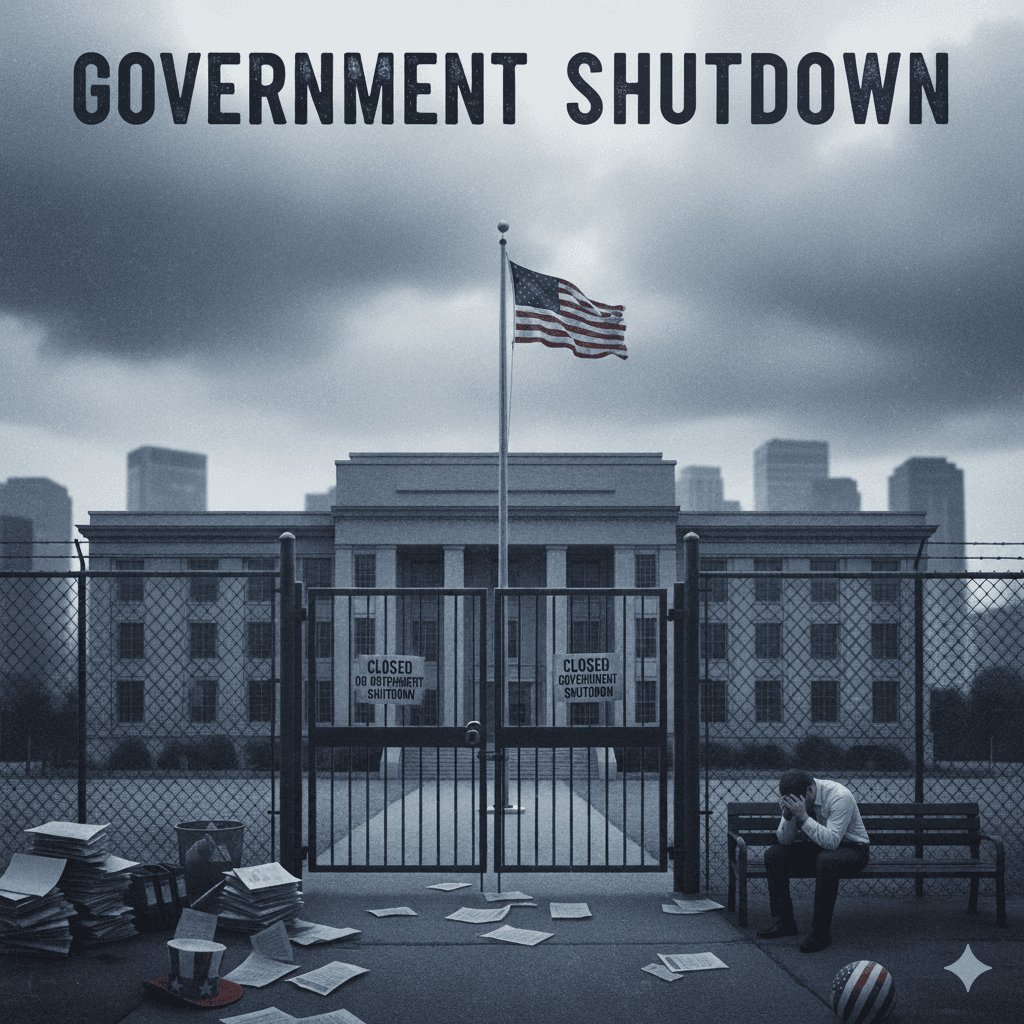
Generated with visual artificial intelligence.
Government Shutdown in the United States
Years of Closure | 1978 2025 2018 2013 1995 | ||||||||
|---|---|---|---|---|---|---|---|---|---|
American Presidents During the Years of Closure | Donald Trump (2nd time) Donald Trump Barack Obama Jimmy Carter Bill Clinton | ||||||||
Activities that Continued Partially During Closure | Emergency sections of social support and assistance programs Scientific projects and research Critical infrastructure and public projects Mandatory cases and emergency proceedings in federal courts Mandatory services (emergency health/police forces/national security) | ||||||||
Activities that Ceased Completely During Closure | Licenses/applications/permits Regular implementation of social support and assistance programs Regular federal court proceedings and judiciary Unpaid portions of federal employees' salaries Tax and audit procedures Cultural institutions Libraries National parks and museums | ||||||||
Government shutdown in the United States (Eng. government shutdown) is a situation in which federal executive operations are partially or completely halted due to the legislature’s failure to enact timely annual or temporary funding legislation. During this process, some public institutions suspend their activities or continue only limited “excepted” services because funding flows are cut off. The funding gap, in summary, refers to the absence of laws or appropriations necessary to finance institutional operations. The existence of a funding gap is the technical trigger for a shutdown.
Modern examples of government shutdowns began to be observed in the United States of America from the 1970s onward. During this period, disruptions in the federal budget process caused by disagreements between the legislative and executive branches led to the institutionalization of the concept of “government shutdown”. While similar budget crises have occurred in other countries, the United States is the only country where this phenomenon has been systematically experienced. This is because the executive branch depends on legislative approval to secure funding, and when budget laws are not enacted on time, operations automatically cease.
The fundamental cause of government shutdowns is usually political disagreement over the budget. When there are disputes in the legislature regarding the allocation of appropriations, spending priorities, or the funding of specific policies, budget laws cannot be passed on time. If temporary funding mechanisms are also not approved, a funding gap emerges. During these periods, the points of contention typically focus on ideologically charged areas such as social spending, immigration policy, or security budgets.
Government shutdowns can vary in duration. Some last only a few days, while others continue for weeks. Short-term shutdowns have limited impact, whereas prolonged ones create significant effects on public services, economic indicators, and employee welfare.
The longest shutdown in the modern era lasted 34 days, from December 22, 2018, to January 25, 2019. During this period, federal employees experienced delayed paychecks, disruptions in public services, and a temporary slowdown in economic activity. The shutdown that began at the end of the fiscal year 2025 on Tuesday, September 30, was triggered by Congress’s failure to approve the new budget and lasted a total of 43 days until its conclusion in November, making it the longest federal government shutdown in U.S. history.

Government Shutdown Clock (The White House)
During a shutdown, institutions are divided into “excepted” and “non-excepted” activities. National security, emergency health services, law enforcement, and certain critical public functions continue without interruption, while cultural institutions, national parks, research projects, and administrative procedures are temporarily suspended. A portion of public employees are placed on furlough, meaning temporary unpaid leave. Personnel assigned to excepted services continue working but do not receive pay until after the shutdown ends.
Government shutdowns affect the economy in multiple layers.
When a shutdown begins, each institution activates its legal emergency contingency plans to determine which personnel will continue working, which services will be suspended, and which payments will be deferred. All activities outside of excepted services are halted until funding legislation is approved. Once the shutdown ends, employees receive back pay and public services resume gradually.

Visual Depicting a Government Shutdown (Generated by Artificial Intelligence)
Prolonged shutdowns generate not only economic but also social negative effects. Income loss among public employees can strain household budgets; the interruption of services disrupts citizens’ daily interactions with the state. Moreover, the credibility and capacity of public institutions become subjects of public debate. For this reason, prolonged shutdowns are regarded as events that remind democratic systems of the importance of administrative stability and budgetary discipline.
Shutdowns are evaluated not only through economic indicators but also in terms of public perception. The suspension of services can temporarily erode public trust in government. Public opinion generally attributes responsibility for the shutdown to the political parties involved. This dynamic also influences the prospects for future budget agreements. Media organizations play a crucial role in informing the public about which services are suspended and how citizens are affected during shutdown periods.
In the modern era, since the late 1970s, the United States has experienced approximately twenty instances of funding gaps, half of which resulted in government shutdowns. The duration of these shutdowns has ranged from a few hours to a full month. In recent years, particularly in 2023, the possibility of a new shutdown emerged on the agenda, but temporary funding measures prevented it at the last moment.
As of the end of the fiscal year 2025 on Tuesday, September 30, the federal government officially shut down after Congress failed to approve the budget law. This shutdown, the first major crisis since the 2019 event, lasted a total of 43 days until its conclusion in November 2025 and is recorded as the longest government shutdown in U.S. history. During this period, numerous government agencies suspended or scaled back operations. Federal employees were forced to work without pay or enter temporary unpaid leave. This process increased economic uncertainty and disrupted access to public services, serving as a significant test of governance credibility.

Infographic on the Subject (Anadolu Agency)
A government shutdown is a concrete manifestation of gridlock in the state’s budgetary process. This phenomenon is not merely a technical fiscal issue; it is also a test of the political culture of compromise. In the long term, shutdowns pose risks to the stability of public administration, citizen satisfaction, and economic confidence. Therefore, strengthening cooperation mechanisms within the budget approval process is considered essential to prevent similar crises in the future.
To prevent such crises, it is recommended that budget timelines be more strictly enforced, temporary funding decisions be made more swiftly, and special financial reserves be established for critical services. Additionally, increasing transparency in negotiation processes between the legislature and the executive can help prevent political conflicts from undermining public services.
Aljazeera. "What is a US government shutdown and who will be affected?" Accessed November 13, 2025. https://www.aljazeera.com/news/2023/9/29/what-is-a-us-government-shutdown-and-who-will-be-affected
Nuroğlu, Elif. “ABD'de hükümet kapandı: Bundan sonra neler olacak”. Anadolu Ajansı. Accessed November 13, 2025. https://www.aa.com.tr/tr/analiz/abdde-hukumet-kapandi-bundan-sonra-neler-olacak/3716490
Ruiter, Emma De. “ABD tarihindeki en uzun hükümet kapanması sona erdi: Trump bütçe tasarısını imzaladı”. Euronews. Accessed November 13, 2025. https://tr.euronews.com/2025/11/13/abd-tarihindeki-en-uzun-hukumet-kapanmasi-sona-erdi-trump-butce-tasarisini-imzaladi
The White House. "Government Shutdown Clock." Accessed November 13, 2025. https://www.whitehouse.gov/government-shutdown-clock/
USAFacts. "Everything you need to know about a government shutdown." Accessed November 13, 2025. https://usafacts.org/articles/everything-you-need-to-know-about-a-government-shutdown/
Wessel, David. “What is a government shutdown?”. *Brookings*. Accessed November 13, 2025. https://www.brookings.edu/articles/what-is-a-government-shutdown-and-why-are-we-likely-to-have-another-one/
Yavuzoğlu, Serkan. “ABD Hükümet Sisteminde Yasama ve Yürütme Organları Arasında Denge ve Denetim Mekanizmaları”. *Adalet Dergisi*, no. 75 (October 2025): 511–39. Accessed November 13, 2025. https://doi.org/10.57083/adaletdergisi.1799461
Zengin Okay, Dilara, and Irmak Akcan. “ABD tarihinin en uzun süren hükümet kapanmasını yaşıyor”. Anadolu Ajansı. Accessed November 13, 2025. https://www.aa.com.tr/tr/dunya/abd-tarihinin-en-uzun-suren-hukumet-kapanmasini-yasiyor/3735401
Çopur, Hakan and Sevgi Ceren Gökkoyun. “ABD'de federal hükümetin en uzun süreli kapanması sona erdi” Anadolu Ajansı. Accessed November 13, 2025. https://www.aa.com.tr/tr/dunya/abdde-federal-hukumetin-en-uzun-sureli-kapanmasi-sona-erdi/3742512
Ün, Lütfullah. “CUMHURBAŞKANLIĞI HÜKÜMET SİSTEMİNİN TÜRK KAMU MALİYESİNE ETKİSİ”. *Abant Sosyal Bilimler Dergisi* 21, no. 2 (July 2021): 299–315. Accessed November 13, 2025. https://doi.org/10.11616/basbed.vi.895024

Generated with visual artificial intelligence.
Government Shutdown in the United States
Years of Closure | 1978 2025 2018 2013 1995 | ||||||||
|---|---|---|---|---|---|---|---|---|---|
American Presidents During the Years of Closure | Donald Trump (2nd time) Donald Trump Barack Obama Jimmy Carter Bill Clinton | ||||||||
Activities that Continued Partially During Closure | Emergency sections of social support and assistance programs Scientific projects and research Critical infrastructure and public projects Mandatory cases and emergency proceedings in federal courts Mandatory services (emergency health/police forces/national security) | ||||||||
Activities that Ceased Completely During Closure | Licenses/applications/permits Regular implementation of social support and assistance programs Regular federal court proceedings and judiciary Unpaid portions of federal employees' salaries Tax and audit procedures Cultural institutions Libraries National parks and museums | ||||||||
No Discussion Added Yet
Start discussion for "Government Shutdown in the United States" article
Historical Development and Countries Where It Occurs
Causes of Government Shutdowns
Different Types of Shutdowns by Duration and Intensity
Institutions and Employees Affected
Economic Effects
Administrative Protocols and Crisis Management
Consequences of Prolonged Shutdowns
Effects on Public Opinion
Historical Record and Current Situation
Preventive Mechanisms and Potential Solutions