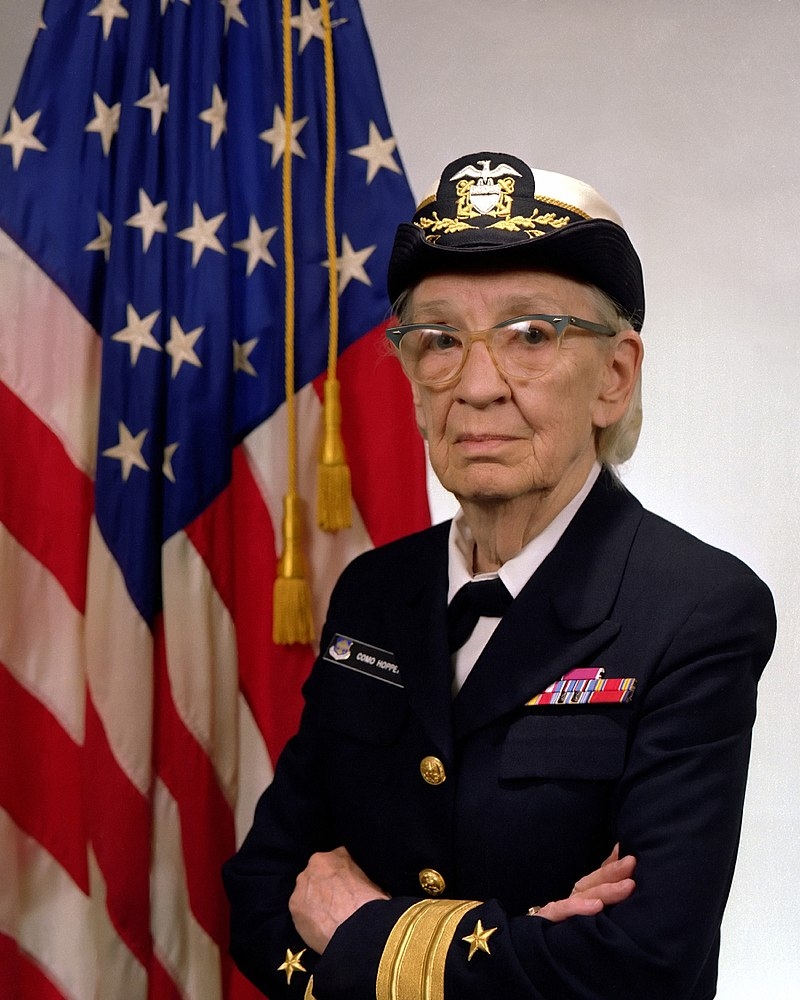

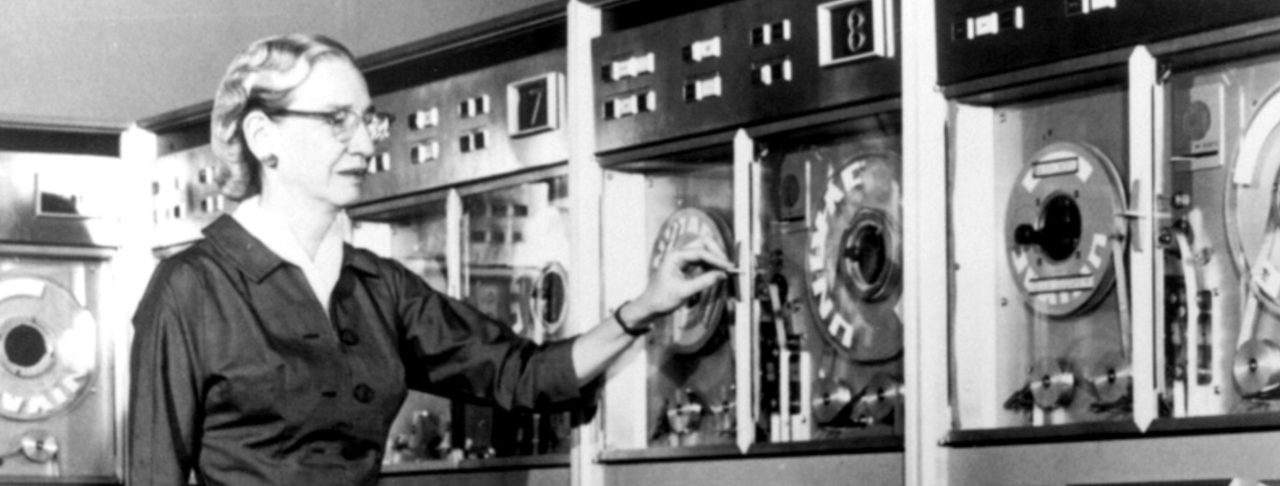

Grace Murray Hopper (9 December 1906, New York – 1 January 1992, Arlington, Virginia) was an American computer scientist, mathematician, and rear admiral. She was the first person to propose the concept of machine-independent programming languages. As one of the earliest programmers of the Harvard Mark I computer, she was the architect of many fundamental concepts still used in software development today.
She was born on 9 December 1906 in New York City as the eldest of three children of Walter Fletcher Murray and Mary Campbell Van Horne. Her childhood curiosity for technology was evident when she dismantled seven alarm clocks to understand their internal mechanisms.
In 1928, she graduated from Vassar College with honors in mathematics and physics. She completed her master’s degree at Yale University in 1930. In 1934, she earned her doctorate in mathematics from Yale University, becoming one of the few women at the time to achieve a doctorate in the field. From 1928 until 1941, she served as an associate professor of mathematics at Vassar College.
With the outbreak of World War II, she joined the United States Navy in 1943. She was assigned to the Mark I computer project under Howard Aiken at Harvard University. After the war, she joined the team that developed the UNIVAC I computer and contributed significantly to the advancement of commercial computer systems.
In 1969, Hopper became the first person to receive the “Computer Sciences Man of the Year” award from the Data Processing Management Association for her contributions to computer science. In 1985, she was promoted to the rank of rear admiral, and in 1991 she was awarded the National Medal of Technology.
Contributions Hopper argued that computers could be used not only for mathematical calculations but also for complex data processing tasks. She introduced the terms “bug” and “debugging” into technical literature to describe hardware malfunctions and their resolution.
Hopper maintained her identity as an educator throughout her life and enjoyed giving technology seminars to young people. She was known for explaining complex technical concepts using simple metaphors—for example, using a piece of copper wire to illustrate the distance electricity travels in a nanosecond.
In 1930, she married Vincent Foster Hopper; the couple divorced in 1945. Childless, Hopper devoted her life to mathematics, naval service, and computer science throughout her career.
After retiring from the Navy in 1986, she continued working as a senior consultant for Digital Equipment Corporation (DEC). She remained actively engaged with the evolution of technology until the end of her life.
On 1 January 1992, she died at the age of 85 of natural causes at her home in Arlington, Virginia. She was buried with military honors at Arlington National Cemetery.
Hopper’s work enabled software to become independent of hardware, opening the door to the modern software industry. In 1996, the U.S. Navy commissioned the USS Hopper, a warship named in her honor.
The annual Grace Hopper Celebration of Women in Computing is the largest gathering of women in technology worldwide.

Early Life and Education
Career and Achievements
Key Works and Contributions
Works and Projects
Personal Life
Later Years and Death
Legacy and Impact