


This article was automatically translated from the original Turkish version.
+1 More
The Great Palace Mosaics Museum is located within the Arasta Bazaar, part of the Sultanahmet Camii Külliyesi in Istanbul’s Sultanahmet district. The museum displays partially preserved mosaic pavements from the northeastern section of the colonnaded courtyard of the Great Palace, dating to the Eastern Roman period. This exhibition area is limited to just 180 m². The mosaics, dated between 450 and 550 CE, reflect the artistic techniques and visual conventions of their time.

Great Palace Mosaics Museum (Governorship of Istanbul, Republic of Türkiye)
The mosaics forming the foundation of the museum were uncovered during archaeological excavations initiated in 1935, which focused on the remains of the Great Palace Complex of the Byzantine Empire. Following their discovery, the exhibition space was organized and the museum opened to the public on 3 December 1953; it was incorporated into the Istanbul Archaeological Museums the same year. From 1979 onward, it operated as a unit under the Directorate of the Hagia Sophia Museum.

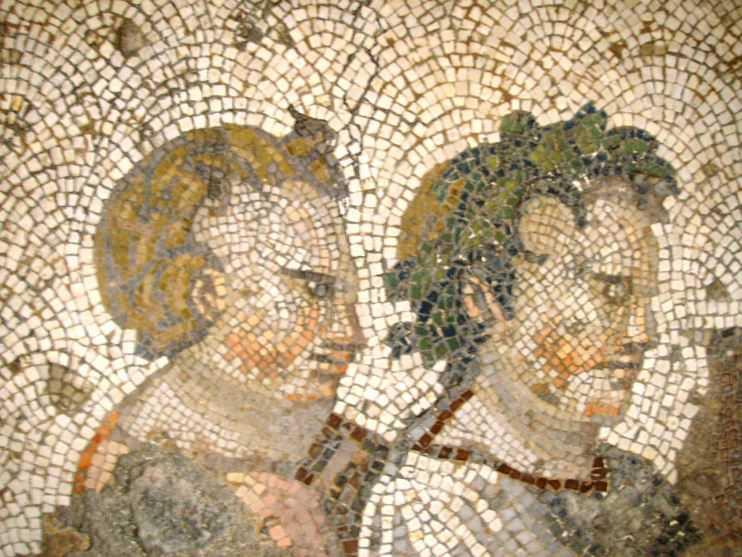
The mosaics on display are composed of limestone, baked clay, colored stones, and glass pieces, each approximately 5 mm in size. The detailed mosaic technique known as “Opus Vermiculatum” was employed for the figurative elements, while the background areas feature a “fish-scale” pattern executed in white marble. Scenes are clearly defined by outlined contours.

Mosaic Scene (Republic of Türkiye Istanbul Governorship)
The Great Palace Mosaics are among the most significant examples of Byzantine art. They reflect the cultural and artistic richness of their era. The animal figures and natural elements depicted illustrate the fine craftsmanship and social context of Byzantine society.
Unlike religious themes, the mosaics emphasize scenes drawn from daily life, nature, and mythology. Among the approximately 150 human and animal figures represented, around 90 distinct themes have been identified. These include a griffin eating a lizard, a fight between an elephant and a lion, a mare nursing a foal, children herding geese, a man milking a goat, a child feeding a donkey, a young girl carrying a jug, bears eating apples, and a hunter battling a tiger.

Mosaic Scene (Governorship of Istanbul, Republic of Türkiye)
Mosaic Scene (Republic of Türkiye, Istanbul Governorship)
Comprehensive restoration and conservation work to preserve the mosaics was initiated in 1982 under a protocol between the General Directorate of Monuments and Museums of the Turkish Ministry of Culture and the Austrian Academy of Sciences. These efforts were completed in 1997 and included cleaning, repair, and the installation of appropriate environmental conditions for display.

Mosaic Scene: Hunters Battling a Tiger (Governorship of Istanbul, Republic of Türkiye)
The museum is situated within the Sultanahmet Camii Külliyesi, in the Arasta Bazaar, approximately 700 meters from the Sultanahmet stop on the Kabataş-Bağcılar tram line. Opening hours vary between summer and winter seasons. The Müzekart is valid for Turkish citizens.
Ministry of Culture and Tourism of the Republic of Turkey. “Büyük Saray Mozaikleri Müzesi - İstanbul.” *Türkiye Kültür Portalı*. Accessed May 9, 2025. https://www.kulturportali.gov.tr/turkiye/istanbul/gezilecekyer/buyuk-saray-mozaikleri-muzesi?ysclid=mafu5jmhwx687135193
T.C. Kültür ve Turizm Bakanlığı. "Büyük Saray Mozaikleri Müzesi." müze.gov. Accessed May 9, 2025. https://muze.gov.tr/muze-detay?SectionId=MOZ01&DistId=MOZ.
T.C. İstanbul Valiliği. "Büyük Saray Mozaikleri Müzesi." T.C. İstanbul Valiliği Web Sitesi. Accessed May 9, 2025. http://www.istanbul.gov.tr/istanbulun-muzeleri-buyuk-saray-mozaikleri-muzesi#_ftnref1
Turkish Museums. “Istanbul Büyük Saray Mozaikleri Müzesi.” Turkish Museums. Accessed May 9, 2025. https://turkishmuseums.kprod.kultur.gov.tr/museum/detail/2069-istanbul-buyuk-saray-mozaikleri-muzesi/2069/1

No Discussion Added Yet
Start discussion for "Great Palace Mosaic Museum" article
Excavation and Establishment
Technical Characteristics of the Mosaics
Themes and Compositions
Restoration and Conservation Efforts
Visit Information