This article was automatically translated from the original Turkish version.
Team(s) | Pelicaniformes | ||||||||
|---|---|---|---|---|---|---|---|---|---|
Family | Ardeidae | ||||||||
Genus | Ardea | ||||||||
Specie(s) | Ardea alba | ||||||||
Order | 85–102 cm | ||||||||
Wingspan | 140–170 cm | ||||||||
Conservation Status | IUCN: Least Concern (LC) | ||||||||
Great Egret (Ardea alba) is a large waterbird belonging to the heron family (Ardeidae) with a wide distribution. This species is observed in wetlands across various regions of the world and is one of the significant bird species in Türkiye, where it breeds in certain wetland areas and is seen during migration periods.
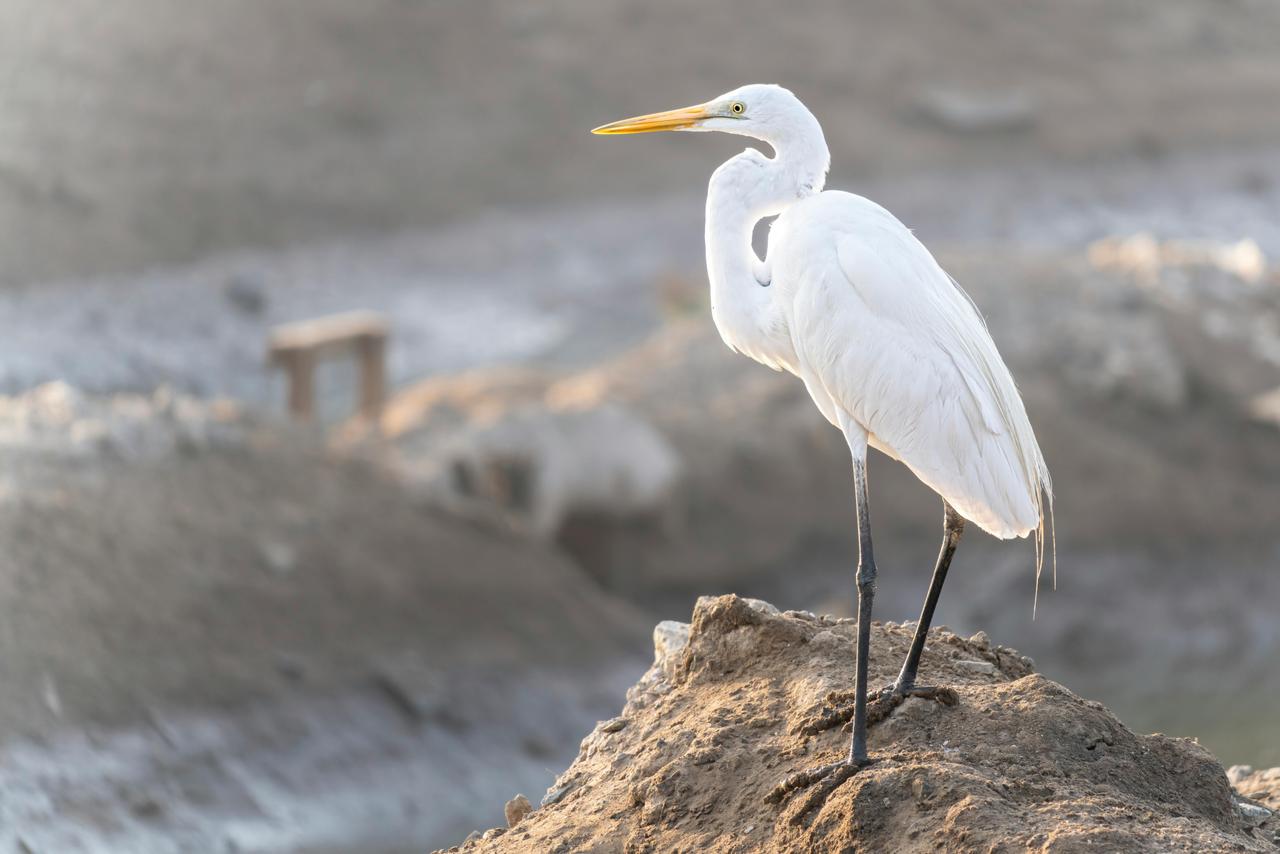
The Great Egret measures 85–102 cm in length, with approximately 40–45 cm of this length comprising its body. Its plumage is entirely white throughout the year. It is distinguished by its long, slender, and S-shaped neck. The bill is typically yellow but turns black during the breeding season; in juveniles, it remains entirely yellow. The legs are black, with the upper portions (tibia) appearing yellowish and sometimes reddish during breeding. Males are generally slightly larger than females.
During the breeding plumage phase, ornamental plumes extend from the back toward the tail; however, unlike the Little Egret, it lacks ornamental head feathers. It can be confused with the Little Egret but is distinguished by its larger size, snake-like elongated neck, and black legs.

Great Egret (Pexels)
The species is common in wetlands and along freshwater margins. It can be found in marshes, reedbeds, lake and river shores, depressions, flooded grasslands, rice paddies, and agricultural irrigation areas. It has also been recorded occasionally along coastal zones, river mouths, deltas, and in mountainous areas up to 1800 meters in elevation. Nests are typically built within reedbeds, sometimes on shrubs or trees.
The Great Egret occurs in the continental climate zones of the Western Palearctic and in many other warm–temperate regions worldwide. In Türkiye, it can be observed throughout the country during winter months and migration periods. Regular breeding records have been reported from wetlands in the Samsun–Amasya–Tokat region. Individuals wintering have been observed along the western Black Sea coast, Thrace, the Aegean region, and around Adana.
The diet is highly varied. Primary food sources include fish and aquatic insects. It also feeds on molluscs, frogs, small mammals, rodents, lizards, snakes, and nestling birds. It hunts by walking slowly in shallow water or by waiting for prey to approach. Upon spotting prey, it strikes with sudden, rapid movements. It typically hunts during daylight hours and alone.
Nesting occurs mostly in reedbeds near wetlands. It breeds once annually. Eggs are pale blue and spindle-shaped. Incubation lasts 25–26 days, with both male and female taking turns. Hatching is asynchronous. Both parents care for the chicks. Young birds become independent after approximately 42 days and remain with their parents until the autumn migration. Sexual maturity is reached at around two years of age.
It usually feeds alone but may also be seen in small groups of 3–15 individuals. After incubation, family groups may form, and individuals sometimes join migratory flocks. It is monogamous, with both parents sharing chick-rearing duties. In flight, the neck is retracted, wingbeats are slow and deliberate, and the legs are extended backward.
At the end of the 19th century and the beginning of the 20th century, the population declined significantly due to intense hunting, primarily for plumes used in hat-making. Thanks to conservation programs, numbers have since recovered. However, today the most significant threats are wetland drainage and habitat loss.
Ornito.org. “Büyük Ak Balıkçıl (Ardea alba).” Ornito.org. Accessed August 16, 2025. https://ornito.org/Bird/Detail/102
Pexels. “Doğal Yaşam Alanında Göl Kenarında Büyük Ak Balıkçıl JPG.” Pexels. Accessed August 22, 2025. https://www.pexels.com/tr-tr/fotograf/dogal-yasam-alaninda-gol-kenarinda-buyuk-ak-balikcil-32481762/
Pexels. “Hindistan’daki doğal yaşam alanında görkemli Büyük Ak Balıkçıl JPG.” Accessed August 16, 2025. https://www.pexels.com/tr-tr/fotograf/hindistan-daki-dogal-yasam-alaninda-gorkemli-buyuk-ak-balikcil-30487211/
İzmir Kuş Cenneti. "Büyük Ak Balıkçıl." T.C. İzmir Kuş Cennetini Koruma ve Geliştirme Birliği. Accessed August 16, 2025. https://izmirkuscenneti.gov.tr/2022/08/08/buyuk-ak-balikcil/

Team(s) | Pelicaniformes | ||||||||
|---|---|---|---|---|---|---|---|---|---|
Family | Ardeidae | ||||||||
Genus | Ardea | ||||||||
Specie(s) | Ardea alba | ||||||||
Order | 85–102 cm | ||||||||
Wingspan | 140–170 cm | ||||||||
Conservation Status | IUCN: Least Concern (LC) | ||||||||
No Discussion Added Yet
Start discussion for "Great White Heron (Ardea alba)" article
Morphological Characteristics
Habitat
Distribution and Habitat Range
Diet
Reproductive Biology
Behavior
Conservation Status