
This article was automatically translated from the original Turkish version.
+1 More
A ground station is a terrestrial telecommunications facility, located on land, sea, or air platforms, designed to communicate with spacecraft in Earth orbit or deep space. These stations form the primary link between the space segment and the ground segment, enabling data exchange via radio frequency (RF) or optical signals. Their fundamental function is to receive telemetry data and scientific mission outputs from the satellite, track its position, and transmit the commands necessary to manage its operations. Modern ground stations range from simple systems that process data from a single satellite to complex automated systems that serve numerous satellite constellations via global networks. These facilities, critical to the sustainability of space missions, serve as operational centers that ensure the satellite remains in orbit, monitor its hardware health, and deliver mission-collected data to end users.
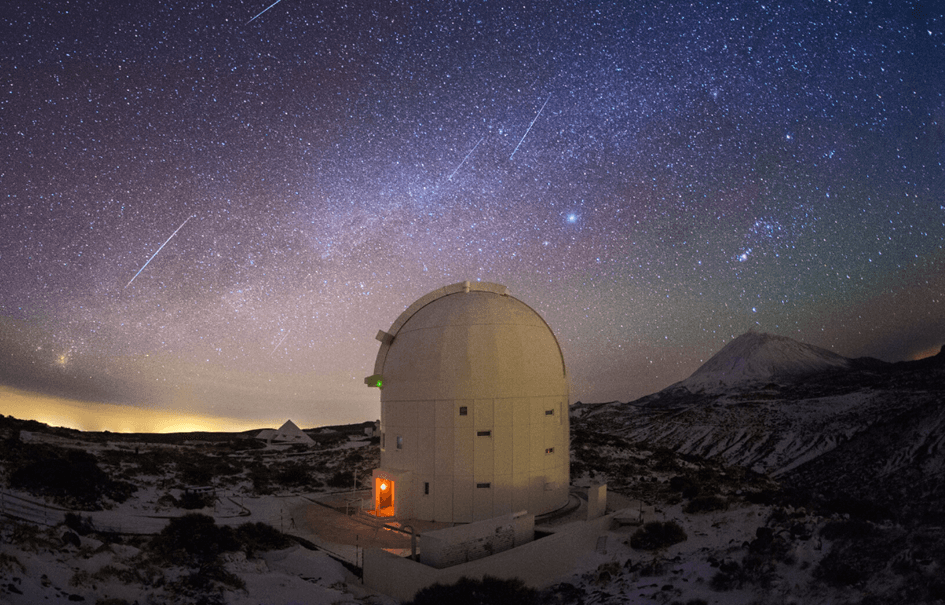
An Optical Ground Station (ESA)
Ground station architecture consists of a series of complex hardware and software subsystems designed to manage data flow between the spacecraft and the Earth. A typical ground station architecture is a ground segment infrastructure comprising an antenna system, radio frequency (RF) front end, modems, data processing units, and control software. This structure captures weak signals from the satellite and converts them into digital data, while simultaneously translating ground-based commands into RF signals for transmission to the satellite.
The antenna system is the most visible component of a ground station and is responsible for collecting electromagnetic waves from space or transmitting them into space. In traditional architectures, parabolic reflector antennas are widely used to achieve high gain. These antennas are typically mounted on motorized mounts capable of tracking the satellite’s movement across the sky along azimuth and elevation axes. The RF front end consists of Low Noise Amplifiers (LNAs) that amplify extremely weak signals captured by the antenna and downconverters that shift the signal frequency to manageable levels. On the uplink side, command signals are amplified by High Power Amplifiers (HPAs) before being transmitted to the satellite via the antenna.
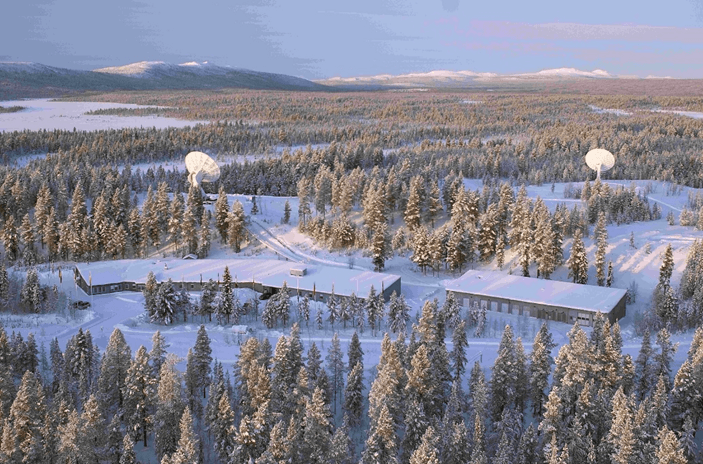
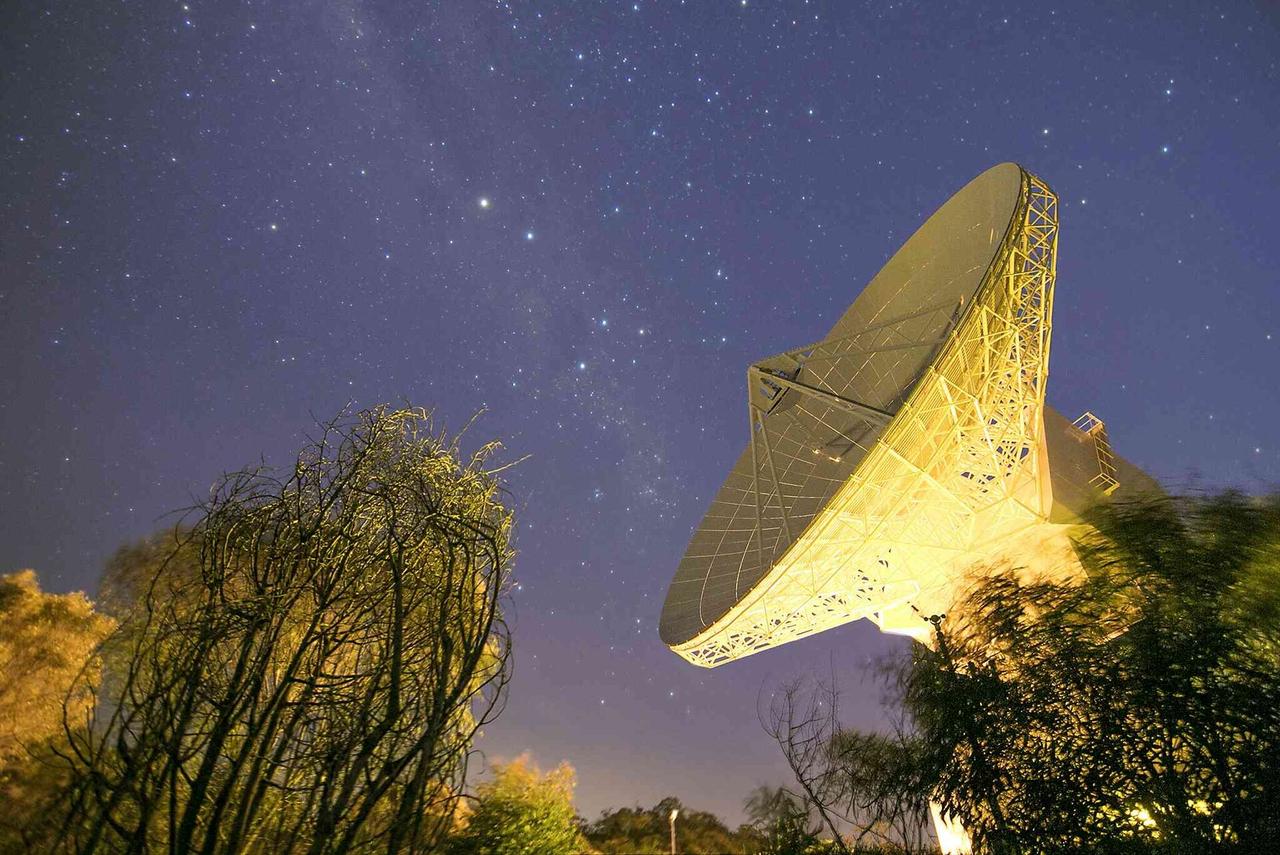
Kiruna Ground Station (ESA)
Signals received from the RF layer are converted into digital data by modems (modulators/demodulators). The demodulated data is then transferred to data processing units for parsing telemetry packets, decoding error correction codes, and transforming raw scientific data into meaningful files. In modern ground stations, these processes are typically executed on software-defined radios (SDRs) and high-performance servers. Processed data is archived in local storage systems before being transmitted to end users or mission control centers. Additionally, a “Monitoring and Control” (M&C) software layer, which continuously monitors all hardware components and environmental conditions such as temperature and power status, is an integral part of the architecture.
The Tracking, Telemetry, and Command (TT&C) system is a vital mechanism that enables communication between a spacecraft and the ground station from launch until the end of its mission life【1】. This system encompasses the processes of monitoring the satellite’s health, precisely determining its orbit, and transmitting commands necessary to execute mission functions. Traditionally conducted via radio frequency (RF), these operations integrate three primary functions: telemetry (downlink), telecommand (uplink), and ranging (distance measurement).
The telemetry function transmits data from various sensors aboard the spacecraft to the ground station. This data includes parameters reflecting the satellite’s “health,” such as battery voltage, solar panel current, temperature readings, and fuel levels. The ground station processes this information in real time to detect any anomalies. Tracking and ranging processes are used to determine the satellite’s position and velocity in space. By measuring the time it takes for a special signal sent from the ground station to reach the satellite and return, the distance to the satellite and its orbital parameters are updated with high precision.
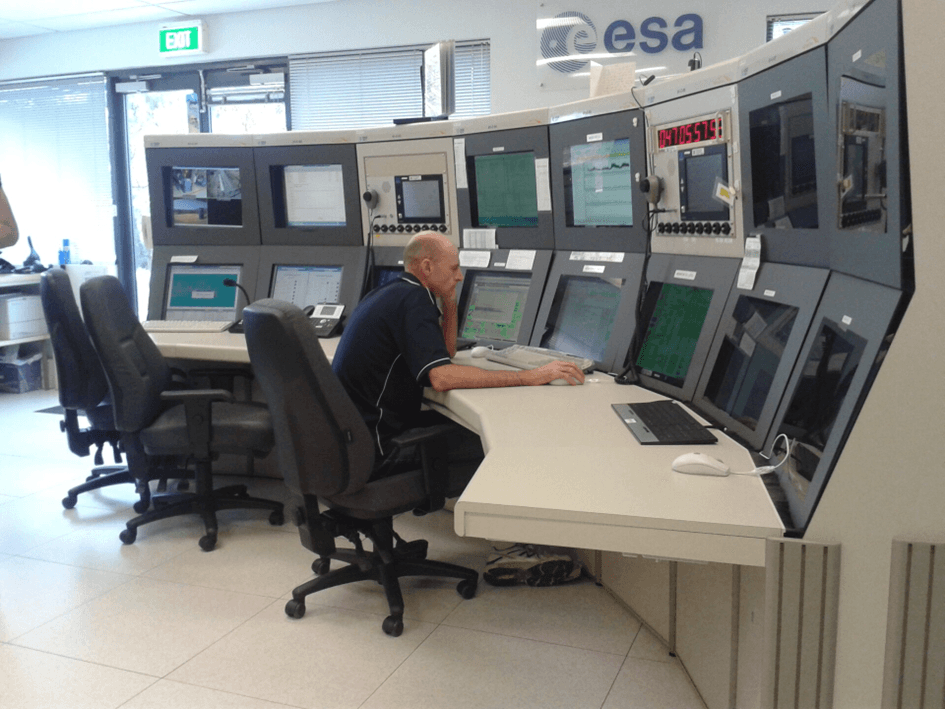
New Norcia Station Control Room (ESA)
The command (telecommand) function involves digital instructions sent from the ground station to the spacecraft to perform specific tasks or make configuration changes. These commands trigger critical operations such as orbit correction maneuvers, activation or deactivation of scientific payloads, or loading software updates. Due to its role as the satellite’s “lifeline,” data integrity and security during command transmission are maintained at the highest level. The accuracy of transmitted commands is typically verified by an acknowledgment signal returned from the satellite, preventing erroneous commands from jeopardizing the satellite’s operational lifespan.
Ground station operations are evolving from traditional ownership models toward more flexible and shared structures in parallel with advances in satellite technology. With the proliferation of small satellite constellations, new service models have emerged aimed at reducing ground segment costs and improving accessibility【2】.
Ground Station as a Service (GSaaS) is a model in which satellite operators use third-party global network infrastructure instead of building and managing their own physical ground stations. In this model, ground station networks are integrated with cloud-based platforms to enable data collection and processing from multiple global locations. GSaaS allows operators to reduce capital expenditures (CAPEX), gain operational flexibility, and access their satellites more frequently from different points on Earth. The system enables direct transfer of satellite data to cloud servers through standardized interfaces and application programming interfaces (APIs).
Traditional ground stations can communicate with a satellite only during limited periods when it is within the station’s line of sight. Space Relay Networks aim to eliminate this limitation. In this architecture, satellites transmit data not directly to Earth but to other satellites in higher orbits (typically geostationary orbit – GEO) that serve as “relays.” These relay satellites then forward the data to ground stations that maintain continuous visibility. Models such as NASA’s Tracking and Data Relay Satellite System (TDRSS) provide uninterrupted or low-latency data transfer and TT&C connectivity, especially for satellites in low Earth orbit (LEO). This operational structure is critical for transmitting emergency commands and supporting missions requiring real-time data【3】.
Rapid advancements in satellite technology, particularly the massive increase in the number of satellites in low Earth orbit (LEO), have necessitated the transformation of ground stations into smarter, more autonomous systems. Modern ground stations are equipped with advanced automation technologies that minimize human intervention, enhance operational efficiency, and enable simultaneous tracking of multiple satellites.
Traditionally manual processes such as planning, tracking, and data processing carried out by operators are now automated through advanced software layers. Automated ground station management systems can manage the entire process—from the satellite entering the station’s visibility zone (AOS), locking the antenna onto the target, receiving data, to the satellite disappearing below the horizon (LOS)—without human assistance. These systems use GNSS (Global Navigation Satellite System) data from the satellite to calculate its position and velocity in real time, thereby improving tracking accuracy and minimizing operational errors. Additionally, self-monitoring algorithms continuously assess the health of system components, enabling automatic failover to backup units in the event of a hardware failure.
One of the most critical technological leaps in modernization is the adoption of phased array antenna systems and Digital Beam Forming (DBF) techniques in place of traditional parabolic antennas. While classical reflector antennas can lock onto only one satellite at a time, DBF technology uses digital signal processing to generate multiple beams capable of simultaneously tracking several satellites at different points in the sky. This capability is vital for managing large satellite constellations. Digital beam forming eliminates the need for mechanical antenna movement by enabling electronic steering, reducing system wear and decreasing tracking response times to the millisecond level.
The continuity and quality of communication between the ground station and the satellite depend on proper radio frequency management and precise calculation of the link budget【4】. Frequency selection in space operations considers mission type, satellite orbit, data bandwidth requirements, and environmental factors. Due to the limited nature of the radio spectrum, these processes are subject to international regulations to prevent electromagnetic interference.
Communication at ground stations is typically conducted over specific frequency bands. VHF and UHF bands are commonly used for small satellite missions and amateur bands, while S, X, Ku, and Ka bands are preferred for commercial and scientific missions requiring high data rates. Frequency selection directly affects signal attenuation in the atmosphere; for example, the high-frequency Ka band is more susceptible to rain and humidity but offers wider bandwidth for transferring large data sets. The frequencies used by ground stations are licensed and registered by the International Telecommunication Union (ITU) and relevant national authorities to prevent interference.
The link budget accounts for all gains and losses along the communication path between the ground station and the satellite. For successful data exchange, the received signal power must exceed the system’s noise threshold (Eb/N0) by a sufficient margin. Link budget calculations consider parameters such as transmitter power, antenna gains, propagation losses (free space path loss), atmospheric absorption, rain attenuation, and cable and connector losses. The G/T value of the ground station (the ratio of antenna gain to system noise temperature) is the most critical performance indicator, determining the station’s sensitivity and the efficiency of the link budget. In deep space missions or small ground stations, appropriate modulation and coding schemes (MODCOD) are selected based on link budget calculations to ensure connection reliability【5】.
Anandan, V. K., C. Pradeep Kumar, S. N. V. Satyanarayana, and Manas Sarkar. "Multiple Satellite Telemetry and Tracking System (MUST)." ISRO Telemetry Tracking and Command Network (ISTRAC), Indian Space Research Organisation (ISRO). Accessed March 10, 2026. https://ieeexplore.ieee.org/stamp/stamp.jsp?arnumber=8770889&casa_token=L8tE7mv1UnEAAAAA:5LZleQ9englz172Y0cwcsw4Qiz8mDhqTxlIWBla0hBAMdT4m3lO7HQO9pe1KA_QjMZERI_dq&tag=1
Bertiger, Bary R., Raymond J. Leopold, and Kenneth M. Peterson. "Telemetry, Tracking and Control for Satellite Cellular Communication Systems." U.S. Patent No. 5,187,805, February 16, 1993. Accessed March 10, 2026. https://patentimages.storage.googleapis.com/71/53/c5/e5b2eecae97362/US5187805.pdf
European Space Agency (ESA). "Kiruna Station." Accessed March 10, 2026. https://www.esa.int/Enabling_Support/Operations/ESA_Ground_Stations/Kiruna_station
European Space Agency (ESA). "New Norcia - DSA 1." Accessed March 10, 2026. https://www.esa.int/Enabling_Support/Operations/ESA_Ground_Stations/New_Norcia_-_DSA_1
European Space Agency (ESA). "Optical Ground Station (OGS)." Accessed March 10, 2026. https://www.esa.int/Enabling_Support/Space_Engineering_Technology/Space_Optoelectronics/Optical_Ground_Station_OGS.
Fortezza, Raimondo. "Automatic Satellite Telemetry, Tracking and Command System." U.S. Patent No. 10,894,618 B2, January 19, 2021. Accessed March 10, 2026. https://patentimages.storage.googleapis.com/4a/b0/fc/c12921523f9085/US10894618.pdf
Modenini, Andrea, and Barbara Ripani. "A Tutorial on the Tracking, Telemetry, and Command (TT&C) for Space Missions." *IEEE Communications Surveys & Tutorials* 25, no. 3 (2023): 1510-1540. Accessed March 10, 2026. https://ieeexplore.ieee.org/stamp/stamp.jsp?arnumber=10155300&casa_token=KDjTzbbgWrsAAAAA:OotefL92Hd7AOrO8eXLYtRYEZ978nbpWd34X1AJM7SniI7rlNw3WRuDggGta85obSTSkqZjh&tag=1
NASA. *State of the Art of Small Spacecraft Technology*. Small Spacecraft Systems Virtual Institute, 2023. Accessed March 10, 2026. https://www.nasa.gov/smallsat-institute/sst-soa/ground-data-systems-and-mission-operations/#11.1
Ukommi, Ubong. "Ground Station Design for Satellite and Space Technology Development." *International Journal of Scientific & Engineering Research* 12, no. 12 (December 2021): 412–421. Accessed March 10, 2026. https://www.researchgate.net/profile/Emmanuel-Ubom/publication/358511532_Ground_Station_Design_for_Satellite_and_Space_Technology_Development/links/62058229cf7c2349ca089763/Ground-Station-Design-for-Satellite-and-Space-Technology-Development.pdf
Zhan, Yafeng, Peng Wan, Chunxiao Jiang, Xiaohan Pan, Xi Chen, and Song Guo. "Service-Oriented Space-Air-Ground Integrated Networks: Challenges and Solutions for the Satellite Tracking, Telemetry, and Command System." *IEEE Wireless Communications* (December 2020): 18–25. Accessed March 10, 2026. https://ieeexplore.ieee.org/stamp/stamp.jsp?arnumber=9316438&casa_token=lPCNnIYS1moAAAAA:-PCGchHru8_Crw1tIcm9QqHdXoejiDcMdVGM6vS8wU23qEZSEFWuoDl1D-Ga0JzQuANrbIQ0&tag=1
Çetin, Göker Burak. "ITU-CSCRS Ground Receiving Station Automation & Renovation." Master's thesis, İstanbul Teknik Üniversitesi, 2007. Accessed March 10, 2026. https://polen.itu.edu.tr/server/api/core/bitstreams/a9a76465-ee00-42e4-84f7-57a14ed012f3/content
[1]
Andrea Modenini and Barbara Ripani, "A Tutorial on the Tracking, Telemetry, and Command (TT&C) for Space Missions," IEEE Communications Surveys & Tutorials 25, no. 3 (2023): 1510, accessed 10 March 2026, https://ieeexplore.ieee.org/stamp/stamp.jsp?arnumber=10155300&casa_token=KDjTzbbgWrsAAAAA:OotefL92Hd7AOrO8eXLYtRYEZ978nbpWd34X1AJM7SniI7rlNw3WRuDggGta85obSTSkqZjh&tag=1 .
Yafeng Zhan et al., "Service-Oriented Space-Air-Ground Integrated Networks: Challenges and Solutions for the Satellite Tracking, Telemetry, and Command System," IEEE Wireless Communications 27, no. 6 (December 2020): 18, accessed 10 March 2026, https://ieeexplore.ieee.org/stamp/stamp.jsp?arnumber=9316438&casa_token=lPCNnIYS1moAAAAA:-PCGchHru8_Crw1tIcm9QqHdXoejiDcMdVGM6vS8wU23qEZSEFWuoDl1D-Ga0JzQuANrbIQ0&tag=1 .
V. K. Anandan et al., "Multiple Satellite Telemetry and Tracking System (MUST)," ISRO Telemetry Tracking and Command Network (ISTRAC), Indian Space Research Organisation (ISRO), 1, accessed 10 March 2026, https://ieeexplore.ieee.org/stamp/stamp.jsp?arnumber=8770889&casa_token=L8tE7mv1UnEAAAAA:5LZleQ9englz172Y0cwcsw4Qiz8mDhqTxlIWBla0hBAMdT4m3lO7HQO9pe1KA_QjMZERI_dq&tag=1 .
[2]
NASA, State of the Art of Small Spacecraft Technology (Small Spacecraft Systems Virtual Institute, 2023), 317, accessed 10 March 2026, https://www.nasa.gov/smallsat-institute/sst-soa/ground-data-systems-and-mission-operations/#11.1 .
[3]
NASA, State of the Art of Small Spacecraft Technology (Small Spacecraft Systems Virtual Institute, 2023), 328, accessed 10 March 2026, https://www.nasa.gov/smallsat-institute/sst-soa/ground-data-systems-and-mission-operations/#11.1 .
[4]
NASA, State of the Art of Small Spacecraft Technology (Small Spacecraft Systems Virtual Institute, 2023), 306-307, accessed 10 March 2026, https://www.nasa.gov/smallsat-institute/sst-soa/ground-data-systems-and-mission-operations/#11.1 .
[5]
Andrea Modenini and Barbara Ripani, "A Tutorial on the Tracking, Telemetry, and Command (TT&C) for Space Missions," IEEE Communications Surveys & Tutorials 25, no. 3 (2023): 1515-1517, accessed 10 March 2026, https://ieeexplore.ieee.org/stamp/stamp.jsp?arnumber=10155300&casa_token=KDjTzbbgWrsAAAAA:OotefL92Hd7AOrO8eXLYtRYEZ978nbpWd34X1AJM7SniI7rlNw3WRuDggGta85obSTSkqZjh&tag=1.

Ground Station Architecture and Core Components
Antenna Systems and RF Substructure
Data Processing and Storage Units
Tracking, Telemetry, and Command (TT&C) Systems
Satellite Health Monitoring and Orbit Determination
Command Transmission and Security
Service Models and Operational Structures
Ground Station as a Service (GSaaS)
Space Relay Networks
Automation and Modernization Technologies
Automated Ground Station Management
Digital Beam Forming (DBF) and Multi-Satellite Tracking
Frequency Management and Link Budget
Frequency Selection and Spectrum Management
Link Budget Analysis