This article was automatically translated from the original Turkish version.
+1 More
Registration Number | 63 | ||||||||
|---|---|---|---|---|---|---|---|---|---|
Application Date | 23.01.2004 | ||||||||
Application Number | C 2004/002 | ||||||||
Publication Date | 11.04.2004 | ||||||||
Type(s) | Mahreç İşareti | ||||||||
Product / Product Group(s) | Chocolate Confectionery and Related Products | ||||||||
Applicant/Registrant(s) | Gümüşhane Provincial Special Administration | ||||||||
Gümüşhane Mulberry Pestil is a type of pestil produced in the province and districts of Gümüşhane (Kelkit, Köse, Şiran, Torul, Kürtün), made using mulberry, honey, milk, and either walnut or hazelnut, and registered with geographical indication status. The product was registered under the designation of “Geographical Indication” effective 23.01.2004 and officially recorded by the Turkish Patent Institute on 27.12.2004 with registration number 63. Gümüşhane Mulberry Pestil is produced according to specific technical characteristics and traditional methods.

Gümüşhane Mulberry Pestil (AA)
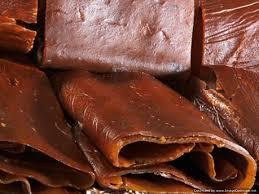
Gümüşhane Mulberry Pestil has a shiny and soft texture. Honey and milk are added to its composition, and significantly higher quantities of walnut or hazelnut kernels are used. To produce 100 kg of Gümüşhane pestil, at least 20 kg of honey, at least 15 kg of milk, and at least 20 kg of walnut or hazelnut kernels are required. The milk and mulberries are sourced from the Gümüşhane region. The local flora and the techniques applied by pestil masters significantly influence the production and quality of the product.
The production of Gümüşhane Mulberry Pestil involves mulberry, honey, walnut or hazelnut, flour, and milk. The process begins by washing the mulberries and boiling them in a cauldron. The resulting juice is strained; part of the strained juice is mixed with flour and beaten, while the remainder is transferred to a special pot and heated with honey and sugar. Once boiling begins, the separately prepared juice and milk mixture is combined with the beaten flour and cooked for a period. The resulting paste, known as herle, is poured onto cloths laid over grids, and hazelnuts or walnuts are added. After spreading, the pestil is left to dry. Once drying is complete, the surface of the cloth not in contact with the pestil is moistened with water, allowing the pestil to be separated from the cloth. In the final stage, the folded pestil is packaged. Drying is carried out in a hygienic environment.
In the traditional production of Gümüşhane Mulberry Pestil, mulberries are harvested from trees and boiled in cauldrons with milk and sugar to prepare a mixture known as herle. After spreading the herle onto cloths, hazelnuts or walnuts are added, and the mixture is subjected to drying. Once drying is complete, the pestil is separated from the cloth and packaged. The entire production process is carried out in villages and rural areas using the communal imece method, involving the collaborative work of multiple individuals.

Gümüşhane Mulberry Pestil (AA)
Gümüşhane Mulberry Pestil must be stored in dry locations away from direct sunlight. It should be consumed within three months at room temperature without any additives. When stored at 5–10 °C, its shelf life may be extended up to six months.
Compliance with the characteristics of Gümüşhane Mulberry Pestil is monitored by a minimum three-member expert commission coordinated by the Gümüşhane Provincial Special Administration. Inspections are conducted at least twice annually by the Provincial Directorate of Agriculture, the Directorate of Industry and Trade, and the Provincial Directorate of Health. In the event of a complaint, inspections may be carried out at any time.
Anadolu Ajansı. "Gümüşhane’de Kazanlar Pestil İçin Kaynıyor." June 6, 2024. Accessed August 18, 2025. https://www.aa.com.tr/tr/yasam/gumushanede-kazanlar-pestil-icin-kayniyor/3267804.
T.C. Turkish Patent and Trademark Office. "Gümüşhane Dut Pestili Coğrafi İşaret Detayı." Accessed August 18, 2025. https://ci.turkpatent.gov.tr/cografi-isaretler/detay/37939.
T.C. Turkish Patent and Trademark Office. "Gümüşhane Dut Pestili Coğrafi İşaret Tescil Belgesi." PDF. Accessed August 18, 2025. https://ci.turkpatent.gov.tr/Files/GeographicalSigns/63.pdf.

Registration Number | 63 | ||||||||
|---|---|---|---|---|---|---|---|---|---|
Application Date | 23.01.2004 | ||||||||
Application Number | C 2004/002 | ||||||||
Publication Date | 11.04.2004 | ||||||||
Type(s) | Mahreç İşareti | ||||||||
Product / Product Group(s) | Chocolate Confectionery and Related Products | ||||||||
Applicant/Registrant(s) | Gümüşhane Provincial Special Administration | ||||||||
No Discussion Added Yet
Start discussion for "Gümüşhane Dut Pestili" article
Distinctive Characteristics
Production Method
Traditional Production
Storage Conditions and Inspection