This article was automatically translated from the original Turkish version.
+2 More
Status | Main palace (Beopgung) | ||||||||
|---|---|---|---|---|---|---|---|---|---|
Tourism | Guard changing ceremony with free admission in Hanbok | ||||||||
Demolition and Restoration Dates | Destruction in 1592, major restoration in 1867 | ||||||||
Buildings | Geunjeongjeon (Throne Hall), Gyeonghoeru (Banquet Pavilion) | ||||||||
Construction | 1395, King Taejo | ||||||||
Location | South Korea Seoul Jongno-gu | ||||||||
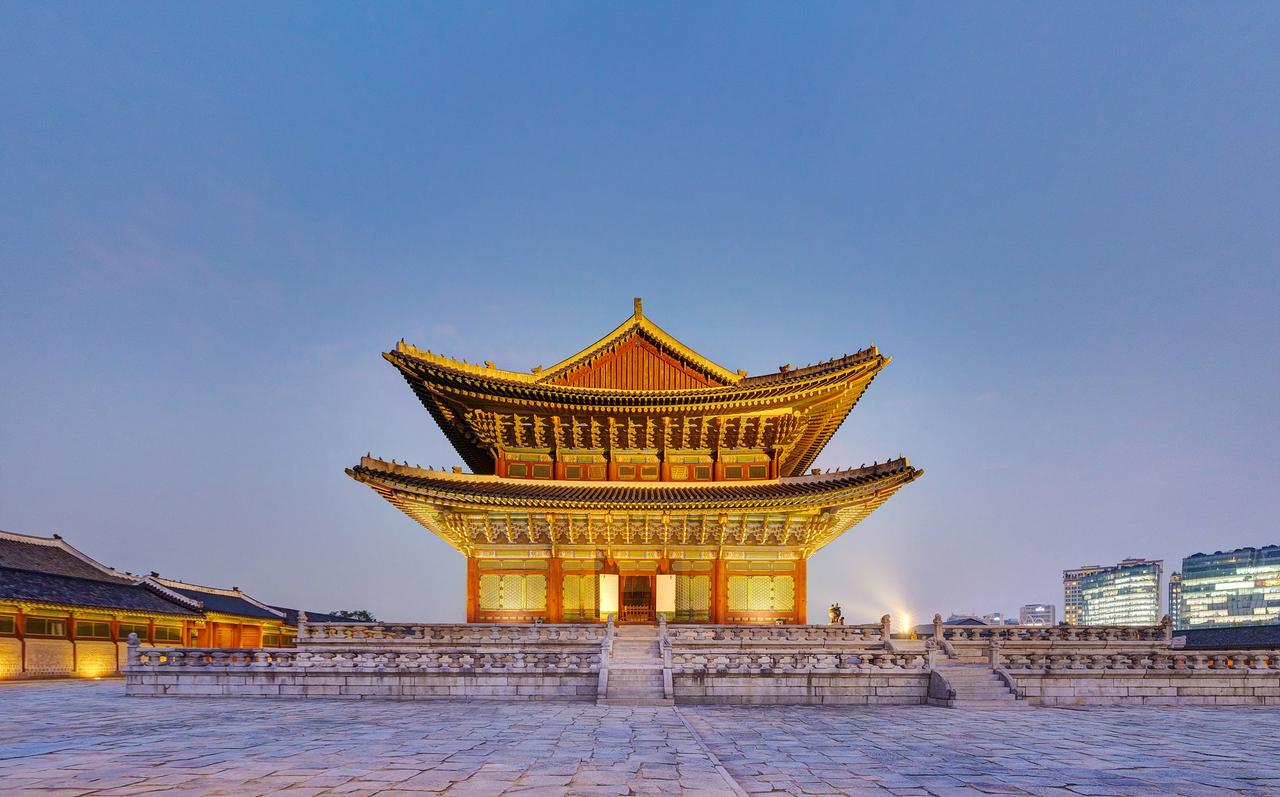
Gyeongbokgung Palace, constructed in 1395 by Taejo, the founder of the Joseon Dynasty, is the principal palace (Beopgung) among Seoul’s five major palaces. 【1】 The name Gyeongbokgung, meaning "palace of great blessing and prosperity for the new dynasty," served as the administrative center and royal residence of the dynasty. 【2】 During the 1592 Japanese invasion (Imjin War), the palace was completely destroyed and remained in ruins for approximately 270 years. It was reconstructed during the reign of King Gojong in 1867 under the leadership of Naegwan Heungseon Daewongun, with new structures added. 【3】 Although much of the complex was demolished during the Japanese colonial period, restoration efforts since 1990 have gradually returned it to its original form.

Gyeonghuigung Palace (Royal Palaces and Tombs Center)
Gyeongbokgung Palace is a comprehensive ensemble of buildings embodying the architectural philosophy and royal authority of the Joseon Dynasty. Constructed in 1395, it is the highest-ranking of the five major palaces of the dynasty. Its architectural layout presents the state’s administrative mechanisms and the royal family’s private living quarters within a defined hierarchy.
Gwanghwamun, the main gate of the palace, is the most significant entrance located on the southern side of the complex. Beyond this gate lies Geunjeongjeon, the Throne Hall, a grand structure where coronation ceremonies were held, state affairs were deliberated, and foreign envoys were received. The architecture of the hall symbolizes the absolute authority of the Joseon kings.
Gyeonghoeru, a two-story pavilion built on a large artificial pond, was used for royal banquets and official entertainments. Constructed on forty-eight stone pillars, the pavilion is regarded as a testament to the aesthetic and engineering achievements of traditional Korean architecture.
The palace was not only an administrative center but also a space where the royal family carried out their daily lives.
Jagyeongjeon is a bedroom complex built by King Gojong for his mother. This structure is particularly renowned for its ornate wall decorations characteristic of palace architecture.
Hyangwonjeong Pavilion is a hexagonal structure situated in the center of a pond on the northern side of the palace grounds. It was designed as a leisure and relaxation area for the royal family.
Today, Gyeongbokgung, along with its constituent buildings, represents a tangible heritage of Korean history. Within the palace grounds, the National Palace Museum of Korea and the National Folk Museum house tens of thousands of artifacts that document the functions of the architectural structures and the lifestyle of the period. Additionally, the traditional guard change ceremonies held before Gwanghwamun Gate are a vital cultural activity that keeps the historical atmosphere of the palace alive for modern visitors.

Gyeongbokgung Palace-Gangnyeongjeon Hall (Royal Palaces and Tombs Center)
Gyeonghuigung was constructed as a secondary palace (Haenggung) for use by Joseon kings during emergencies in the later period of the dynasty. Construction began in 1617 during the reign of King Gwanghaegun, and the palace was also known as the Western Palace. Its main gate, Heunghwamun, and Sungjeongjeon Hall, where the king conducted state affairs, are its most important structures. Although most of the buildings were dismantled, relocated, or destroyed during the Japanese colonial period, selective restoration efforts since the late 1980s have reopened certain sections to the public.
Gyeonghuigung is among the Joseon palaces that suffered the most extensive damage throughout its history. Originally spanning approximately 100,000 square meters and housing over 100 buildings, the complex was nearly entirely demolished during the Japanese colonial administration (1910–1945). Most palace structures were dismantled, sold, or moved elsewhere, and the palace grounds were repurposed for colonial schools and buildings. Archaeological excavations initiated by the Seoul Metropolitan Government in the late 1980s, followed by comprehensive restoration projects between 1987 and 2002, led to the reconstruction of the palace’s main sections, which were reopened to the public in 2002.

Gyeongbokgung Palace (AA)
Gyeongbokgung and Gyeonghuigung palaces play a critical role in preserving and promoting the historical heritage of South Korea. The National Palace Museum of Korea and the National Folk Museum within Gyeongbokgung house tens of thousands of artifacts from the dynastic era. Daily "Sumunjang" (Guard Change) ceremonies held at the palace present a living example of traditional Korean culture to visitors.
Today, these palaces have become central attractions in the country’s tourism industry. A strategic initiative allows visitors who wear traditional Korean attire, known as "hanbok," to enter the palace grounds free of charge, promoting both the preservation of cultural heritage and the encouragement of modern tourism.
Anadolu Ajansı. "Seul'deki Gyeongbokgung Sarayı Ülke Turizminin Çekim Noktası Oldu." Accessed March 17, 2026. https://www.aa.com.tr/tr/kultur/seuldeki-gyeongbokgung-sarayi-ulke-turizminin-cekim-noktasi-oldu/3178907
Korea Heritage Service. "Geunjeongjeon Hall." Accessed March 17, 2026. https://royal.cha.go.kr/ENG/contents/E101020000.do?schBdcode=gbg&pageType=story&bdProgramCode
Korea Heritage Service. "Gyeongbokgung Palace." Accessed March 17, 2026. https://royal.cha.go.kr/ENG/contents/E101010000.do
Korea Heritage Service. "Gyeonghuigung Palace." Accessed March 17, 2026. https://www.kh.or.kr/cms/content/view/1314
Seoul Metropolitan Government. "Gyeongbokgung Palace in Seoul." Accessed March 17, 2026. https://english.seoul.go.kr/gyeongbokgung-palace-in-seoul/gyeongbokgung-palace-in-seoul-2/.
Seoul Museum of History. "Gyeonghuigung Palace." Accessed March 17, 2026. https://museum.seoul.go.kr/eng/about/annex/gyeonghuigungPalace.jsp.
[1]
Korea Heritage Service, "Gyeongbokgung Palace," accessed 15 March 2026. https://royal.cha.go.kr/ENG/contents/E101010000.do.
[2]
Korea Heritage Service, "Gyeongbokgung Palace," accessed 19 March 2026. https://royal.cha.go.kr/ENG/contents/E101010000.do.
[3]
Korea Heritage Service, "Gyeongbokgung Palace," accessed 19 March 2026.

Status | Main palace (Beopgung) | ||||||||
|---|---|---|---|---|---|---|---|---|---|
Tourism | Guard changing ceremony with free admission in Hanbok | ||||||||
Demolition and Restoration Dates | Destruction in 1592, major restoration in 1867 | ||||||||
Buildings | Geunjeongjeon (Throne Hall), Gyeonghoeru (Banquet Pavilion) | ||||||||
Construction | 1395, King Taejo | ||||||||
Location | South Korea Seoul Jongno-gu | ||||||||
No Discussion Added Yet
Start discussion for "Gyeongbokgung Palace" article
Architectural Structures and Functions of Gyeongbokgung Palace
Gwanghwamun Gate and Geunjeongjeon Hall
Gyeonghoeru Pavilion
Royal Private Quarters and Leisure Structures
Jagyeongjeon and Hyangwonjeong
Cultural Function of the Palace Complex
Gyeonghuigung Palace
Historical Development and Restoration Process
Cultural Heritage and Modern Tourism