


This article was automatically translated from the original Turkish version.
+2 More
Hanbok (한복) is a traditional garment of Korea, historically worn both in daily life and on special occasions. Worn by women, men, and children, hanbok is not merely clothing but a cultural heritage that embodies the symbolic, aesthetic, and functional dimensions of Korean culture. It is especially preferred by Korean families during ceremonies such as holidays and memorial days.
The historical origins of hanbok extend back to Korea’s Three Kingdoms period (57 BCE – 668 CE). From this era onward, clothing was regarded not only as a means of physical coverage but also as an instrument of social status, authority, and aesthetic preference. Over time, the structure and design of hanbok underwent numerous changes, with the modern forms of hanbok emerging particularly during the Joseon Dynasty (1392–1910).
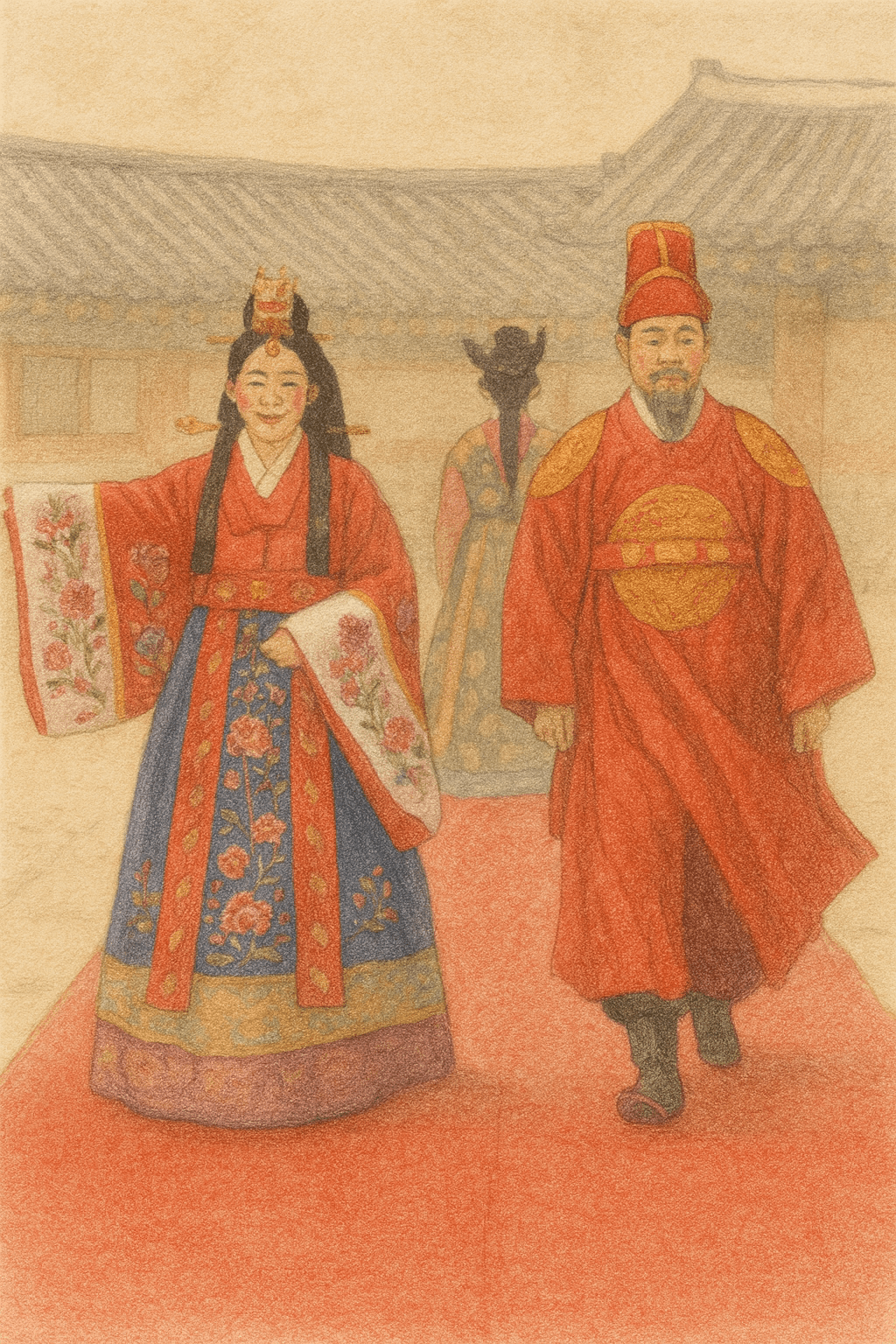
Hanbok (Generated by Artificial Intelligence)
The basic structure of hanbok consists of two parts: the upper garment, known as the chogori, and the lower garment, either a skirt (chima) or trousers (paji). Women’s hanbok features a short chogori paired with a voluminous chima, while men’s hanbok is characterized by a longer chogori and loose trousers that fasten at the ankles. The upper chogori includes two front panels, sleeves extending from low shoulders, a detachable paper collar strip (tongjong), and a ribbon known as the goreum. Other accompanying elements include socks (poson), undergarments (sok paji, sok chima), an outer coat worn over the hanbok (turumagi), footwear (shinbal), and hats (kat).
In women’s hanbok, small pouches attached at the waist are an important accessory. These pouches are typically decorated with natural motifs such as plums or lotus flowers. In traditional usage, the cut and style of hanbok components could vary according to the wearer’s social class. Women from lower classes often tied their skirts higher to partially reveal their undergarments, while upper-class women secured their garments with abundant fabrics and delicate sashes.
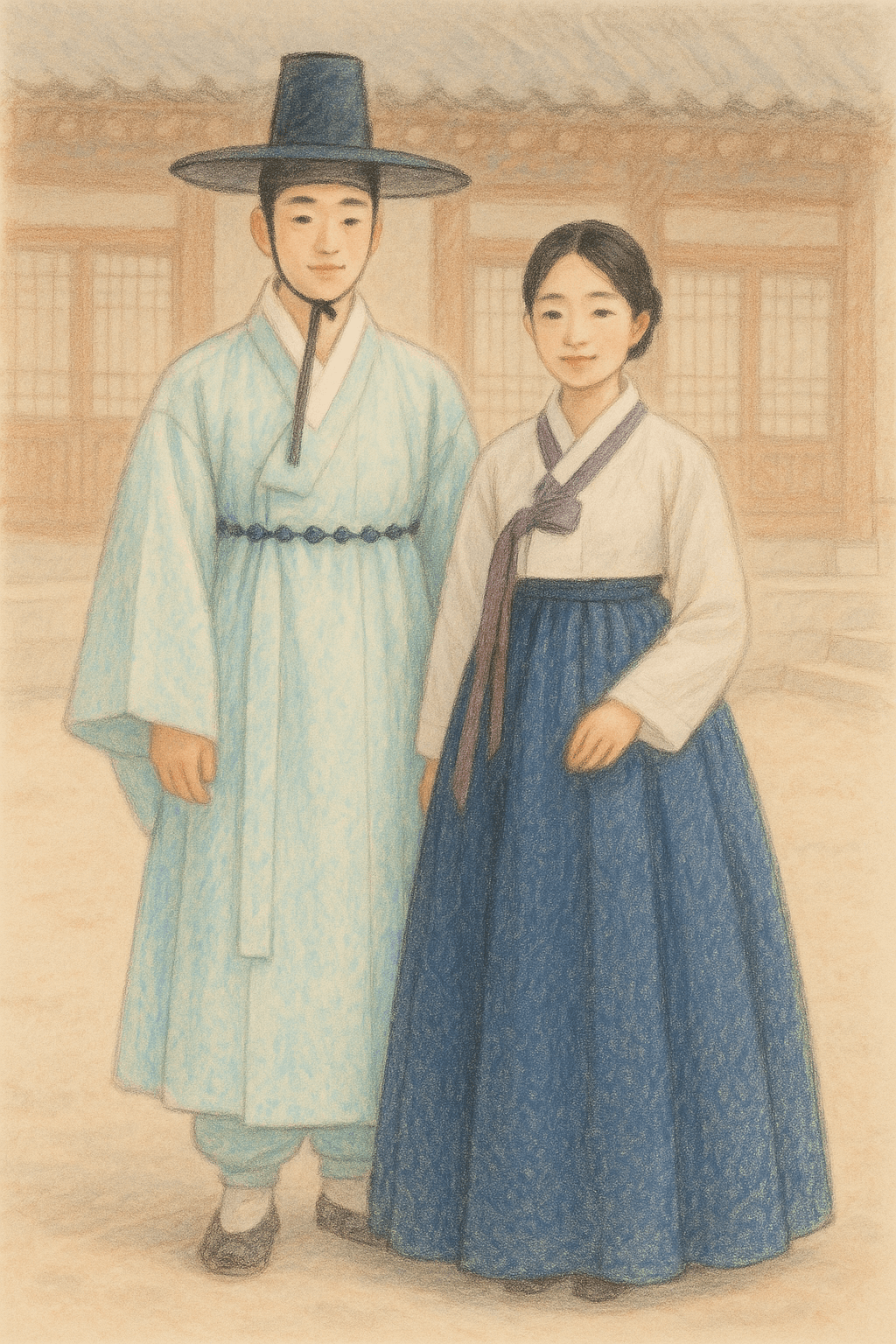
Hanbok (Generated by Artificial Intelligence)
One of the most significant forms of hanbok, beyond its aesthetic value, is the white hanbok, which has become a powerful symbol of Korean identity since the late 19th century. This color reflects both a simple way of life and the national character of the Korean people, who historically referred to themselves as “the people in white clothing.” In the 1938 poem “Sad People” by poet Yoon Dong-ju, the white hanbok is described as covering a “sad body.”
Although numerous laws during the Joseon and Goryeo periods sought to restrict the wearing of white hanbok, the populace continued the tradition. During Japanese colonial rule, those who wore white hanbok were punished by having ink splashed on their garments or slogans stamped onto them, and they were denied access to public services, education, and basic rights. Despite all these pressures, white hanbok became a symbol of resistance against colonialism. It reemerged as a symbol during the democratization movements of the 1980s and in anti-American nationalist rhetoric.
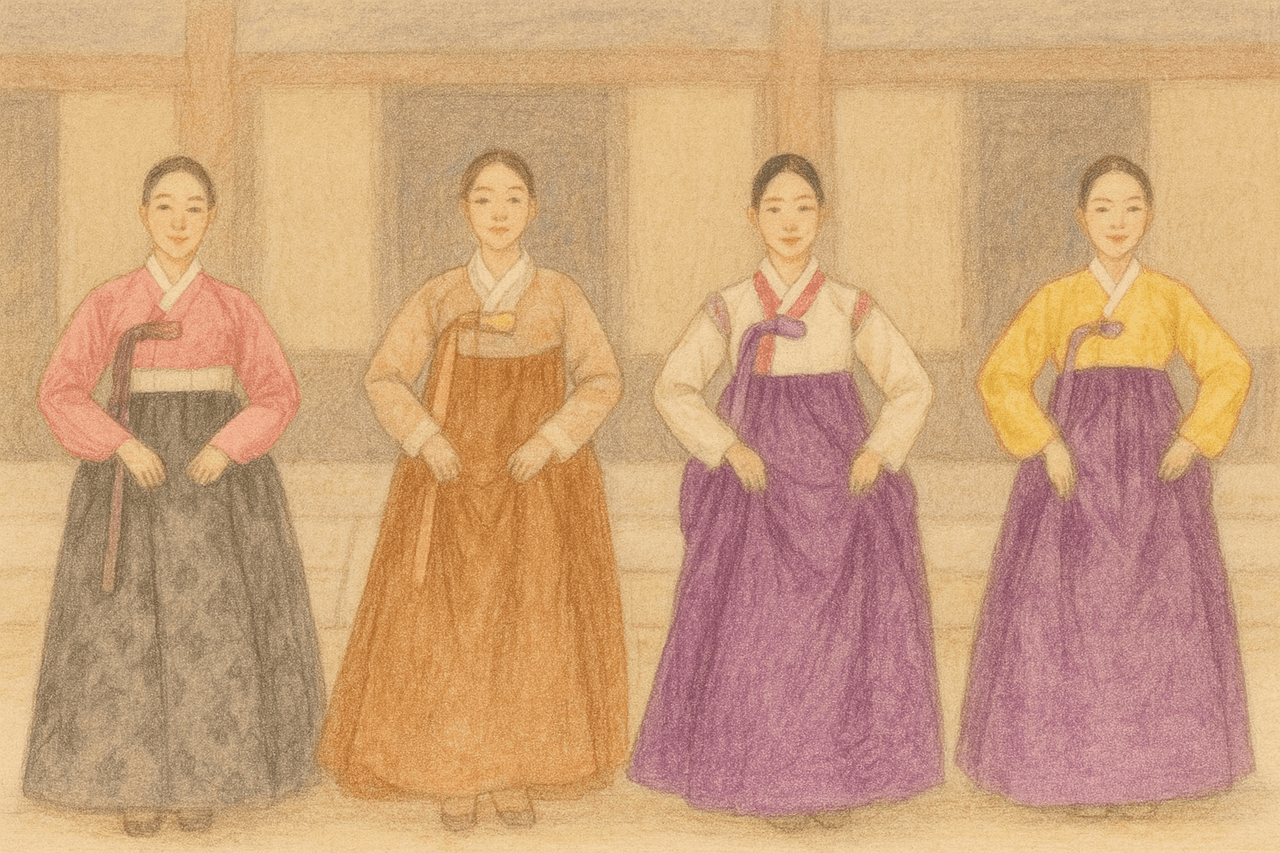
Hanbok (Generated by Artificial Intelligence)
In modern Korea, hanbok is primarily worn on special occasions such as traditional holidays, weddings, and ceremonies. Although its use in daily life has declined, new interpretations of hanbok have found a place in the world of fashion. The Kaeryang hanbok (revived hanbok), introduced in the 1990s, offered advantages in comfort and lower cost but failed to achieve lasting popularity due to nationalist discourse.
In recent years, neo hanbok (new hanbok) has been developed to appeal to younger generations, reinterpreting traditional forms using modern materials and design techniques. These hanbok garments draw inspiration from digital printed fabrics, ink-wash patterns, and folk art motifs (hwajo-do). Traditional materials such as silk are combined with textiles produced through modern technology.
Additionally, Western techniques such as drapage have transformed the classical two-dimensional silhouette of hanbok, enabling designs that fit the body more closely. Through these methods, traditional cuts merge with contemporary fashion standards. Fusion hanbok models showcased in fashion shows symbolize the convergence of traditional and modern Korea, demonstrating how hanbok has been repositioned as a dynamic medium of expression.
Cho, Sunhyung. “Reinterpretation of Hanbok.” In *International Textile and Apparel Association Annual Conference Proceedings* 75, no. 1 (2018): 1-4. Accessed August 16, 2025. https://www.iastatedigitalpress.com/itaa/article/1333/galley/1206/view/
Jeong, Sarah H. “Hanbok, Korean Traditional Dress: A Selected Annotated Bibliography.” *Journal of East Asian Libraries* 5, no. 138 (2006): 9-16. Accessed August 16, 2025. https://scholarsarchive.byu.edu/cgi/viewcontent.cgi?article=2237&context=jeal
Kim, Hanna, and Seunghee Suh. “A Study on the Development of Korean Fashion Design Using the Forced-Relationship Techniques” *Journal of Fashion Business* 24, no. 5 (2020): 21–34. Accessed August 16, 2025. https://koreascience.kr/article/JAKO202034465347174.view
Lee, Yeseung. “The White-Clad People: The White Hanbok and Korean Nationalism.” *Cultural Dynamics* 34, no. 4 (2022): 271–296. Accessed August 16, 2025. https://westminsterresearch.westminster.ac.uk/download/7db7292d63ef5928c8831eb416a138448e7afb9cd3ca303a98c0f074cafed06a/2034091/Lee.%20The%20white-clad%20people.%202022.pdf

Structure and Key Elements of Hanbok
White Hanbok and Its Nationalist Significance
Modern Interpretations of Hanbok Today