


This article was automatically translated from the original Turkish version.
+2 More
T.C. Bayramiç Kaymakamlığı (Erişim Tarihi: 22.06.2025)
Hadımoğlu Konağı is a historical building located in the Bayramiç district of Çanakkale. Recognized as a prominent example of 18th-century provincial âyan architecture, the mansion was commissioned by Hadimzade Osman Bey in 1796–1797. Today, it functions as a museum displaying ethnographic artifacts collected from the Bayramiç region and used in daily life. The mansion retains characteristic features of the 18th century through its ornate ceilings, penwork, and gold leaf decorations, and continues to serve as a significant cultural heritage site for Bayramiç.
Hadımoğlu Konağı (Bayramiç Subdistrict Governorship)
According to inscriptions, the mansion is estimated to have been constructed between 1795 and 1796 (H. 1211). A two-line inscription, recorded in endowment documents but now lost, states that the building was erected by Hac Emirî (emir-ul hac) Osman on 6 Recep 1211 (5 January 1797). Additionally, on a medallion at the center of the northern façade, the date “Maşallah 1211” is inscribed in penwork on Arabic stucco. It is widely accepted that Hadimzade Osman Bey, the most prominent official in Bayramiç at the time, commissioned the mansion. Osman Bey is known to have constructed a külliye in Bayramiç comprising a mosque (1792), a fountain (1793–1794), and a bridge (1800–1801), and the mansion is believed to have been part of this complex. Osman Bey is identified as a member of the Hadımoğlu family, who originated from Hadim in Konya and established themselves as local notables in the region. The Hadımoğlu Konağı was purchased from the heirs in 1973 and transferred to the Ministry of Culture. After restoration, it was converted into a museum and assigned to the Bayramiç Subgovernorship in 1996.
Hadımoğlu Konağı is an example of âyan architecture that emerged in the second half of the 18th century. Buildings of this period typically resembled smaller-scale copies of imperial Ottoman architecture from Istanbul. The mansion is situated at the intersection of two streets in the center of Bayramiç. It is a two-story structure oriented east-west and surrounded by a courtyard on the north and west. The surviving portion of the building is the harem section. It is known that the selamlık section once existed, was internally connected to the harem, and stood opposite a fountain bearing the same name, but it was demolished in 1948. In the southeast corner of the courtyard, a three-part brick bathhouse ruin, added externally to the harem section, remains.
Courtyard: Access to the courtyard is through a two-story arched entrance on the northwest. The entrance is framed within a vertical rectangular niche and features a circular-arched iron gate. The courtyard has a trapezoidal plan and its floor is paved with cut stone. Due to its use as a museum, various inscriptions, cubes, columns, and base fragments are displayed in the courtyard. A marble fountain is located at the center of the western edge.
Facades: All facades of the surviving harem section, except the northern one facing the courtyard, are blind. The high perimeter walls were constructed with a skewed plan to harmonize with the surrounding street layout, resulting in a chamfered northeast corner. The upper part of the chamfer is decorated with triangular motifs divided by horizontal bands. The other repaired sections of the building, painted red, suggest that the façades underwent renovations in later years.
Entrance Unit: The entrance unit located in the northeast corner of the mansion is designed as a two-story tower and is accessed from within via a staircase attached to the wall.
Ground Floor: The ground floor, constructed of cut stone, has openings on the north and south facades while the other sides are blind. On the north facade, there are six vertically rectangular windows with iron grilles and pointed arches. The first space after the entrance is a square-shaped sofa. Along the north and west edges of the sofa, marble benches with carved balustrades extend. Near the center of the sofa is a marble basin. The sofa floor is composed of large marble blocks. At the southern end of the sofa, a transverse section oriented east-west is positioned perpendicularly; this section opens to the west into a helâ. The helâ is a narrow, rectangular corridor. At the eastern end of this transverse section is a relatively simple room with a hearth, likely originally used as a kitchen or pantry.
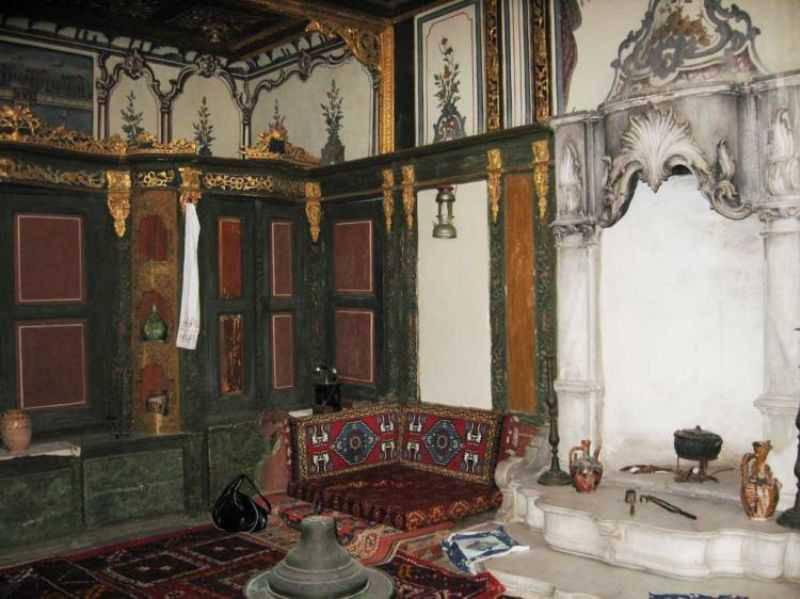
Northeast Room (Ground Floor): This room is nearly square in plan. It is surrounded by a wooden bench, and on the side facing the entrance, a schematic depiction of a mosque is rendered in C- and S-shaped decorative motifs. The room contains a hearth and a double-compartment wooden cabinet made of rosewood. The ceiling is adorned with radial cartouches opening outward from a central circular motif composed of twenty-four fruit-shaped elements. Red and green dominate the ceiling decorations.
Northwest Room (Ground Floor): The door has been converted into an arched opening during restoration. It is surrounded by a wooden bench with stone balustrades, and on the side facing the entrance, a relief-style schematic depiction of a mosque is present. The room contains a marble hearth and a three-compartment wooden cabinet. The ceiling features a rectangular decorative element with edges arranged in curved vine-like patterns.
Staircase: A fifteen-step wooden staircase located at the southern end of the sofa stands before a doorway that once opened to the selamlık section but is now sealed. On the ceiling above the staircase is a painted motif of a whirligig in red and blue.
Upper Floor: The upper floor, with a wooden floor, follows the same plan layout as the ground floor. The sofa on the ground floor has been transformed into a balcony on the upper floor. The northern facade of the upper floor, unlike that of the ground floor, is decorated. The rooms open to the courtyard and terrace through three windows each. Immediately above the windows, along the ceiling cornice, penwork decorations and small rows of latticed windows are notable. The penwork motifs mostly depict flowers emerging from vases. The upper floor consists of two “başoda” (main rooms), a third room added to the south of the eastern başoda, and a sofa between them. On the western side of the upper floor, as on the ground floor, there is a helâ.
Northeast Room (Upper Floor – Başoda): This room is square in plan. It is surrounded by a wooden bench. On the eastern wall, two wooden cupboards with carved lids decorated with vine scrolls and flowers are present. One of the cupboard lids features a motif of a mosque with two minarets (in Empire style reminiscent of the Ortaköy and Dolmabahçe Mosques in Istanbul) and a kiosk. In the room, a marble hearth with a rectangular frame and baroque-style decorations rests on a marble base. The ceiling is enclosed within three nested square frames adorned with gold leaf, floral vine scrolls, and C- and S-shaped motifs. This room is one of the two “başoda” rooms distinguished by its elaborate decorations.
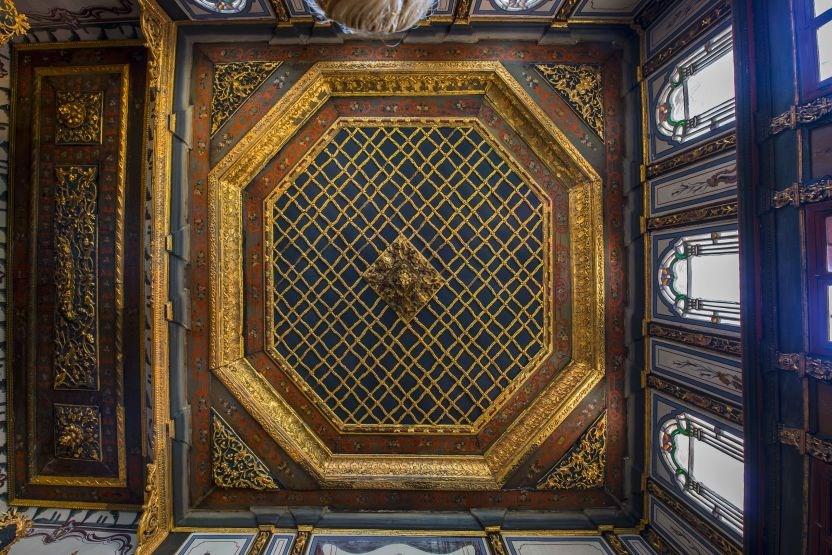
Northwest Room (Upper Floor – Başoda): The room has a plan close to square. It is surrounded by a wooden bench. On the western side of the bench is a marble hearth, its davlumbaz (chimney hood) carved with high-relief baroque-style decorations. On the southern wall is a double-door cabinet. Within the western wall, a staircase leads to the now-demolished selamlık section. The ceiling is divided into two sections with gold leaf decorations; a composition centered on an octagon completed by triangular sections at the corners is particularly striking.
Hadımoğlu Konağı (Bayramiç Subprefecture)
Hadımoğlu Konağı is a significant representative of the artistic movement in 18th-century Turkish painting influenced by the West, particularly evident in its penwork wall paintings. This decorative style spread from the capital (Topkapı Palace) to Anatolia, appearing in mosques, houses, fountains, and tombs. Every room in the mansion features ornate ceilings decorated with penwork and gold leaf. On the southern walls of the two “başoda” rooms on the upper floor, above the wooden cabinets, and on the eastern wall of the upper-floor helâ, three landscape paintings are present.
Painting on the Southern Wall of the Northeast Room: This landscape, framed in a baroque-style border, depicts two landmasses separated by a sea. On the left side of the painting, a three-arched bridge connects the two landmasses.
Painting on the Southern Wall of the Northwest Room: Various buildings are shown along a seashore, with wooded areas and hills behind them. The depicted location is possibly the Beşiktaş Palace in Istanbul, which was demolished in 1835 to make way for Dolmabahçe Palace.
Painting on the Eastern Wall of the Upper-Floor Helâ: This penwork landscape is framed by a panel formed by baroque-style “S”-shaped motifs at the corners. The main motif consists of mountain ranges with pine and acacia trees and five buildings. It has also been suggested that this painting depicts Bayramiç itself.
Overall, these landscape paintings reveal a hybrid style that adopts the West’s third dimension through a miniature technique. It has been noted that these depictions reflect not only the artist’s observation but also imagination and longing for the capital.
Hadımoğlu Konağı belongs to the “external sofa” plan type, in which rooms are arranged along one side of the sofa. While in traditional Turkish houses, the staircase is rarely placed directly opposite the entrance due to concerns of security and privacy, the mansion’s location within a large courtyard does not contradict this principle. The high perimeter walls and watchtower suggest the building was designed not merely for a wealthy local official but also to meet the security needs of a wary derebey. Architectural parallels to the mansion include the Emirgan Şerifler Yalı Köşkü (1725–1728) and an 18th-century house in the courtyard of the Takyeciler Mosque in Istanbul. The ceilings of the mansion are decorated with geometric patterns, with the most ornate elements concentrated at the center. The ceiling of the ground-floor sofa is executed in high relief and adorned with floral and C- and S-shaped motifs. A whirligig motif appears on the ceiling above the staircase and on the upper-floor sofa. The ceilings of the rooms have baroque-derived concave profiles. Particularly, the ceiling decorations of the upper-floor rooms, with their central gold-leaf octagonal and circular motifs and stucco embellishments, are striking. The closest parallels to these ceiling examples are found in the ceiling of the Ikballer Chamber in Topkapı Palace. Hearths are located on walls without windows, near the center of the benches, and are semicircular in plan.
Bayramiç Kaymakamlığı Governorate. "17. Yüzyıla Ait Nadir Türk Evlerinden Biri: Hadımoğlu Konağı." Bayramiç Subdistrict Governorate Official Website. Accessed June 21, 2025. http://www.bayramic.gov.tr/17-yuzyila-ait-nadir-turk-evlerinden-biri-hadimoglu-konagi.
Çanakkale Savaşları Üniversitesi, Gallipoli Historical Area Directorate of the Çanakkale Battles. "Bayramiç Hadımoğlu Mansion." *Çanakkale Battles Official Website*. Accessed June 21, 2025. https://canakkalesavaslari.comu.edu.tr/bayramic-hadimoglu-konagi.html.

T.C. Bayramiç Kaymakamlığı (Erişim Tarihi: 22.06.2025)
No Discussion Added Yet
Start discussion for "Hadımoğlu Mansion Ethnography Museum (Çanakkale)" article
History
Architectural Features
Decorative Features and Wall Paintings
Plan Typology and Comparisons