


This article was automatically translated from the original Turkish version.
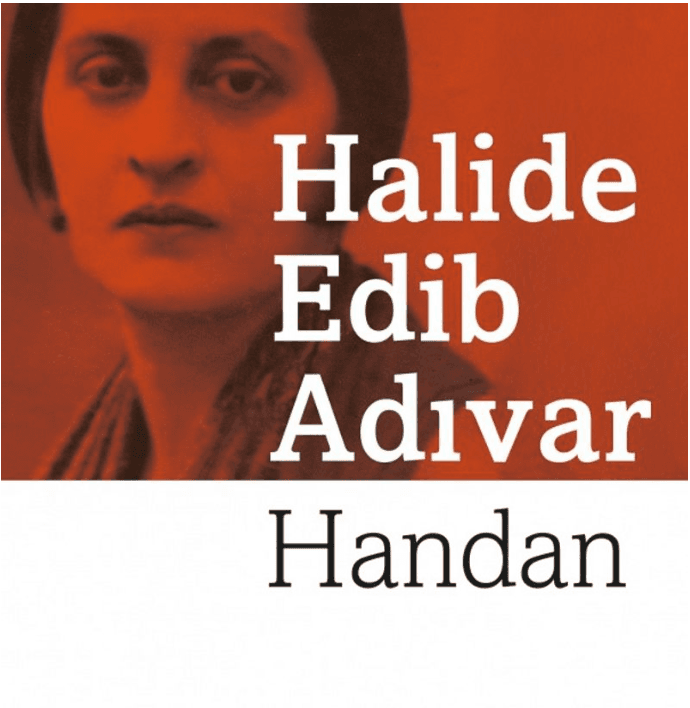
Handan
Handan is the novel written by Halide Edip Adıvar in 1912 and is regarded as the first Turkish novel to examine women’s psychology in detail. The novel is constructed entirely of letters and revolves around a “first-person narrative” technique. The events unfold during the reign of Sultan Abdülhamid II, and the author explores the inner world of the individual through themes such as love, marriage, loyalty, and loneliness. The work carries the imprint of the political atmosphere and the intellectual circles of the period between 1876 and 1909, which lasted thirty-three years. It was first serialized in the newspaper Tanin and later published as a book. In this novel, Halide Edip particularly brings to the forefront the individual and social questioning of female identity.
Handan consists entirely of letters. Refik Cemal, Neriman, Handan, Hüsnü Paşa, and other characters reveal their inner worlds and perspectives on events through letters exchanged among them. The novel includes 66 letters. Through these letters, the narrator presents the plot in a fragmented yet cohesive manner. Each letter functions as a document reflecting the protagonist’s psychology and the social conditions in which she finds herself. Particularly, the letters written by Handan herself are crucial in conveying her personal anguish and psychological disintegration. The novel also employs the “stream of consciousness” technique. Passages detailing Handan’s inner world are presented directly and without interruption. In this respect, the novel is one of the earliest examples in Turkish literature of a narrative grounded in psychological analysis.
The novel develops in three main sections:
The novel opens with a letter written by Refik Cemal to Server. Refik Cemal’s marriage to Neriman and Neriman’s introduction of Handan to him lead to a retrospective narration of Handan’s past. Handan’s youthful relationship with Nazım, Nazım’s revolutionary ideals, and the rejection of his marriage proposal; followed by Nazım’s suicide in response to this rejection and Handan’s ensuing guilt, form the pivotal turning points of the first section.
Handan’s marriage to Hüsnü Paşa is recounted. During this period, which takes place in cities such as Paris and London, Handan’s loneliness, the fractures within her marriage, and Hüsnü Paşa’s indifferent and corrupt behavior come to the fore. Hüsnü Paşa views Handan not as a wife but as “a woman.” Handan’s inward withdrawal and psychological collapse are reflected in her letters. In this section, Refik Cemal’s growing friendship with Handan introduces a new tension into the plot.
Handan’s illness, the intensification of Refik Cemal’s concern for her, and her treatment in Sicily are described. Handan, partially suffering from memory loss, becomes emotionally attached to Refik Cemal; however, she experiences profound sorrow upon realizing that Neriman is in love with her husband. Her illness worsens, and she dies while undergoing treatment in Paris. Her body is brought to Istanbul, and those around her discuss her tragic story.
The prominent themes in the novel are:
Handan is one of the most prominent examples in Turkish fiction of psychological analysis and a focus on the individual’s inner world. In this work, Halide Edip Adıvar examines female identity in conjunction with the social and cultural structure of her time. The epistolary form imparts a fragmented yet intense realism to the plot, while the stream-of-consciousness technique highlights the mental depth of the characters. The novel is not merely a love story; it is also a social panorama of its era.
"Handan Roman Özeti – Halide Edip Adıvar," Türk Edebiyatı, Accessed July 27, 2025. https://www.turkedebiyati.org/handan-halide-edip-adivar/
Adıvar, Halide Edib. Handan. İstanbul: Can Yayınları, 2021. (İlk baskı: 1912) Accessed July 27, 2025.
Şahin, Veysel. “Kurmaca Tekniği Bakımından Halide Edip Adıvar’ın Handan Romanı.” Fırat Üniversitesi Sosyal Bilimler Dergisi 18, no. 2 (2008). Accessed July 27, 2025. https://turkoloji.cu.edu.tr/YENI%20TURK%20EDEBIYATI/veysel_sahin_halide_edip_adivar_kurmaca_teknigi.pdf

Handan
Structure and Narrative Technique
Plot and Sections
Section I:
Section II:
Section III:
Characters and Characterization
Themes
Literary Significance