


This article was automatically translated from the original Turkish version.
+1 More
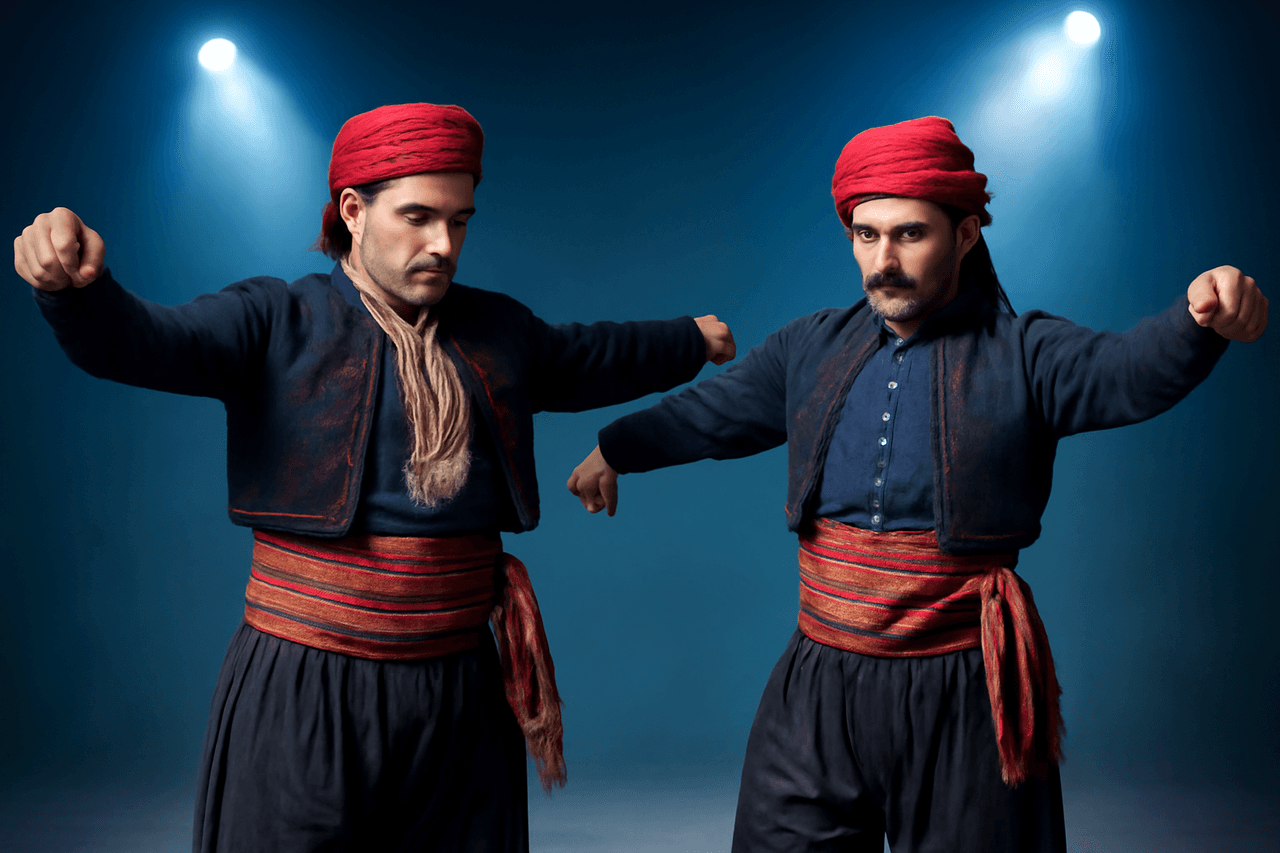
Harmandalı Zeybeği (generated by artificial intelligence)
Region(s) | Aegean Region (centered on İzmir Balıkesir and Denizli) Manisa Muğla surrounding areas of Aydın | ||||||||
|---|---|---|---|---|---|---|---|---|---|
Type(s) | Folk dance (heavy zeybek) | ||||||||
Style and Tempo | Usul: 9/8 (local distributions: 3+2+2+2; 2+2+2+3) | ||||||||
Performance Format | quartet and small ensemble formations also exist duo Solo (single zeybek) is common | ||||||||
Accompanying Instruments | kabak kemane (in stage/city performances) bağlama clarinet Davul-zurna (dominant) | ||||||||
Clothing | Efe attire: embroidered cepken, şalvar/potur, belt/kolan, shirt, knee guards, yemeni/çarık, headgear/poshu | ||||||||
Harmandalı Zeybeği is a folk dance characterized by the heavy zeybek style of the Aegean region, performed either as a solo or in small groups. It is recognized by wide arm movements, an upright posture, and strong contact with the ground; musical accompaniment is predominantly in 9/8 meter. Under the umbrella of “Harmandalı,” interpretations centered in İzmir exhibit distinct local variations in tempo, figure sequence, and posture across settlements in Aydın, Muğla, Manisa, Balıkesir, Denizli, and surrounding areas. Although rooted in wedding and festival contexts, the dance maintains a central position in contemporary repertoires through staging and pedagogical practices.
Harmandalı brings the expressive world of the heavy zeybek style to the stage. Performance begins with a brief salute and “space assessment” section; it progresses through walking, turning, knee bends, and controlled descents. Dancers execute gestures—such as the heavy raising and lowering of arms, emphasis on the waistline, and brief pauses—in alignment with the rhythmic structure. Solo performances allow for greater improvisation; paired and quartet formations are traditional. Posture is defined by a low and stable center of body weight, open shoulder-chest alignment, broad yet controlled arm lines, and economical use of gaze and facial expression.
The meter is predominantly 9/8; in local performances, the accent pattern may vary as 3+2+2+2 or 2+2+2+3. The heavy zeybek tempo is fundamental; in staged arrangements, the introduction may be slower while the middle section is relatively more animated. Accompaniment traditionally features drum and zurna; on urban stages, clarinet, bağlama, and occasionally kabak kemane are commonly used. The melody can be performed as an instrumental dance tune or as a vocal folk song; in vocal versions, themes of valor, leadership (efe), and camaraderie (kızan) are emphasized.
The historical background of Harmandalı is intertwined with the zeybek culture and the efe–kızan hierarchy that became prominent in the Aegean from the late 19th century onward. Local memory distinguishes between “old” and “new” Harmandalı; the interpretation based on the popular melody that emerged in the early 20th century has since become dominant in educational and stage repertoires, distinguishing itself from earlier naming traditions. Throughout the Republican era, collection efforts, institutional repertoires, and community staging practices standardized the dance into teachable patterns, while field recordings and audiovisual documentation of master performers gained increasing importance for preserving local postural nuances. İzmir-centered interpretations gained visibility on urban stages, while performances preserving quartet formations around Bergama demonstrate the persistence of regional diversity.
An eight-part skeletal framework, frequently used in training and performance, clarifies the movement logic without compromising originality:
Multiple melody–dance variants are known under the name “Harmandalı.” While İzmir-centered stage interpretations are widespread, variations in tempo, figure sequence, knee strike placement, and salute form occur along the Aydın, Muğla, Manisa, Balıkesir, and Denizli corridors. Examples preserving quartet formations around Bergama are documented. In training and performance, the “three–five” counting pattern serves as a rhythmic organizer for walking and figure entrances.
The efe costume consists of an embroidered cepken, şalvar or potur, belt or kolan, shirt, knee pads, yemeni or çarık, and a headpiece or poşu. Colors, motifs, and accessories vary by region. On stage, contrasting colors and defined lines enhance the visibility of movement trajectories. In solo performance, the dancer is given ample space; for paired or quartet performances, linear, crescent, or circular formations are preferred.
Harmandalı is a core element of the repertoire in folk dance courses, associations, municipal conservatories, and university ensembles. Standardized figure sequences are taught on competition and festival stages; notation, video, and field recordings serve as educational materials. Current trends aim to strengthen the stage language while preserving original nuances through documentation of local master performances.
T.C. Kültür ve Turizm Bakanlığı. “Harmandalı Zeybeği.” Accessed August 16, 2025. https://ekitap.ktb.gov.tr/TR-79257/harmandali-zeybegi.html.İstanbul Üniversitesi, Osmanlı Dönemi Müziği Uygulama ve Araştırma Merkezi (OMAR). “Details (İzmir Harmandalı Zeybeği).” Entry ID: 1787. Accessed August 16, 2025. https://omarsiv.istanbul.edu.tr/Details?EntryId=1787&SearchQuery=harmandal%C4%B1&TotalCount=140.Erkan, Tarkan. “Müzik Türü Olarak Zeybek (İzmir-Torbalı Örneği).” Akademik Bakış Dergisi 48 (March–April 2015): 285–296. Accessed August 16, 2025. https://dergipark.org.tr/en/download/article-file/382975.

Harmandalı Zeybeği (generated by artificial intelligence)
Region(s) | Aegean Region (centered on İzmir Balıkesir and Denizli) Manisa Muğla surrounding areas of Aydın | ||||||||
|---|---|---|---|---|---|---|---|---|---|
Type(s) | Folk dance (heavy zeybek) | ||||||||
Style and Tempo | Usul: 9/8 (local distributions: 3+2+2+2; 2+2+2+3) | ||||||||
Performance Format | quartet and small ensemble formations also exist duo Solo (single zeybek) is common | ||||||||
Accompanying Instruments | kabak kemane (in stage/city performances) bağlama clarinet Davul-zurna (dominant) | ||||||||
Clothing | Efe attire: embroidered cepken, şalvar/potur, belt/kolan, shirt, knee guards, yemeni/çarık, headgear/poshu | ||||||||
Dance Identity and Performance Context
Musical Structure and Meter
History and Origin Context
Figure Sequence and Postural Elements
Variants and Nomenclature
Costume and Stage Setup
Training, Prevalence, and Contemporary Performance