
This article was automatically translated from the original Turkish version.
+1 More
Location | Batman | ||||||||
|---|---|---|---|---|---|---|---|---|---|
Dating | Ottoman Akkoyunlu Ayyubid Artukid Seljuk Early Byzantine Roman Hellenistic Iron Age Bronze Age Chalcolithic Neolithic | ||||||||
Excavation Start | 1986 | ||||||||
Prominent Structures | Büyük Saray-Küçük Saray Orta Kapı Eyyûbî Kızlar Camii İmam Abdullah Zaviyesi Artuklu Hamamı Er-Rızk Camii Zeynel Bey Türbesi | ||||||||
Hasankeyf derives its name from the Arabic expression “Hısnıkeyfa,” meaning “rock fortress” or “stone castle.” The archaeological site, located along the banks of the Tigris River, has historically occupied a crucial position on both land and water routes between Diyarbakır and Cizre. This strategic location, combined with its position along trade routes and relative lack of warfare, transformed Hasankeyf into a cultural center.
The fortress, constructed during the Roman period to monitor the Iranian frontier, enhanced the city’s strategic importance. Subsequently, various political entities including the Umayyads, Abbasids, Artuqids, Ayyubids, Akkoyunlus, and Ottomans held sovereignty over Hasankeyf. Following the Battle of Manzikert in 1071, the region came under Seljuk control, was captured by the Ayyubids in 1232, and remained under Akkoyunlu rule until the early 15th century. After the Battle of Otlukbeli in 1473, the Safavids briefly held sway, followed by the Ottomans who gained dominance in 1515 during the Eastern Campaign of Yavuz Sultan Selim.

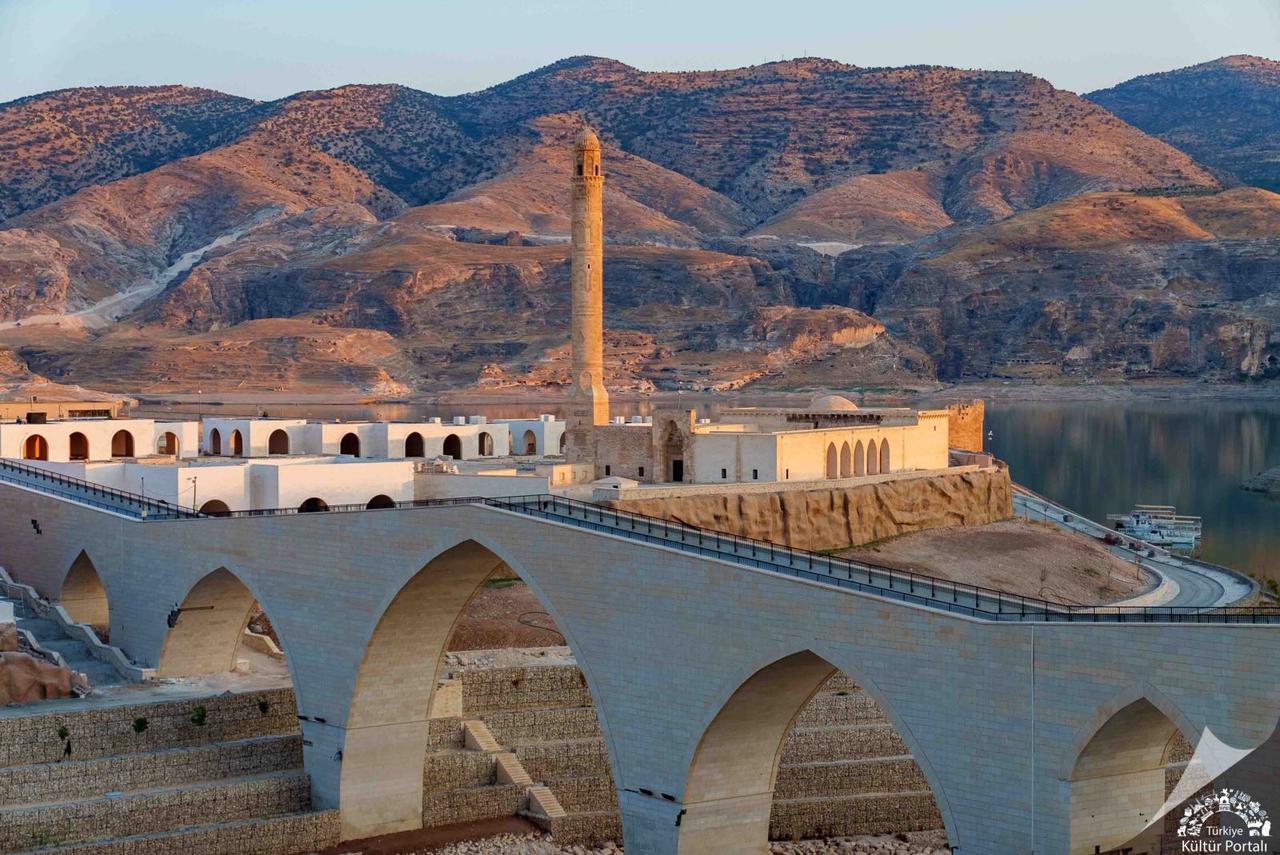
Hasankeyf (Türkiye Culture Portal)
The first scientific archaeological excavations in Hasankeyf were initiated in 1986 under the direction of the Mardin Museum Directorate and with the advisory guidance of Professor Dr. M. Oluş Arık, continuing until 2004. From 2004 to 2017, excavations continued under the leadership of Professor Dr. Abdüsselam Uluçam. Between 2018 and 2021, rescue excavations were conducted under the direction of the Batman Museum and Hasankeyf Museum. Since 2021, excavations and research have been carried out under the leadership of Associate Professor Dr. Zekai Erdal of Mardin Artuklu University.
Excavations have revealed numerous structural remains spanning from the Iron Age to the Hellenistic period, from the Eastern Roman to the Ottoman era. These include the Great Palace, Small Palace, Ulu Mosque, and old cemetery in the Inner Castle–Upper City area; and the Zeynel Bey Külliyesi, Artuklu Bath, Imam Abdullah Zaviyesi, Ayyubid Girls’ Mosque, Er-Rızk Mosque, and Süleyman Han Mosque in the Lower City area.
The area, declared a first-degree archaeological site in 1981, was thoroughly documented from both geotechnical and archaeological perspectives in relation to the Ilısu Dam and HES Project. Between 2017 and 2020, as part of efforts to relocate and preserve monuments, the Zeynel Bey Türbesi, Artuklu Bath, Imam Abdullah Türbesi, Orta Kapı, the minaret of Er-Rızk Mosque, and certain architectural elements of Süleyman Han Camii were moved to Hasankeyf Kültür Parkı.
Based on findings from rescue excavations conducted between 2008 and 2019 at Hasankeyf Höyük, associated with the Hasankeyf Archaeological Site, this site is recognized as one of the earliest known Neolithic settlements in Anatolia. The earliest settlement traces date to the second half of the 10th millennium BCE, corresponding to the Pre-Pottery Neolithic A (PPNA) period. Remains from the Iron Age and Hellenistic period have also been uncovered in the same area. Hasankeyf Höyük is now submerged beneath the waters of the Ilısu Dam Reservoir.
The Hasankeyf Museum is located in the new settlement area of Hasankeyf district, Batman Province, on Müze Caddesi in Kültür Mahallesi. Construction of the museum began in 2012; it received provisional acceptance in 2015 and final approval in 2019. The museum became operational on 29 September 2018 with the opening of the ground floor exhibition hall and was officially granted the status of “Hasankeyf Museum Directorate” by a Ministry Decree dated 10 May 2019.
The museum’s collection includes geophysical materials, plant fossils, archaeological, ethnographic, and architectural artifacts, coins, seals, and tablets. The artifacts are displayed chronologically and thematically across fourteen separate rooms on two floors. The exhibited objects cover a broad historical range from the Paleolithic Period to the Republican Era. The items in the museum’s collection were obtained from excavations at various höyüks and necropolis sites in Batman, Diyarbakır, Siirt, and Mardin.
A significant portion of the museum is dedicated to the scientist Al-Jazari, who lived between 1136 and 1206. The Al-Jazari Science Hall features reconstructions and examples of his inventions related to cybernetics and mechanics.
%2520kopya.jpg&w=1280&q=75)
Hasankeyf Museum (Türkiye Culture Portal)
The remains identified at the Hasankeyf Archaeological Site encompass the Neolithic, Chalcolithic, Bronze Age, Iron Age, Hellenistic, Roman, Early Byzantine, Great Seljuk, Artukid, Ayyubid, Akkoyunlu, Ottoman, and Turkish Republic periods. The artifacts and architectural structures demonstrate Hasankeyf’s continuous interaction with various cultural and political entities throughout history.
Hasankeyf Archaeological Site: Eski Hasankeyf Kale Mahallesi, İç Kale – Hasankeyf/Batman
Hasankeyf Museum: Kültür Mahallesi, Müze Caddesi, No:16 Hasankeyf/Batman
Phone: 0 488 502 49 30
Email:
Ministry of Culture and Tourism. "Batman Hasankeyf Museum Directorate." *General Directorate of Cultural Heritage and Museums*. Accessed July 8, 2025. https://kvmgm.ktb.gov.tr/TR-281299/batman-hasankeyf-muze-mudurlugu.html
Ministry of Culture and Tourism. "Hasankeyf Müzesi." *Culture Portal*. Accessed July 8, 2025. https://www.kulturportali.gov.tr/turkiye/batman/gezilecekyer/hasankeyf-muzesi-
Ministry of Culture and Tourism. "Hasankeyf Örenyeri Site." *Culture Portal*. Accessed July 8, 2025. https://www.kulturportali.gov.tr/turkiye/batman/gezilecekyer/hasankeyf-orenyeri
Turkish Museums. "Batman Hasankeyf Müzesi." Turkish Museums. Accessed July 8, 2025. https://www.turkishmuseums.com/museum/detail/1997-batman-hasankeyf-muzesi/1997/1
Turkish Museums. "Batman Hasankeyf Örenyeri." Turkish Museums. Accessed July 8, 2025. https://www.turkishmuseums.com/museum/detail/1998-batman-hasankeyf-orenyeri/1998/1

Location | Batman | ||||||||
|---|---|---|---|---|---|---|---|---|---|
Dating | Ottoman Akkoyunlu Ayyubid Artukid Seljuk Early Byzantine Roman Hellenistic Iron Age Bronze Age Chalcolithic Neolithic | ||||||||
Excavation Start | 1986 | ||||||||
Prominent Structures | Büyük Saray-Küçük Saray Orta Kapı Eyyûbî Kızlar Camii İmam Abdullah Zaviyesi Artuklu Hamamı Er-Rızk Camii Zeynel Bey Türbesi | ||||||||
No Discussion Added Yet
Start discussion for "Hasankeyf Archaeological Site (Batman)" article
Excavation and Conservation Efforts
Hasankeyf Höyük
Hasankeyf Museum
Chronological Scope
Address and Contact Information