

This article was automatically translated from the original Turkish version.
Discovery Year | 7 March 2003 | ||||||||
|---|---|---|---|---|---|---|---|---|---|
Average Solar Distance | 43 AU (≈6.5 billion km) | ||||||||
Mass | One twentieth of the Moon's mass | ||||||||
Size(s) | 1 000 km 600 km × 2 000 km × 1 | ||||||||
Haumea is a dwarf planet located in the Kuiper Belt, the region beyond Neptune in the Solar System. Discovered on 7 March 2003, this celestial body was initially designated “2003 EL61” and was named Haumea in 2006 by the International Astronomical Union.
It is named after Haumea, the Hawaiian goddess of fertility and childbirth; its two known moons, Hi’iaka and Namaka, bear the names of Haumea’s mythological daughters. Haumea is known as one of the fastest rotating large bodies in the Solar System.
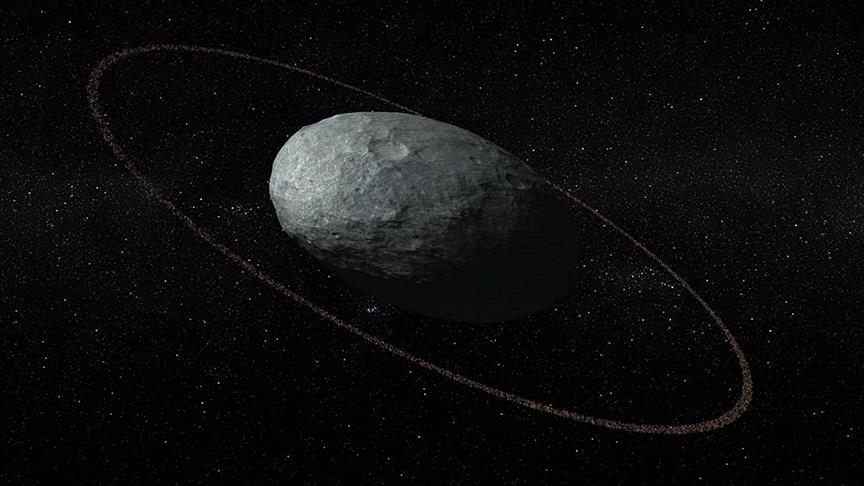
Haumea has an ellipsoidal shape with dimensions of approximately 1,000 km, 1,600 km, and 2,000 km. With an average equatorial diameter of about 1,740 kilometers, Haumea is roughly one-seventh the diameter of Earth. Its average distance from the Sun is 43 astronomical units (approximately 6.5 billion kilometers). Due to this distance, its surface is extremely cold and lacks conditions suitable for life.
Haumea completes one orbit around the Sun in approximately 282 to 285 Earth years. It rotates on its own axis in just 3.9 hours, a rapid rotation that has given it an ellipsoidal, egg-like shape. This fast spin causes differential surface stresses, leading to a pronounced distortion of the dwarf planet’s form.

Haumea (Pixabay)
Haumea’s surface is largely covered by crystalline water ice, with about one-third of its surface area exhibiting different color tones. The dark red region (Dark Red Spot, DRS) is likely composed of minerals and organic compounds. The ice content on the surface is estimated to be between 66% and 80%. Beneath the ice, radioactive materials such as potassium-40, thorium-232, and uranium-238 may be released by surface stresses, potentially forming organic salt compounds like potassium cyanide. Haumea’s shape and rapid rotation are the result of a major collision with another celestial body in the Kuiper Belt approximately 4.5 billion years ago. The fragments ejected from this impact formed Haumea’s moons, Hi’iaka and Namaka.
Haumea has two known moons: Namaka, the inner moon, and Hi’iaka, the outer moon. Both were discovered in 2005 and named after Haumea’s mythological daughters. Hi’iaka is regarded as the protective goddess of the Hawaiian islands and hula dancers, while Namaka is a water spirit in Hawaiian mythology. Haumea is also the first known object in the Kuiper Belt to possess rings. The existence of these rings was announced in 2017 following observations made by telescopes around the world.

Haumea (Anadolu Agency)
The structure of Haumea and its moons has been studied using near-infrared spectroscopy and light curve analysis. These studies have been used to determine the distribution of crystalline water ice on the surface, the characteristics of the DRS, and the orbital positions of the moons. Data obtained from the SINFONI spectrograph at the European Southern Observatory’s Very Large Telescope (VLT) have revealed Haumea’s unique surface features in detail.
Haumea formed as a result of a major collision in the Kuiper Belt approximately 4.5 billion years ago. A glancing impact allowed Haumea to survive intact while ejecting fragments that became its moons. This catastrophic collision played a critical role in shaping Haumea’s rapid rotation and distinctive ellipsoidal form.
Anadolu Ajansı. "Türk bilimcilerin de katkısıyla cüce gezegenin halkası keşfedildi." Accessed August 16, 2025. https://www.aa.com.tr/tr/bilim-teknoloji/turk-bilimcilerin-de-katkisiyla-cuce-gezegenin-halkasi-kesfedildi/941908.
Gourgeot, F., Carry, B., Dumas, C., Vachier, F., Merlin, F., Lacerda, P., Barucci, M. A., and J. Berthier. “Near-infrared spatially resolved spectroscopy of (136108) Haumea’s multiple system.” *Astronomy & Astrophysics*, 593, A19 (2016): 1–10. Accessed August 16, 2025. https://doi.org/10.1051/0004-6361/201526423.
NASA. "Haumea Facts." Science.nasa.gov. Accessed August 16, 2025. https://science.nasa.gov/dwarf-planets/haumea/
Pixabay. "Haumea, Gezegen, Dünya JPG." Accessed August 16, https://pixabay.com/tr/photos/harita-haumea-gezegen-d%C3%BCnya-4818832/
Özyar, Ümit Fuat. “Yumurta Şekilli Cüce Gezegen Haumea.” TÜBİTAK e-Dergi, (2012): 30-31. Accessed August 16, 2025. https://services.tubitak.gov.tr/edergi/yazi.pdf;jsessionid=5JI46Hyi-Rk2AAeqwvT1lGGT?dergiKodu=4&cilt=46&sayi=791&sayfa=30&yaziid=33978.


Discovery Year | 7 March 2003 | ||||||||
|---|---|---|---|---|---|---|---|---|---|
Average Solar Distance | 43 AU (≈6.5 billion km) | ||||||||
Mass | One twentieth of the Moon's mass | ||||||||
Size(s) | 1 000 km 600 km × 2 000 km × 1 | ||||||||
Size and Distance
Orbit and Rotation
Structure and Composition
Moons and Rings
Research and Observations
Formation and Evolution