This article was automatically translated from the original Turkish version.
+1 More
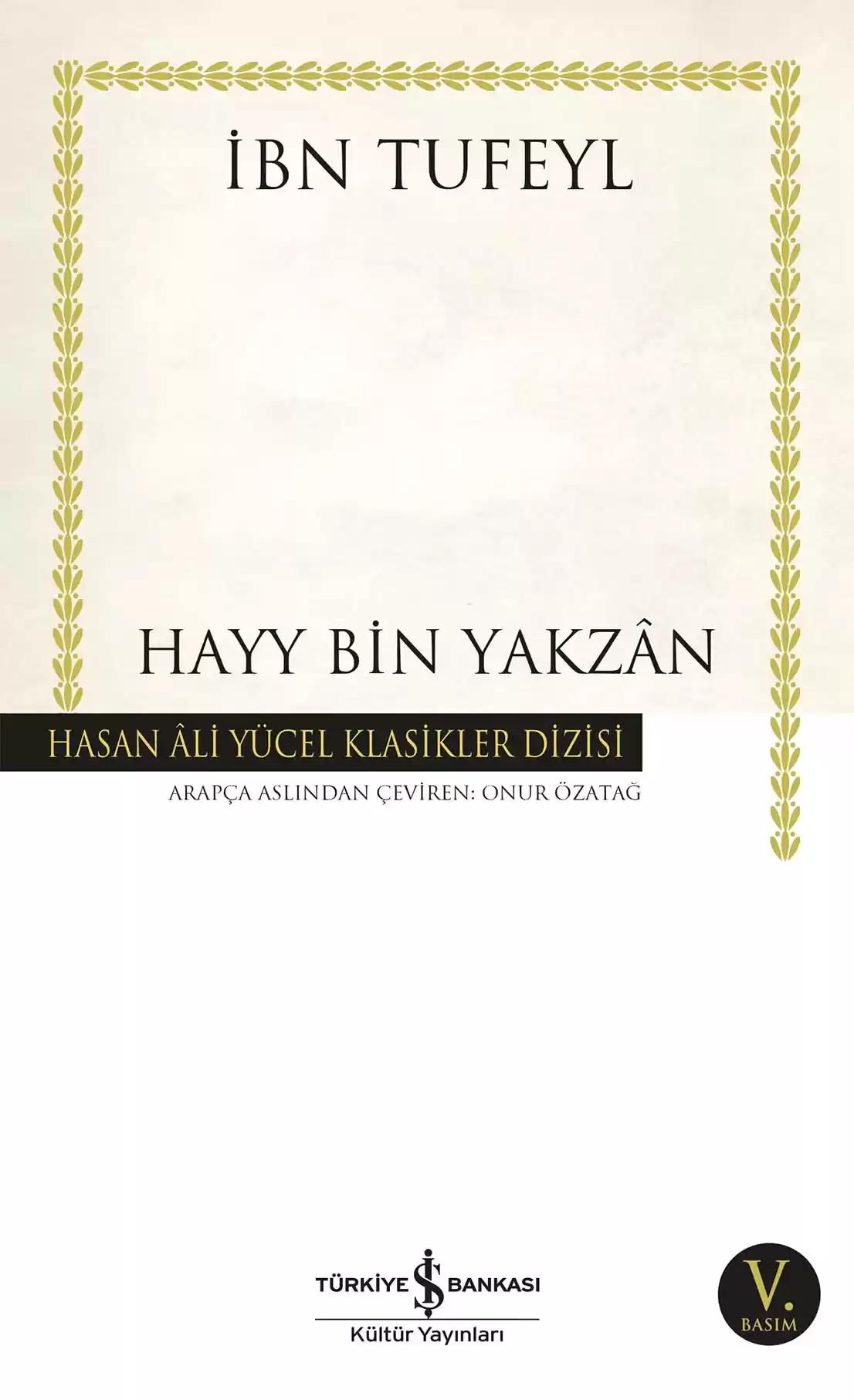
Title of the Work | Hayy ibn Yaqzan (Esrarü'l-Hikmeti'l-Meşrikiye) | ||||||||
|---|---|---|---|---|---|---|---|---|---|
Author(s) | Ibn Tufayl | ||||||||
Translator(s) | Onur Özatağ | ||||||||
Publisher(s) | Türkiye İş Bankası Kültür Yayınları | ||||||||
Number of Pages | 152 | ||||||||
Hayy ibn Yaqzan is a philosophical and allegorical narrative written by the Andalusian philosopher and physician Ibn Tufayl (d. 1186). The work centers on its eponymous hero, who is born and raised alone on a deserted island and arrives at truth solely through observation of nature. In this regard, the text reflects the Islamic philosophical pursuit of knowledge grounded in the natural world.
Hayy ibn Yaqzan begins life on a deserted island as a child who arrives either miraculously or naturally. He is raised by a female gazelle. Through careful observation of his surroundings, Hayy strives to understand the nature of objects; over time, he comes to intellectually grasp himself, nature, and the cosmos. Using reason within natural processes, he first comprehends physical reality and then progresses to the metaphysical plane. In the final stage, he attains active intellect and recognizes the unity of the universe.
Ibn Tufayl’s text also possesses a literary dimension. The descriptions, metaphors, and symbols within the work enable the expression of philosophical and Sufi thought in literary language. The literary style is woven around themes of growth, reason, spiritual purification, and individual contemplation.
The work is founded on the idea that innate reason, through processing sensory experience, can arrive at universal truth. Hayy dissects the structure of existence without any teacher, relying solely on observation and reflection. The process of acquiring knowledge progresses from sensory perception to rational reasoning and ultimately to intuition. In this process, Ibn Tufayl draws upon Aristotelian (Peripatetic) philosophy and the Islamic philosophical concept of active intellect.
The novel also carries a Sufi structure. Hayy’s life of solitude mirrors the Sufi path of self-discipline and attainment of divine truth. The idea that knowledge can be accessed not only through reason but also through intuition and inner illumination holds a central place in the text.
The work explores the theme that a human being can educate himself without external instruction. The individual interacting with nature constructs knowledge through personal experience. In this sense, the text is regarded as an early example of naturalist educational thought. Hayy’s development throughout the narrative is grounded in the belief that humans can attain knowledge through nature.
Hayy ibn Yaqzan has exerted influence not only within the Islamic world but also in Western intellectual history. Translated into Latin in the 17th century, it influenced thinkers such as Spinoza and Locke. It has been noted that the work shares thematic similarities with island narratives such as Robinson Crusoe.
Faruk, Meryem. “İbn Tufeyl’in ‘Hay Bin Yakzan’ Efsanesinde Yer Alan Felsefî, Tasavvufî ve Edebî Yönlerin Değerlendirilmesi.” *DÂD: Arap Dilbilimi ve Edebiyatı Dergisi* 2, no. 3 (2021): 357–386. https://www.academia.edu/49077488/%C4%B0bn_Tufeyl_in_Hay_Bin_Yakzan_Efsanesinde_Yer_Alan_Felsef%C3%AE_Tasavvuf%C3%AE_ve_Edeb%C3%AE_Y%C3%B6nlerin_De%C4%9Ferlendirilmesi_Makale_%C3%87evirisi_
Öztürk, Murat. “İbn Tufeyl’in Doğaya Dönük Eğitim ve Felsefe Anlayışını Aktardığı Hay Bin Yakzan Adlı Felsefi Romanı Üzerine Bir İnceleme.” *Hasan Ali Yücel Eğitim Fakültesi Dergisi* 12, no. 23 (2015): 1–8.
İbn Tufeyl. Hayy Bin Yakzân. Çev. Onur Özatağ. İstanbul: Türkiye İş Bankası Kültür Yayınları, 2021.

Title of the Work | Hayy ibn Yaqzan (Esrarü'l-Hikmeti'l-Meşrikiye) | ||||||||
|---|---|---|---|---|---|---|---|---|---|
Author(s) | Ibn Tufayl | ||||||||
Translator(s) | Onur Özatağ | ||||||||
Publisher(s) | Türkiye İş Bankası Kültür Yayınları | ||||||||
Number of Pages | 152 | ||||||||
No Discussion Added Yet
Start discussion for "Hayy ibn Yaqzan (Book)" article
Subject and Narrative Structure
Philosophical Dimension
Sufi Dimension
Educational Perspective
Effects and Significance