This article was automatically translated from the original Turkish version.
+2 More
Registration Number | 432 | ||||||||
|---|---|---|---|---|---|---|---|---|---|
Registration Date | 27.05.2019 | ||||||||
Application Number | C2016/018 | ||||||||
Application Date | 04.03.2016 | ||||||||
Name of the Geographical Indication | Hekimhan Walnut | ||||||||
Name of the Product | Walnut | ||||||||
Type of Geographical Indication | Place of Origin | ||||||||
Applicant/Registrant(s) | Fırat Development Agency | ||||||||
Address of the Registrant | Turgut Özal Mahallesi Turgut Özal Bulvarı Nu:69/A Yeşilyurt / MALATYA | ||||||||
Geographical Boundary | Hekimhan District Malatya Province | ||||||||
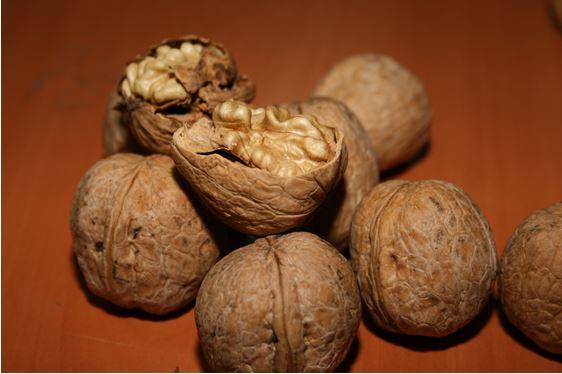
Hekimhan Walnut is a variety of Juglans regia L. cultivated in the Hekimhan district of Malatya Province, Türkiye. It is characterized by its thin shell (1.00–1.50 mm), high kernel yield of 50–60%, light brown shell color, and kernel color ranging from white to pale yellow. The fruits are round and classified as extra-large, with an average weight of 10–15 grams. In dried fruits, protein content ranges from 11–18%, fat content from 60–70%, ash content from 1.5–2%, and moisture content from 2.5–5%. The continental climate of Hekimhan district and its rich, well-drained organic soils provide optimal growing conditions for this walnut variety. The trees exhibit protogynous flowering, and harvest typically extends from mid-September to the end of October.
The Hekimhan walnut belongs to the class Dicotyledoneae, order Juglandes, family Juglandaceae, and genus Juglans. It is a variety of Juglans regia L., also known as the Persian walnut. In the natural flora of Hekimhan district, some walnut trees reach ages of up to 400 years. These trees do not derive from a single genotype but encompass multiple types grown from seed, all sharing similar general characteristics.
The fruits of the Hekimhan walnut are characterized by a thin shell, with thickness ranging from 1.00 to 1.50 millimeters. The shell color is light brown, with moderate surface roughness. The fruits detach easily from the shell. The fruit shape is round and classified as extra-large in size grading.
Fruit weight ranges from an average of 10 to 15 grams, while kernel weight is between 6 and 9 grams. The kernel yield is 50–60%. The kernel color ranges from white to pale yellow.
Analyses of dried Hekimhan walnut fruits have revealed the following average chemical composition values:
These values were obtained from samples dried until the internal moisture content dropped below 8%. The drying process continues until the membrane separating the kernel lobes has dried.
The Hekimhan walnut has a taproot system and exhibits protogynous flowering (female flowers open first). Flowering occurs between 20 March and 20 April. Fruit maturation and harvest take place during October. Tree growth is of medium vigor, and leaf fall occurs between November and December.
The Hekimhan district offers favorable climatic and soil conditions for walnut cultivation. These environmental factors have led to the development of a natural walnut population in the region. These same conditions confer distinct characteristics upon the Hekimhan walnut that differentiate it from other walnut varieties, including its thin shell (up to 1.5 mm), high kernel yield of 50–60%, light-colored kernel, and fat content ranging from 60–70%.
A continental climate prevails in the region. However, the absence of extreme temperatures during late August and September, when the kernel is maturing, plays a crucial role in determining quality. The trees can withstand winter temperatures as low as -20 °C to -25 °C. Nevertheless, extreme heat during critical growth and harvest periods can negatively affect the trees. High temperatures during these phases may cause kernel discoloration. Particularly, excessive heat during flowering induces plant stress and causes morphological abnormalities in female flowers. Both excessively low and high temperatures pose risks to Hekimhan walnut cultivation. The required winter chilling period is estimated at 1200 to 1500 hours.
In terms of soil preference, the Hekimhan walnut shares similar requirements with other walnut varieties in Anatolia. It thrives in deep, well-drained, loamy, silt-loam, or sandy-loam soils rich in organic matter. The optimal soil pH range is between 5.5 and 7.5.
In Hekimhan district, production is carried out not only from the natural walnut population but also through grafting of scions from locally superior trees onto walnut rootstocks. Walnut orchards in the district center and villages are established on land between 1100 and 1800 meters in elevation, where irrigation water is available. A minimum spacing of 8×10 meters or 10×10 meters is recommended during planting, along with the use of pollinator varieties.
Planting of saplings can be conducted from the onset of leaf fall in autumn until the beginning of sap flow in spring. However, spring planting is most commonly preferred. Tree training follows the central leader system. In this method, trees are trained to develop a straight, tall trunk with a framework of 4–5 main branches arranged spirally at intervals of 25 to 50 centimeters.
Harvesting must be carried out promptly once the internal membrane begins to turn brown and should not be delayed. Harvest timing varies slightly between villages but generally begins around 15 September and extends to the end of October. Practically, the optimal harvest time is indicated when the green outer husk begins to split and approximately 80% of the fruits can be detached from the tree by shaking. Immediately after harvest, fruits are manually or mechanically dehulled and spread out for drying in open areas. Drying is considered complete when the moisture content of the shelled nuts reaches 8%.
The harvest of Hekimhan walnuts is conducted when the internal membrane begins to turn brown. Harvest timing varies between villages but generally begins around 15 September and continues until the end of October. The splitting of the green husk and the ability to dislodge approximately 80% of the fruits by shaking are practical indicators of optimal harvest time.
Harvested walnuts are promptly dehulled and dried in open-air drying areas. The drying process continues until the moisture content of the shelled nuts reaches 8%.
A monitoring authority has been established to verify compliance with the production area, cultivation methods, and product characteristics specified in the official registration document for Hekimhan Walnut. This authority consists of at least one expert from the Apricot Research Station Directorate, the Malatya Directorate of Agriculture and Forestry, and the Hekimhan District Directorate of Agriculture and Forestry.
Monitoring is conducted annually as a routine procedure. Additional inspections may be carried out whenever necessary or in response to complaints. The monitoring authority may receive support or procure services from experts employed by public or private institutions. Furthermore, the monitoring authority has the legal authority to initiate judicial proceedings to protect rights related to the product.
Turkish Patent and Trademark Office. "Hekimhan Cevizi Coğrafi İşaret Tescil Belgesi." Accessed July 13, 2025. https://ci.turkpatent.gov.tr/Files/GeographicalSigns/7be857a4-ce14-4daf-862c-8072748bfce7.pdf.
Turkish Patent and Trademark Office. "Hekimhan Cevizi." Geographical Indications. Accessed July 13, 2025. https://ci.turkpatent.gov.tr/cografi-isaretler/detay/38187.

Registration Number | 432 | ||||||||
|---|---|---|---|---|---|---|---|---|---|
Registration Date | 27.05.2019 | ||||||||
Application Number | C2016/018 | ||||||||
Application Date | 04.03.2016 | ||||||||
Name of the Geographical Indication | Hekimhan Walnut | ||||||||
Name of the Product | Walnut | ||||||||
Type of Geographical Indication | Place of Origin | ||||||||
Applicant/Registrant(s) | Fırat Development Agency | ||||||||
Address of the Registrant | Turgut Özal Mahallesi Turgut Özal Bulvarı Nu:69/A Yeşilyurt / MALATYA | ||||||||
Geographical Boundary | Hekimhan District Malatya Province | ||||||||
Systematic Classification
Physical Characteristics
Chemical Properties
Botanical Characteristics
Cultivation Methods
Harvest and Drying
Monitoring Mechanism