


This article was automatically translated from the original Turkish version.
+1 More
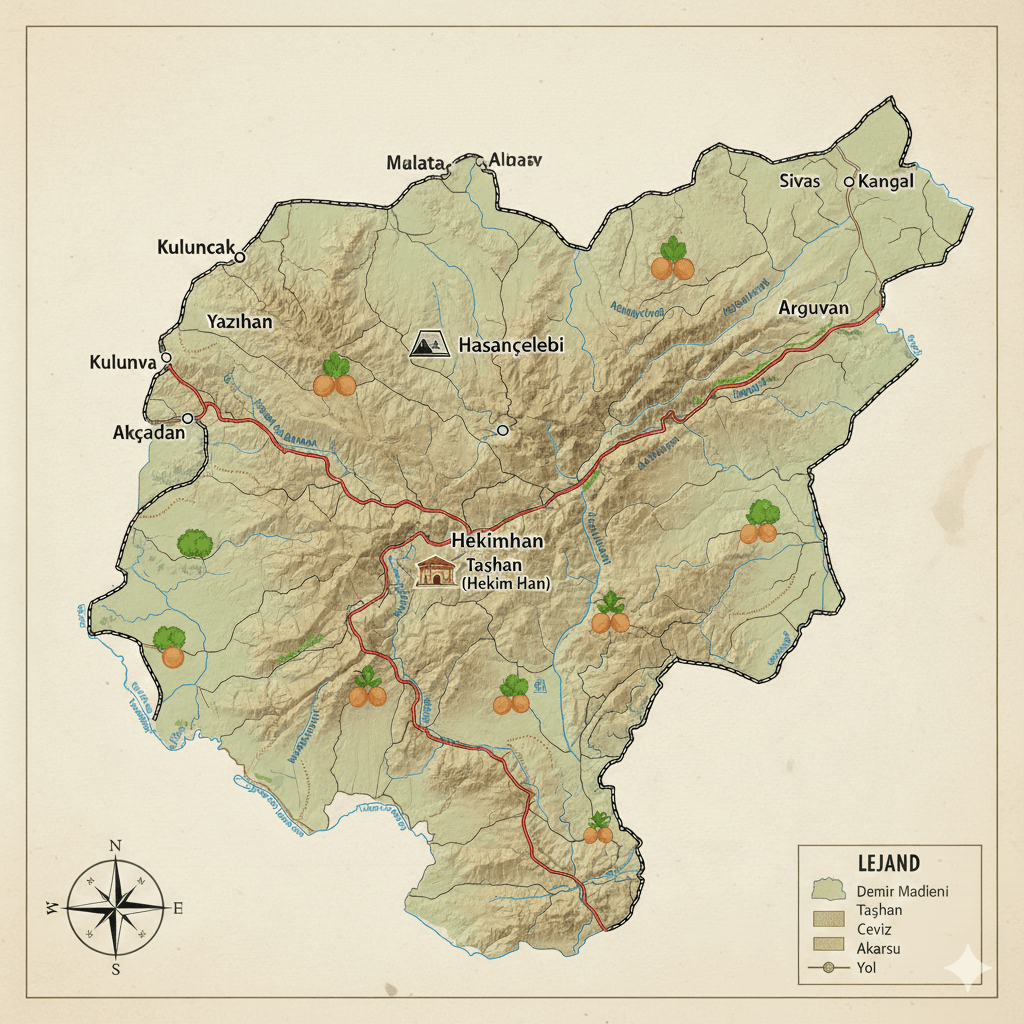
Hekimhan (generated with artificial intelligence)
Mayor(s) | Mehmet Şerif Yıldırım | ||||||||
|---|---|---|---|---|---|---|---|---|---|
Province(s) | Malatya | ||||||||
Population | 18.015 (2024) | ||||||||
District Governor | Muhammed Fatih Günlü | ||||||||
Geographic Region | Eastern Anatolia | ||||||||
Hekimhan is a district located in the northeastern part of Malatya Province in Türkiye’s Eastern Anatolia Region. Situated 85 kilometers from the city center of Malatya, Hekimhan covers an area of 1,844 km², making it the largest district in Malatya by surface area. Its boundaries are bordered by Arguvan to the east, Yazıhan and the central district of Malatya to the southeast, Akçadağ to the south, Kuluncak and Darende to the west, and the Kangal district of Sivas to the north.
The district center lies at an elevation of 1,040 meters above sea level and is situated at a lower altitude compared to the surrounding mountainous areas, though the overall terrain remains rugged and mountainous. The highest point in the district is Yamadağı, which reaches an elevation of 2,680 meters.
The region experiences a continental climate with hot, dry summers and cold, snowy winters. The primary rivers are Kuruçay and Yağca Çayı. Vegetation cover is sparse, consisting mainly of degraded oak forests, juniper, and hawthorn. Due to limited forest cover, erosion and flooding are common on steep slopes. According to 2024 data, the total population of the district is 18,015.
The prevailing legend regarding the district’s name involves a physician named Emrullah, who was exiled from Egypt to Malatya. During his return journey to Istanbul, he stayed at a caravanserai in the area known as Taşhan. He repaired its damaged sections and inscribed his name on it. This structure, known as “Han-ı Hekim,” eventually gave its name to the settlement.
The settlement’s rise in importance began during the Ottoman Empire between 1656 and 1661, when Köprülü Mehmet Pasha established the area for military purposes. During this period, the Seljuk-era caravanserai was restored, and the Köprülü Mehmet Pasha Camii was constructed beside it. Administratively, the settlement initially belonged to Keban as a village, then became a subdistrict under Akçadağ. On 1 July 1921, it gained independent district status through the merger of the Hasançelebi and Gelengeç subdistricts.
Hekimhan’s economy is based on mining, agriculture, and animal husbandry. The district is one of Türkiye’s key centers for iron and chromium reserves. The opening of iron mines by Bilfer Mining in 1953 and their transfer to the General Directorate of Iron and Steel Enterprises in 1978 significantly increased employment opportunities in the region. Hekimhan Station ranks as the 11th largest railway station in Türkiye for ore transportation.
Agricultural activities are carried out in the valleys between mountains and on limited arable land. Cereals are cultivated on the high plateaus around Kurşunlu, while the district’s most prominent agricultural product is the walnut. In recent years, apricot production has emerged as an economically significant activity, impacting local living standards. Industrial activity in the district is represented by brick factories, apricot processing facilities, and small-scale workshops.
The district has a high level of education and literacy. The educational infrastructure includes preschools, primary schools, middle schools, and various types of high schools. Additionally, mobile education services, boarding middle schools, and residential high schools provide accommodation support. Health services are delivered through a 30-bed state hospital in the district center, an emergency station, and neighborhood health centers.
The historical fabric of the district includes the Taşhan, built in 1218 during the Seljuk period by Ebül Hasan El-Malatı. Another significant structure is the Köprülü Mehmet Pasha Camii, reflecting Ottoman architecture. Archaeological sites include the Boğazgören Hittite Inscription, Çimenlik Castle, and the Yayladamı Tumuli. Natural tourism attractions include Girmana Canyon, Yamadağı Ski Center, Hasançelebi Ilıca Recreation Area, Şıpşıpı, and Dipsiz Göl. Transportation is facilitated by the Malatya-Sivas highway and railway line.
Hekimhan Kaymakamlığı. "Hekimhan Kaymakamlığı." Accessed February 8, 2026. https://www.hekimhan.gov.tr/.
Malatya Valiliği. "Hekimhan." Accessed February 8, 2026. https://www.malatya.gov.tr/hekimhan.
T.C. Ministry of Culture and Tourism -Malatya İl Directorate of Culture and Tourism. "Hekimhan." Accessed February 8, 2026. https://malatya.ktb.gov.tr/TR-58276/hekimhan.html.

Hekimhan (generated with artificial intelligence)
Mayor(s) | Mehmet Şerif Yıldırım | ||||||||
|---|---|---|---|---|---|---|---|---|---|
Province(s) | Malatya | ||||||||
Population | 18.015 (2024) | ||||||||
District Governor | Muhammed Fatih Günlü | ||||||||
Geographic Region | Eastern Anatolia | ||||||||
No Discussion Added Yet
Start discussion for "Hekimhan (District)" article
Etymology and Historical Development
Economic Structure, Mining and Agricultural Activities
Social Infrastructure, Education and Health Services
Cultural Heritage and Tourism Potential
