

This article was automatically translated from the original Turkish version.
+1 More
Length(s) | 600 metres | ||||||||
|---|---|---|---|---|---|---|---|---|---|
Year of Discovery(ies) | 1802 | ||||||||
Width | 250 metres | ||||||||
Country | Australia | ||||||||
Biological Structure | Extremophilic microorganisms | ||||||||
Access | Only from the air | ||||||||
Salinity Rate | Very High | ||||||||
Explorer | Matthew Flinders | ||||||||
Water Color | Pink | ||||||||
Location | Middle Island | ||||||||
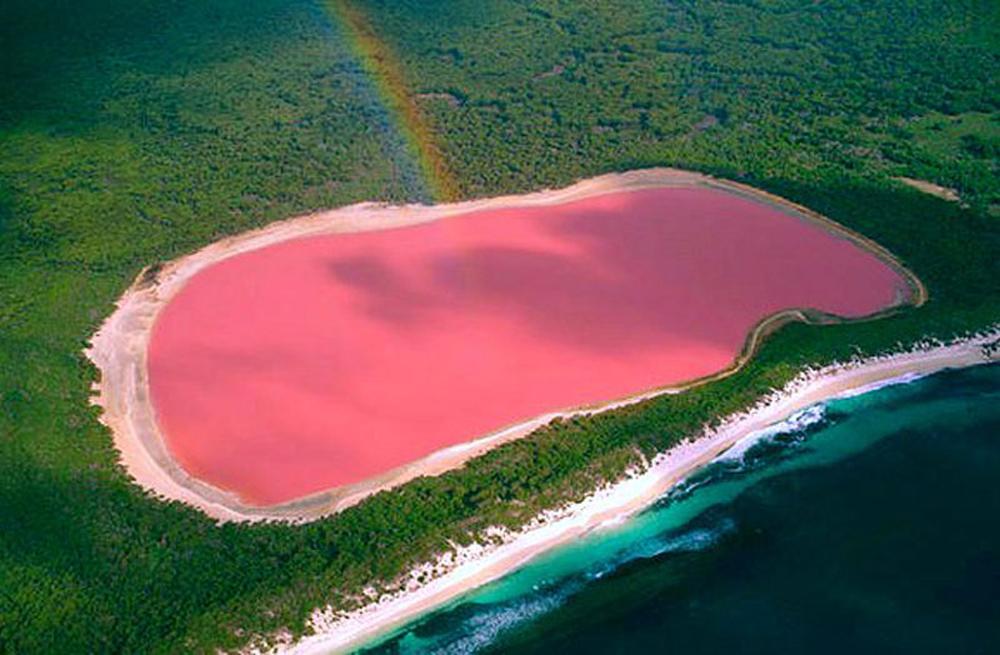
Lake Hillier is a saline lake located on Middle Island, the largest island of the Recherche Archipelago off the coast of Western Australia, renowned for its distinctive pink color. This unusual hue remains constant throughout the year and is retained even when the lake water is bottled. Unlike many other pink lakes around the world, it maintains its color regardless of temperature fluctuations. This body of water, covering approximately 0.15 square kilometers, is separated from the ocean by a narrow strip of beach and lies at the center of an untouched natural environment.

Lake Hillier (Flickr)
Lake Hillier is situated at the western tip of Middle Island within the Recherche Archipelago. The lake measures 600 meters in length and up to 250 meters in width at its broadest point. It is surrounded by a dense green vegetation of eucalyptus and paperbark trees. To the north it directly borders the Southern Ocean, creating a striking visual contrast between the deep blue ocean waters and the lake’s pink surface when viewed from above. The shoreline of this shallow lake is lined with salt crust deposits. These deposits and environmental factors result in a salinity level significantly higher than that of the adjacent ocean waters.
The lake’s existence was first documented in the early 19th century by British navigator and cartographer Matthew Flinders. In January 1802, Flinders climbed to the highest peak of the island, now known as Flinders Peak, and observed the lake. In his journal entries, he noted its small size, rose-pink color, and high salt content. A year later, in 1803, Flinders named the lake “Hillier” in memory of William Hillier, a crew member of HMS Investigator who died of dysentery on Middle Island.
In the early 20th century, the lake was used for salt extraction for approximately six years. Today, all mining activities have ceased, and the lake is preserved solely for scientific research and tourism purposes.
For many years, the precise cause of Lake Hillier’s pink color remained a mystery in the scientific community, with various theories proposed. While some other pink lakes around the world lose their color and turn blue or gray due to climate change, overuse of resources, or reduced rainfall altering salinity levels, Lake Hillier has retained its pink hue permanently due to its stable structure. The combination of high salinity and exposure to sunlight influences the metabolic activity of microorganisms within the lake.
Detailed metagenomic sequencing and microbiome analyses have confirmed that the primary factor underlying the lake’s pink color is a community of extremophilic microorganisms. The lake hosts an exceptionally diverse ecosystem composed of archaea, bacteria, algae, and viruses. The lake’s microbiome is dominated by the halotolerant microalga Dunaliella salina and the halophilic bacterium Salinibacter ruber. These organisms synthesize beta-carotene pigment, the same compound that gives carrots and flamingos their color, to survive in extreme saline conditions.
Metagenomic analyses have also identified numerous other pigment-producing polyextremophilic microbes in the lake, including Halobacillus, Psychroflexus, and Halorubrum. Scientific studies have successfully reconstructed the complete or partial genomes of 21 distinct microorganisms, comprising 14 bacteria and 7 archaea. Only two of these have been classified as previously known species; the rest show potential as new species. A large proportion of the metabolic pathways in the lake’s microbiome are directly linked to pigment production, and the lake’s vibrant pink color is the collective result of chemicals generated by this microbial consortium.
The water of Lake Hillier is not toxic to human health, and the algae such as Dunaliella salina and bacteria present pose no harm to the skin. Although swimming in the shallow, hypersaline water is theoretically safe, physical visits to the island or entry into the lake are prohibited due to its designation as a protected area reserved exclusively for research. Visitors can view the lake only from the air via specialized helicopter tours. From above, the lake resembles a massive pink gumdrop set against its surrounding vegetation and sandy shoreline.
Atlas Obscura. "Lake Hillier in Western Australia." Accessed February 26, 2026. https://www.atlasobscura.com/places/lake-hillier
Henderson, Artis. "Australia's famous pink lakes are disappearing." National Geographic. Accessed February 26, 2026. https://www.nationalgeographic.com/environment/article/western-australia-pink-lakes-travel
Hillierlake.com. "Lake Hillier – The Pink Lake Hillier of Australia." Accessed February 26, 2026. https://hillierlake.com/
Sierra, Maria A., Krista A. Ryon, Braden T. Tierney, Jonathan Foox, Chandrima Bhattacharya, Evan Afshin, Daniel Butler, Stefan J. Green, W. Kelley Thomas, Jordan Ramsdell, Nathan J. Bivens, Ken McGrath, Christopher E. Mason, and Scott W. Tighe. "Microbiome and metagenomic analysis of Lake Hillier Australia reveals pigment-rich polyextremophiles and wide-ranging metabolic adaptations." *Environmental Microbiome* 17, no. 1 (2022): 60. Accessed February 26, 2026. https://doi.org/10.1186/s40793-022-00455-9
WorldAtlas. "Lake Hillier." Accessed February 26, 2026. https://www.worldatlas.com/lakes/lake-hillier.html

Length(s) | 600 metres | ||||||||
|---|---|---|---|---|---|---|---|---|---|
Year of Discovery(ies) | 1802 | ||||||||
Width | 250 metres | ||||||||
Country | Australia | ||||||||
Biological Structure | Extremophilic microorganisms | ||||||||
Access | Only from the air | ||||||||
Salinity Rate | Very High | ||||||||
Explorer | Matthew Flinders | ||||||||
Water Color | Pink | ||||||||
Location | Middle Island | ||||||||
Geographical Location and Physical Characteristics
Discovery and History
Water Color and Scientific Explanations
Microbiological Composition
Tourism and Access to the Area