

This article was automatically translated from the original Turkish version.
+2 More
Location | Beybağı Neighborhood Erzincan | ||||||||
|---|---|---|---|---|---|---|---|---|---|
Important Restorations | Alaeddin Keykubad (13th century), Uzun Hasan (1455), Ottoman Period | ||||||||
Construction Material | Regularly cut stone, brick (in vaults) and spolia stones | ||||||||
Architectural Type | Rectangular prism rubble masonry mass, Nizamiye Gate | ||||||||
Architectural Periods | Selçuklu, Mengücekli, İlhanlı, Akkoyunlu, Ottoman | ||||||||
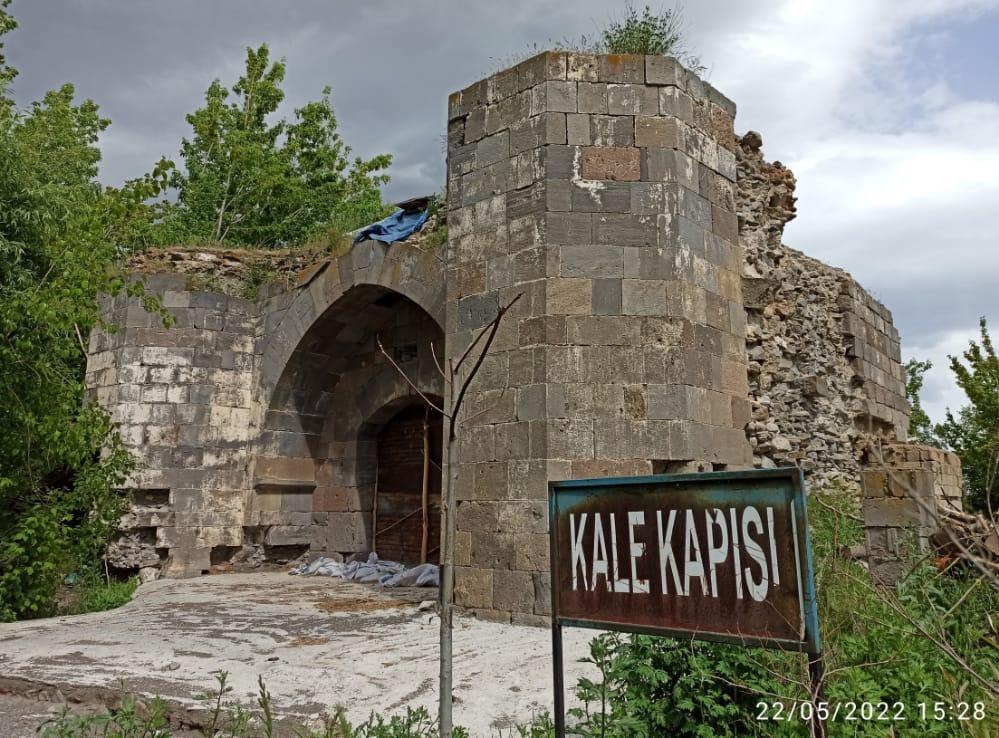
Historical Erzincan Gate is the only surviving architectural structure from the Historical Erzincan Castle that has reached the present day in its entirety, located in the Beybağı Neighborhood of Erzincan city center.

Historical Erzincan Gate (generated by artificial intelligence)
Although the exact date of the gate’s initial construction is unknown, it is believed to date back to the 10th century or earlier. The structure was used by various civilizations that ruled the region, including the Mengujekids, Anatolian Seljuks, Ilkhanids, Eretnids, Akkoyunlus, and Ottomans.【1】
Some documented restoration works throughout its history include the following:
Seljuk Period: It was reinforced by Sultan Alaeddin Keykubad in response to the threat of Mongol invasion.
Akkoyunlu Period: It was restored in 1455 by Uzun Hasan.
Ottoman Period: It underwent various repairs during the reigns of Kanuni Sultan Süleyman and subsequent rulers.
The structure is a rectangular prismatic masonry mass built with regularly cut facing stones. Its architectural details are as follows:
North Facade: This facade features pentagonal towers at each corner and is designed with a pointed arch. The entrance is through a flattened archway located at the center of this facade.
Interior Space: The square-plan interior is covered by a brick-built pointed barrel vault oriented north-south. At the center of the vault is a square-section ventilation opening.
Material: Reused stones, known as "devşirme taşlar," were incorporated into the construction in various places; for example, one stone on the eastern facade bears a nine-pointed star motif.
The castle and its gate are mentioned in the works of 15th-century Spanish envoy Clavijo, 16th-century miniaturist Matrakçı Nasuh, and 17th-century traveler Evliya Çelebi.【2】 Evliya Çelebi noted that entry to the city was through an iron gate, with a moat and bridge located in front of it.

Historical Erzincan Castle as depicted by miniaturist Matrakçı Nasuh (generated by artificial intelligence)
In the 1939 Erzincan earthquake, the structure suffered major damage and is currently isolated from its historical surroundings. Data from 2018 indicate that despite being a registered protected cultural asset, the building was used for a time as a warehouse, stable, and hay storage, with visible stone removal and detachment. Approximately 30 meters to the west of the gate, the remains of the Taş Burç, believed to have once served as the donjon (inner keep tower), still exist.
Historical Erzincan Gate (YouTube)
"Erzincan'da depremlerden sağ çıkan kale kapısı..." *Erzincan Net.* February 16, 2025. Accessed February 15, 2026. https://www.erzincannet.com/erzincanda-depremlerden-sag-cikan-kale-kapisi
"KALE KAPISI – ERZİNCAN MERKEZ." *Tarihi Mekanlar Kişisel Ansiklopedi.* Accessed February 15, 2026.
"Tarihi kale kapısı ahır ve samanlık yapıldı." *KamudanNetHaber.* December 8, 2018. Accessed February 15, 2026. https://www.kamudannethaber.com/tarihi-kale-kapisi-ahir-ve-samanlik-yapildi/3743/
Bulut, Hüseyin. "1643 Tarihli Avarız Defterine Göre Erzincan Şehri’nin Mahalleleri." History Studies International Journal of History (Prof. Dr. Enver Konukçu Armağanı). Erzincan Üniversitesi, 2012. pp. 21-24. Accessed February 15, 2026. https://www.historystudies.net/dergi/tar201512b0b5b.pdf
Erzincan Turizm. "Erzincan Kültür Eğitim Vakfı (EKEV)." Accessed February 15, 2026. http://www.ekev24.org.tr/turizm.aspx
Gürelli, Mustafa. "KALE KAPISI – ERZİNCAN." *Tarih Gezisi*. July 21, 2020. Accessed February 15, 2026. https://tarihgezisi.com/kaleler/kale-kapisi-erzincan/
T.C. Ministry of Culture and Tourism. "ERZİNCAN KALE KAPISI." *Kültür Portalı.* Accessed February 15, 2026. https://www.kulturportali.gov.tr/turkiye/erzincan/kulturenvanteri/erzincan-kale-kapisi
Taşlara Kayalara Fısıldayan Doktor. "Erzincan Kalesi - Dr. Murat." YouTube. Accessed February 15, 2026. https://www.youtube.com/watch?v=A2KbOXQRFJU
Çerçi, Faris. "EVLİYA ÇELEBİ’NİN ERZİNCAN YOLCULUĞU." *Erzincan Üniversitesi Sosyal Bilimler Enstitüsü Dergisi* 5, no. 2 (2012): 417-454. Accessed February 15, 2026. https://dergipark.org.tr/tr/pub/erzisosbil/article/80857
[1]
Ministry of Culture and Tourism of the Republic of Türkiye. "ERZİNCAN GATE." Culture Portal. Access date: 15 February 2026. https://www.kulturportali.gov.tr/turkiye/erzincan/kulturenvanteri/erzincan-kale-kapisi
[2]
"Historical gate was converted into a stable and hay storage." KamudanNetHaber. 8 December 2018. Access date: 15 February 2026. https://www.kamudannethaber.com/tarihi-kale-kapisi-ahir-ve-samanlik-yapildi/3743/
Location | Beybağı Neighborhood Erzincan | ||||||||
|---|---|---|---|---|---|---|---|---|---|
Important Restorations | Alaeddin Keykubad (13th century), Uzun Hasan (1455), Ottoman Period | ||||||||
Construction Material | Regularly cut stone, brick (in vaults) and spolia stones | ||||||||
Architectural Type | Rectangular prism rubble masonry mass, Nizamiye Gate | ||||||||
Architectural Periods | Selçuklu, Mengücekli, İlhanlı, Akkoyunlu, Ottoman | ||||||||
No Discussion Added Yet
Start discussion for "Historical Erzincan Gate" article
History and Restorations
Architectural Features
Historical Witnesses and Current Condition