

This article was automatically translated from the original Turkish version.
Original Name(s) | Chungking Express | ||||||||
|---|---|---|---|---|---|---|---|---|---|
Director(s) | Wong Kar-wai | ||||||||
Screenplay(s) | Wong Kar-wai | ||||||||
Cast(s) | Faye Wong Tony Leung Chiu-wai Brigitte Lin Takeshi Kaneshiro | ||||||||
Country | Hong Kong | ||||||||
Genre | Crime Comedy Drama Romantic | ||||||||
Production Year | 1994 | ||||||||
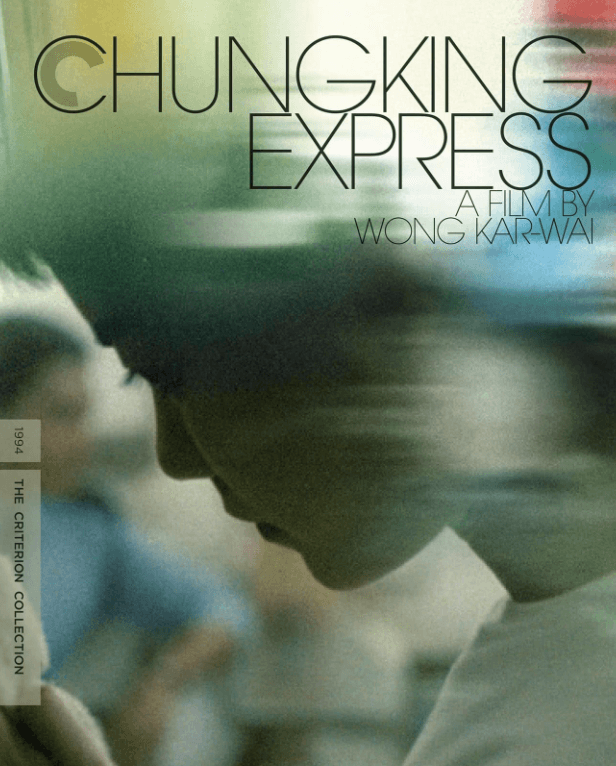
Hong Kong Express (Chungking Express) is a romantic drama film written and directed by Wong Kar-wai in 1994. The production, with cinematography by Christopher Doyle, explores two separate yet thematically linked love stories set against the crowded and contrasting urban atmosphere of Hong Kong.
In the film, one story follows Officer 223, a police officer who encounters by chance a mysterious woman with a blonde wig, while the other centers on Officer 663, who is shaken after his hostess girlfriend leaves him. Both narratives are shaped around themes of loneliness, time and repetition; everyday objects form the emotional rhythm of the storytelling.

Takeshi Kaneshiro, Still from the Film (IMDb)
The film tells two seemingly independent but thematically connected stories of two police officers suffering from heartbreak. These two narratives are not directly linked; the film appears like a fusion of two short films. In the first story, Officer 223 He Qiwu (Takeshi Kaneshiro) has broken up with his girlfriend of five years. To fill the emotional void, he buys a can of pineapple every day, its expiration date always set for May 1. This ritual becomes an obsession with both his lost lover and the passage of time. Qiwu’s path crosses briefly with a drug smuggler woman wearing a blonde wig (Brigitte Lin); this fleeting encounter becomes a random convergence of two solitary lives.
In the second story, Officer 663 (Tony Leung Chiu-wai) is deeply affected after his hostess girlfriend (Valerie Chow) abandons him. A young woman named Faye (Faye Wong), who works at the snack bar he visits daily, secretly falls in love with him. Faye secretly enters his apartment and rearranges his belongings, intruding into his life; this act alters the rhythm of both objects and emotions. The film ends ambiguously with Faye returning to Hong Kong a year later as a hostess.
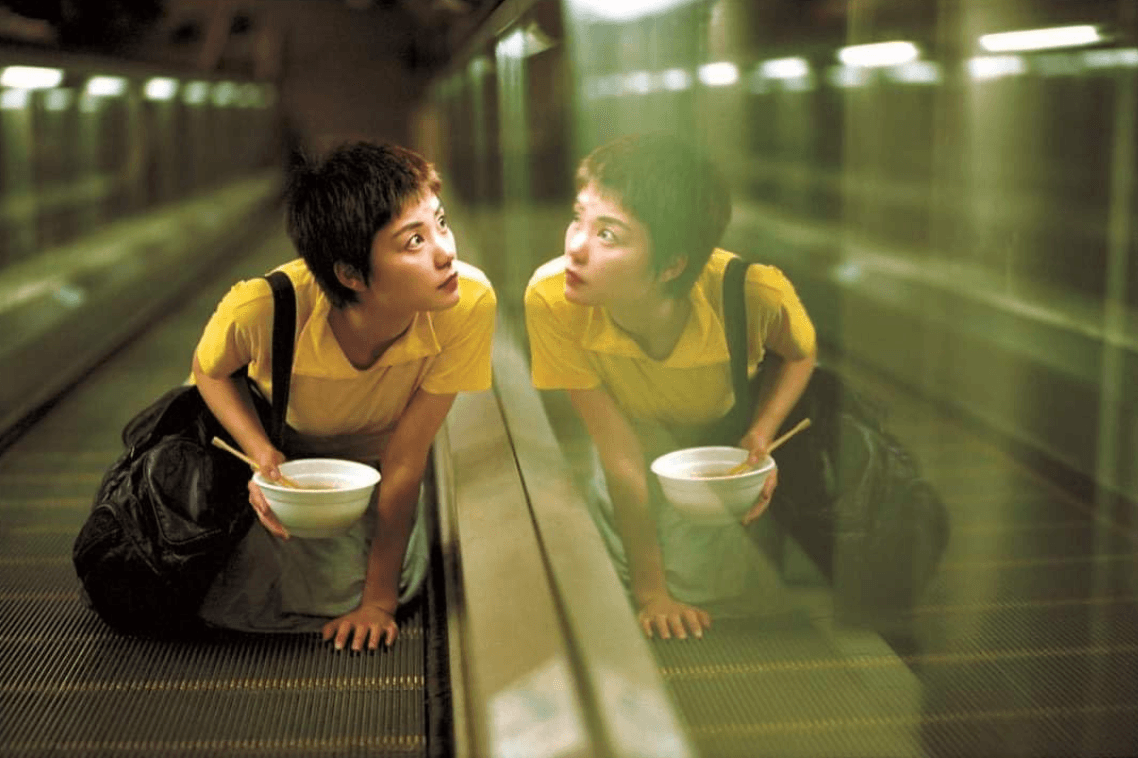
Faye Wong, Still from the Film (IMDb)

Takeshi Kaneshiro and Brigitte Lin, Still from the Film (IMDb)
Both stories focus on the emptiness and solitude following the end of relationships. The characters attempt to fill the absence of their lovers with objects: cans of pineapple, hostess uniforms, airplane tickets — all remnants of love.
Hong Kong Express (Chungking Express) treats love as a matter of timing. The characters find and lose each other at the wrong moments. The film presents time not as linear but cyclical. Elements such as Officer 223’s daily purchase of canned pineapple, Faye’s repeated listening to a song, and Officer 663’s recurring dialogues with his belongings create a rhythmic sense of time.
The film’s two independent yet parallel narratives reflect Hong Kong’s post-colonial identity. Governed by the principle of “one country, two systems,” Hong Kong is divided like the two officers’ worlds. Faye’s dream of California and Officer 223’s obsession with the past allude to Hong Kong’s identity oscillating between East and West.
Hong Kong functions in the film as both setting and character. The rushing crowds, neon lights and narrow spaces frame the characters’ emotional isolation. The city’s pace stands in contrast to the characters’ internal rhythms.
Hong Kong’s neon-lit streets, narrow alleys and “non-places” — snack bars, corridors, passageways — reflect the emotional states of the characters. Doyle’s camera is constantly in motion, portraying the city as a labyrinth and its inhabitants as lost wanderers within it. The symbolic use of color is striking: red represents love, green symbolizes loneliness, yellow conveys the weight of the past, and blue signifies tranquility.
The briefest encounters in the film — such as Faye and the woman with the blonde wig passing each other without noticing in a shop window — exemplify Wong Kar-wai’s theme of “chance intersections.” These moments point to the anonymous meetings and missed possibilities inherent in urban life.
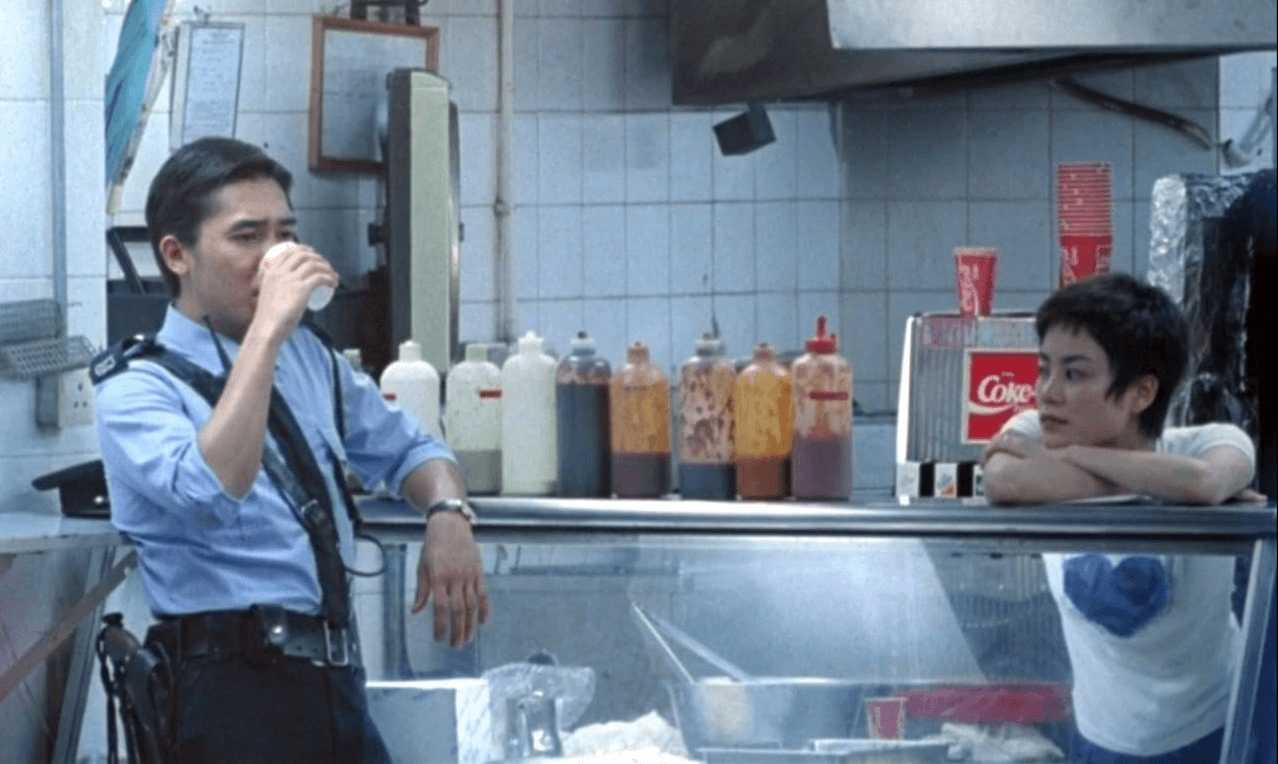
Tony Leung Chiu-wai and Faye Wong, Still from the Film (
Christopher Doyle’s cinematography visualizes Wong Kar-wai’s impressionistic storytelling. Handheld camera work, blurred transitions, color filters and varying speeds reflect the characters’ inner worlds. The color palette of yellow, blue and red defines the emotional atmosphere. Rapid cuts and slowed sequences serve the film’s thematic rhythm.
The film’s music determines the emotional rhythm of the narrative. The Mamas & The Papas’s song “California Dreamin’” symbolizes the yearning for freedom. Together with Faye Wong’s rendition of “Dreams”, these two songs define the film’s emotional cycle.
Hong Kong Express (Chungking Express) is the film in which Wong Kar-wai’s formal and thematic codes matured. It also played a pivotal role in establishing 1990s Hong Kong cinema on the global stage. Wong Kar-wai explores themes such as the transience of love, urban loneliness, the fragility of time and identity crisis through innovative narrative and sound techniques. The storytelling language he would further develop in his subsequent films crystallized in this work.
IMDb. "Chungking Express (1994) - Media Viewer." IMDb. Accessed October 12, 2025. https://www.imdb.com/title/tt0109424/mediaviewer/rm3188024065/?ref_=ttmi_mi_10_1
IMDb. "Chungking Express (1994) - Media Viewer." IMDb. Accessed October 12, 2025. https://www.imdb.com/title/tt0109424/mediaviewer/rm4124477954/?ref_=ttmi_mi_7_3
IMDb. "Chungking Express (1994) - Media Viewer." IMDb. Accessed October 12, 2025. https://www.imdb.com/title/tt0109424/mediaviewer/rm68638720/?ref_=ttmi_mi_20_2
IMDb. "Chungking Express (1994) - Media Viewer." IMDb. Accessed October 12, 2025. https://www.imdb.com/title/tt0109424/mediaviewer/rm870890241/?ref_=ttmi_mi_32_3
IMDb. "Chungking Express (1994) - Media Viewer." IMDb. Accessed October 12, 2025. https://www.imdb.com/title/tt0109424/mediaviewer/rm896242946/?ref_=ttmi_mi_8_1
IMDb. "Chungking Express (1994) - Plot." IMDb. Accessed October 12, 2025. https://www.imdb.com/title/tt0109424/plotsummary/?ref_=tt_stry_pl
MUBI. "Ödüller ve Festivaller: Arakçılar." Accessed October 12, 2025.
Ongan, Hümay. "Wong Kar-wai Filmlerinde Nesnelerin Ritmi." *CINEMEDIA* 2:1 (2025): 24-30. https://cinearji.com/wp-content/uploads/2025/08/humay_ongan.pdf
Tolunay İşlek, Süheyla. "Wong Kar-wai Yapbozunun Chungking Express Parçası." *SEKANS Sinema Kültürü Dergisi*, no. 7 (April 2018): 44–50. https://www.academia.edu/44513534/WONG_KAR_WAI_YAPBOZUNUN_CHUNGKING_EXPRESS_PAR%C3%87ASI
Yıldırım, Alican. "Wong Kar Wai Filmlerinde Sesin Anlatıya Etkisi: Hong Kong Ekspresi ve Düşkün Melekler Örneği." *Türkiye Film Araştırmaları Dergisi* 3, no. 1 (2023): 15-31. https://dergipark.org.tr/tr/pub/film/issue/78496/1284322

Original Name(s) | Chungking Express | ||||||||
|---|---|---|---|---|---|---|---|---|---|
Director(s) | Wong Kar-wai | ||||||||
Screenplay(s) | Wong Kar-wai | ||||||||
Cast(s) | Faye Wong Tony Leung Chiu-wai Brigitte Lin Takeshi Kaneshiro | ||||||||
Country | Hong Kong | ||||||||
Genre | Crime Comedy Drama Romantic | ||||||||
Production Year | 1994 | ||||||||
No Discussion Added Yet
Start discussion for "Hong Kong Express (Film)" article
Plot
Characters
Themes
Love, Loneliness and Time
Identity and the Hong Kong Metaphor
Space, Color and Objects
Encounters and Missed Moments
Form and Style
Music
Nominations and Awards