


This article was automatically translated from the original Turkish version.
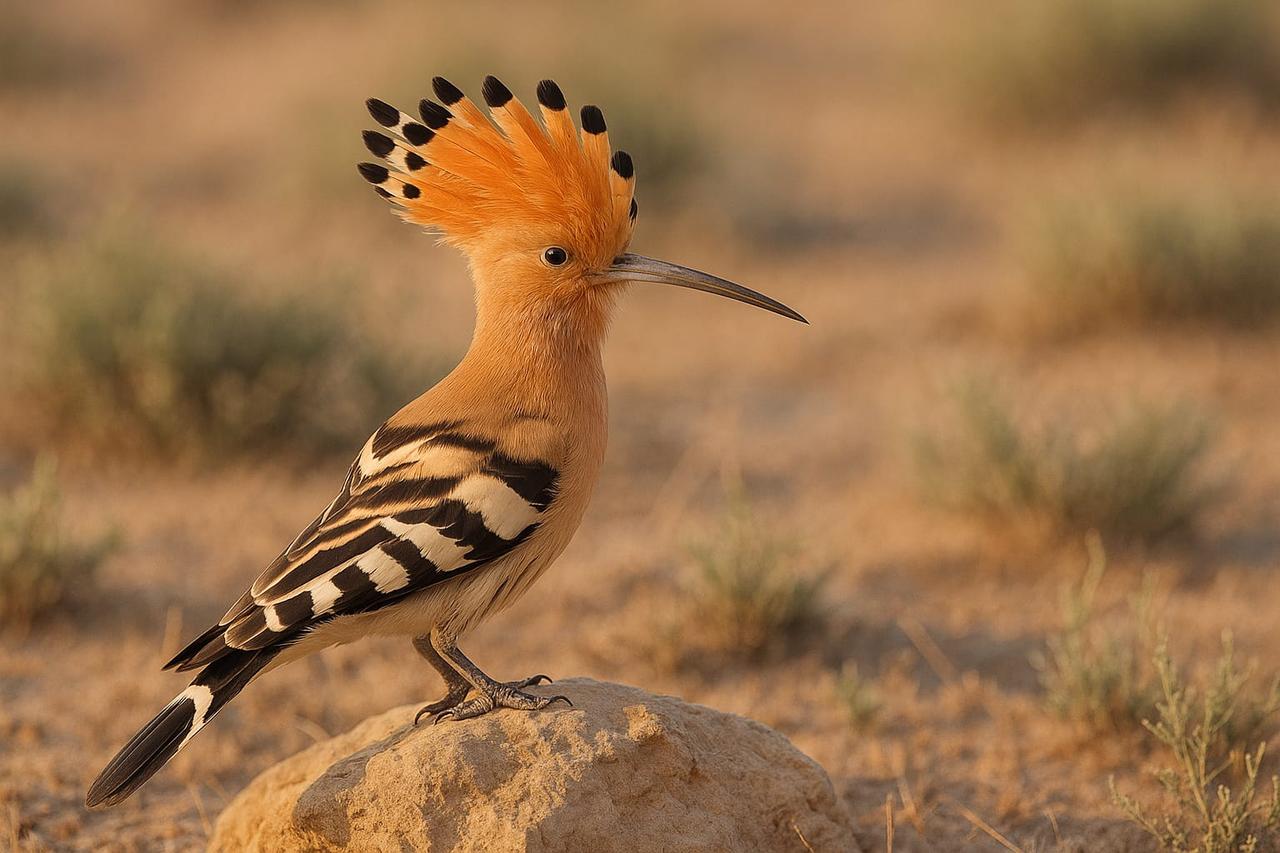
Hoopoe (Upupa epops)
Team(s) | Coraciiformes | ||||||||
|---|---|---|---|---|---|---|---|---|---|
Family | Upupidae | ||||||||
Distribution(s) | Europe North Africa Asia | ||||||||
Most Dense Countries | Spain, Türkiye, Portugal | ||||||||
Habitat | Open areas shrublands agricultural lands | ||||||||
Distinguishing Feature | Long crest feathers, black-and-white wing patterns | ||||||||
Beak Structure | Long, slender and slightly curved – suitable for insect hunting | ||||||||
Subspecies | There are eight described subspecies | ||||||||
The hoopoe (Upupa epops) is a bird species belonging to the order Coraciiformes and the family Upupidae. It is classified within the animal kingdom (Animalia), under the phylum Chordata and the subphylum Vertebrata. The genus Upupa, to which this species belongs, represents the hoopoes. Upupa epops is a widely distributed species across Europe and Asia, recognized by its distinctive crest of feathers. Its subspecies include U. e. epops, U. e. africana, U. e. ceylonensis, U. e. longirostris, U. e. major, U. e. marginata, U. e. senegalensis and U. e. waibeli.

Hoopoe (Pexels)
The hoopoe (Upupa epops) is a medium-sized bird easily identifiable by its distinctive physical features. Its body is generally colored in light brown tones, with a prominent crest of long feathers on the head that are raised upright and tipped with black. The wing and tail feathers exhibit striking black-and-white banded patterns. Its bill is long, slender and slightly curved downward, an adaptation well suited for extracting insects from the soil surface. There is no marked difference in external appearance between the sexes. The wingspan ranges from approximately 44 to 48 cm, and the body length varies between 25 and 29 cm.
The hoopoe (Upupa epops) has a broad geographic range extending across Europe, Asia and North Africa. In Europe it is particularly abundant in southern, central and eastern regions. The largest breeding populations are found in Spain (50%), Türkiye (13%) and Portugal (12%). The species holds significant importance within European Union countries, which together host approximately 77% of the total European population. Hoopoes prefer semi-natural habitats such as open areas, agricultural land, scrubland and sparse woodlands. Due to these habitat preferences, they are commonly observed in rural landscapes affected by human activity. However, due to limited habitat data, detailed information on habitat use cannot be fully elaborated in this source.
The total breeding population of the hoopoe (Upupa epops) in Europe is estimated at between 1.3 million and 2.76 million pairs. Approximately 77% of these individuals are found in the 27 member states of the European Union. The largest national populations are recorded in Spain (715,000–1,210,000 pairs), Türkiye (150,000–400,000 pairs) and Portugal (100,000–500,000 pairs). Other significant populations occur in Poland (33,000–61,000 pairs), France (50,000–90,000 pairs), Greece (60,000–80,000 pairs) and Russia (60,000–165,000 pairs).
As of 2015, the hoopoe (Upupa epops) is classified as Least Concern on the European Red List. Its population across Europe is reported to be generally stable. This assessment is based on official data submitted by European Union member states to the European Commission under Article 12 of the Birds Directive during 2013–2014, as well as contributions from BirdLife International partners. The quality of monitoring data varies between countries; some nations such as Germany, Poland and Sweden provide high-quality data, while others including Albania, Montenegro and Azerbaijan are assessed as having low data quality.
Despite its widespread distribution, the species may be vulnerable to human-induced threats such as local habitat loss, agricultural practices and pesticide use, making continuous monitoring and assessment essential.
Animal Diversity Web. "Upupa epops: Classification." University of Michigan Museum of Zoology. Accessed May 31, 2025. https://animaldiversity.org/accounts/Upupa_epops/classification/.
BirdLife International. Upupa epops. The IUCN Red List of Threatened Species 2020: e.T22682655A181836360. Date Published 2020. Accessed May 31, 2025. https://www.iucnredlist.org/species/22682655/181836360.
Pexels. “Hayvan Sevimli Tatlı Şirin [Fotoğraf].” Pexels. Accessed May 31, 2025. https://www.pexels.com/tr-tr/fotograf/hayvan-sevimli-tatli-sirin-7338385/.

Hoopoe (Upupa epops)
Team(s) | Coraciiformes | ||||||||
|---|---|---|---|---|---|---|---|---|---|
Family | Upupidae | ||||||||
Distribution(s) | Europe North Africa Asia | ||||||||
Most Dense Countries | Spain, Türkiye, Portugal | ||||||||
Habitat | Open areas shrublands agricultural lands | ||||||||
Distinguishing Feature | Long crest feathers, black-and-white wing patterns | ||||||||
Beak Structure | Long, slender and slightly curved – suitable for insect hunting | ||||||||
Subspecies | There are eight described subspecies | ||||||||
No Discussion Added Yet
Start discussion for "Hoopoe (Upupa epops)" article
Morphological Characteristics
Distribution and Habitat
Population Size
Conservation Status