T3AI-Mini’s first version with 427.7 million parameters processed 30 billion text tokens during training. The training configuration of this first version also served as the starting point for a new baseline to be used in future studies. Before committing to full training it was necessary to determine which configurations were worth modifying. Therefore the initial comparisons were conducted with one billion token (1B) training runs.
In each pair of experiments the same texts were processed in the same order. At the end of training both models predicted the next token in previously unseen texts. The model assigning higher probabilities to correct tokens had a lower validation loss. This difference indicated which configuration yielded better results with the same amount of data.
Some experiments focused on how weights were updated while others concentrated on the attention mechanism. The greatest reduction in loss was achieved by updating the weight matrices of layers with Muon. In the first version this task was handled by an update algorithm called AdamW (an optimizer). AdamW scales each weight update individually while Muon treats a layer’s updates as a single matrix.
For the new baseline these two methods were combined. Layer matrices are updated with Muon while other parameters are updated with AdamW using an increased learning rate. When tested with two billion tokens (2B) this configuration produced lower loss than the first version’s settings but the difference narrowed. Head gate and Force-sink variants tested in the attention mechanism were not adopted into the new training configuration.
Transformer is a model architecture that processes relationships between tokens in text using an attention mechanism. In T3AI-Mini some layers can operate multiple times on the same token. This arrangement called looped transformer increases computational depth by reusing the same weights in each pass. Universal Transformer is one of the early examples of this idea.【1】 The number of passes required at each position is determined by the Adaptive Computation Time method.【2】 A later study reported that on context-aware learning tasks a looped transformer approached the performance of a standard transformer using less than 10 percent of its parameter count.【3】
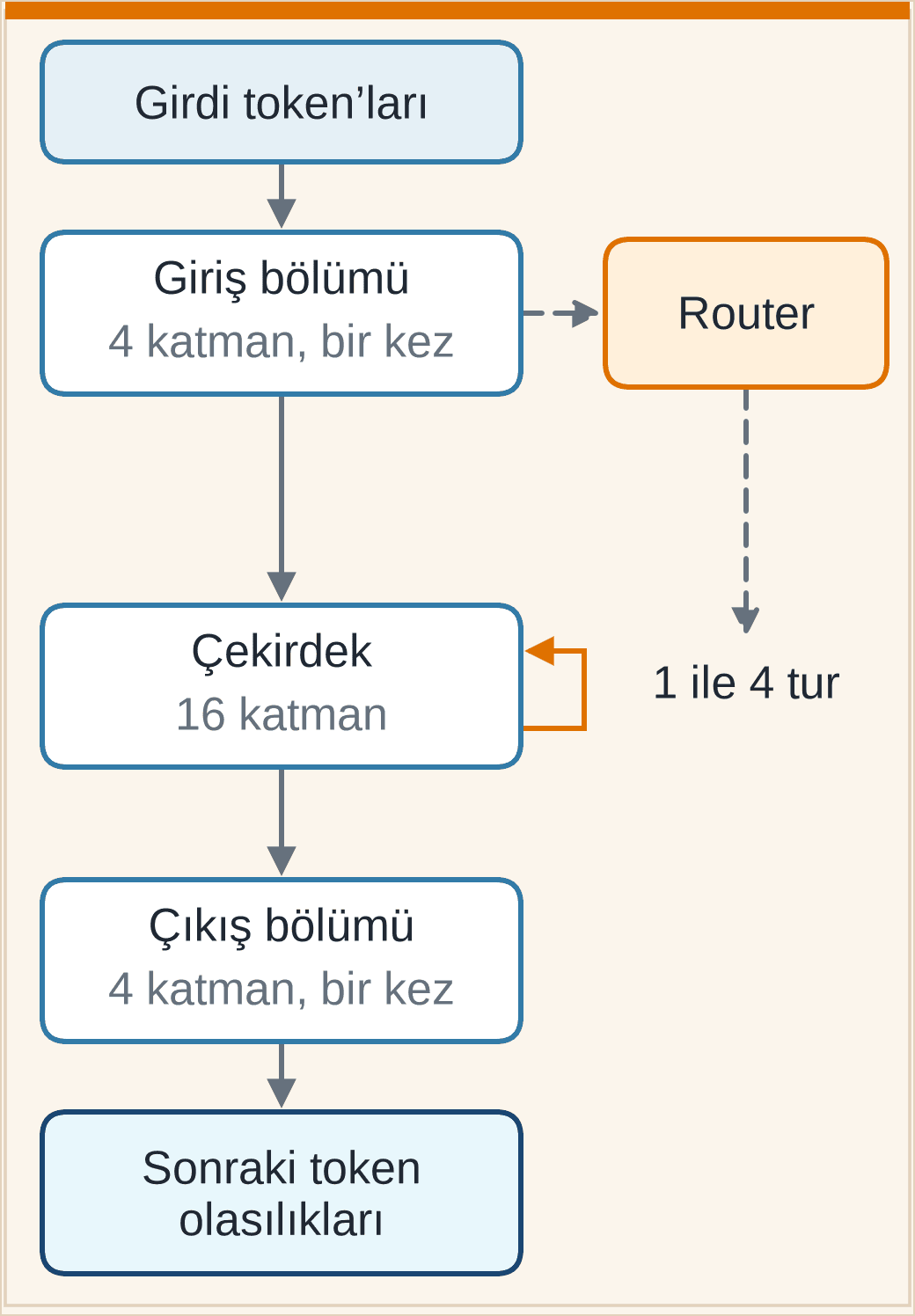
The Advanced Path of T3AI-Mini (Generated with Artificial Intelligence.)
The model has four layers in the input (stem) sixteen in the core (core) and four in the output (tail). The input and output layers each process tokens once. The core can loop up to four times using the same weights. Thus the model can perform between 24 and 72 layer computations per token using the same 24 layers. Each layer contains an attention block with input normalization and a feedforward block using the SwiGLU activation function. The hidden representation dimension is 1024 and the number of attention heads is 16. The model’s context window accepts 2048 tokens. The vocabulary contains 48007 tokens.
Animation of the Number of Passes the Router Assigns to Four Tokens (Generated by Artificial Intelligence).
The router determines how many passes each token makes in the core. This small network examines the output of the input section and calculates a probability for each of the four possible pass counts: 1 2 3 and 4. During training the number of passes is sampled from this distribution. During evaluation the first pass count at which the cumulative probability reaches 0.5 is selected. Once a token completes its passes its representation is fixed. The output layers process all tokens. The animation shows the path taken by four tokens with different pass counts.
Router selects the number of passes and also learns during training how beneficial each pass is. The cross-entropy loss for the next token is first computed using the number of passes selected by the router. Additionally all tokens are passed through 1 2 3 and 4 passes in sequence and the loss for each transition is measured. These four losses are weighted by the probabilities generated by the router. The router learns from this weighted loss.
The number of passes can also affect the overall training loss. To compare models with equal depth during validation each token was passed through the core three times. The measured value on the validation set of 21078157 tokens was the average negative log probability per token. Since loss is computed using the natural logarithm the unit is nats. The measurement where the router selects the number of passes was also used to determine whether its decisions changed.
Each experiment was paired with a comparative training session initialized with the same initial value (seed) for the random number generator. Within each pair, the data sequence and the random numbers used by the router were identical. Initial weights were also matched in optimizer trials. Because Head gate and Force-sink altered the architecture, these pairs began with different losses while the data sequence remained unchanged. The difference between the final validation losses of the two trainings was used as the gain from the change. A positive gain indicates that the new setting reduced the loss. Acceptance decisions were based on at least two seeds.
The first version was trained on an internal compilation. For these experiments, a compilation of 2.03 billion tokens was assembled from six open datasets. By byte count, the largest share belonged to general Turkish text (53 percent). This portion was sourced from BellaTurca.【4】 Other sources: General English text (FineWeb),【5】 English mathematics (OpenMathInstruct-2),【6】 Turkish mathematics (turkish-math-186k),【7】 Turkish and English parallel text (OPUS-100)【8】 and code (github-code-clean).【9】 One percent of each source was reserved for validation.
Each training step processed 131,072 target tokens. A 1B budget corresponded to 7,630 steps and a 2B budget to 15,259 steps. The baseline for all experiments was AdamW.【10】 The learning rate increased during the first percent of training, remained constant until 80 percent, then decreased linearly to zero. Such schedules have been examined in the literature as alternatives to cosine schedules.【11】
Seed changes alone can produce differences in loss. Therefore, for a setting to be accepted, it had to reduce the loss by at least 0.010 nat across at least two seeds. If the standard deviation of three trainings with identical settings exceeded this difference, subsequent experiments would not proceed. The standard deviation was 0.0002 nat for the first version’s settings and 0.0005 nat when AdamW’s learning rate was doubled. In the paper, this second setting is referred to as the “AdamW reference”. Decision rules were dated and recorded to prevent criteria from changing based on outcomes. This practice is called pre-registration. In the 2B experiments, the timing of each rule’s registration was reported alongside the corresponding result.
Table 1: Tested Changes
Step duration is reported relative to the median step duration of the AdamW training with learning rate 0.0008 and seed 1730.
The learning rate is one of the settings that determine how much the weights change at each step. In the first experiment, AdamW’s peak learning rate was increased from 0.0004 to 0.0008. The pattern of how the rate rose and fell during training remained unchanged. For the new rate to be adopted as reference, it needed to reduce the loss by at least 0.010 nat without causing sudden spikes. A spike was defined as a step whose loss exceeded the median of the previous 200 steps by more than 0.5 nat.
A higher learning rate also reduced loss across three seeds. The differences were 0.0253, 0.0258, and 0.0258 nat, with an average of 0.0256 nat. The acceptance threshold was met across all three seeds, and no spikes occurred in the training loss. Thus, AdamW with a learning rate of 0.0008 became the reference for subsequent experiments. This choice was initially based on measurements performed on a different hardware setup. The three seed repetitions confirmed the same decision.
Further increasing the rate yielded limited gains. In seed 1730, a rate of 0.0012 reduced the loss by 0.0001 nat, while 0.0016 reduced it by 0.0023 nat. With a rate of 0.0032, the training loss spiked three times, and the final validation loss remained 0.0229 nat higher than the reference. Since no rate in the sweep met the 0.010 nat threshold, the reference was unchanged.
A language model may allocate disproportionately high attention to the first token in the sequence when predicting the next token. This is known as an attention sink.【12】 One explanation suggests that this focus on the first token helps prevent excessive mixing of information.【13】 Gated Attention regulates how much information is passed to the next layer by applying a sigmoid gate to the output of the head. It has been reported to reduce the attention sink.【14】 Force-sink aims to induce the attention sink earlier in the sequence.【15】
Head gate and Force-sink were added separately to the AdamW reference. Here, head gate is a variant of Gated Attention that uses a single score per head. At each layer, a learned weight matrix generates one score for each of the 16 heads based on the representation of the token entering the attention block. The sigmoid function converts this score into a coefficient between zero and one. The head’s output is then multiplied by this coefficient. This procedure requires an additional 393,216 parameters. Force-sink, by contrast, uses the first 16 components of the representation for the first token and the remaining components for all other tokens. No additional parameters are needed.
Head gate reduced loss sufficiently to meet the acceptance threshold in two seeds. At the end of training, the loss was 0.0155 and 0.0123 nat lower. At step 4,000, the differences were larger, at 0.0207 and 0.0179 nat respectively. Force-sink did not meet the acceptance threshold, yielding gains of only 0.0047 and 0.0048 nat.
Attention allocated to the first token was monitored at the 1st, 8th, and 16th layers of the core. For each token, the proportion of attention directed toward the beginning of its text segment was measured. In the third round, this proportion ranged from 0.19 to 0.41 in the reference. With head gate, it dropped to between 0.006 and 0.040. With Force-sink, it rose to between 0.51 and 0.82.
The two methods affected attention to the first token in opposite directions, yet both reduced loss. The change in attention proportion alone could not fully explain the difference in loss. The previously written rule of thumb also limits the interpretation of the measured effect of head gate. This experiment could not determine how much of the loss improvement stemmed from the weakening of the attention sink.
Head gate had a cost. The median training step duration was 1.33 times longer than the reference and exceeded the 1.15-fold threshold. This deviation was recorded and the experiment completed before the loss results were observed.
Muon regulates the update applied to the weight matrix at each step. First, it computes a momentum-based update from recent gradients. Then, it approximates this update to be nearly orthogonal using an iteration called Newton-Schulz.
For example, suppose two columns of an update matrix are (3, 2) and (2, 3). These two columns point in similar directions. While AdamW scales each component independently based on its own gradient history, Muon transforms the two columns together to make their directions approximately perpendicular.
The method is designed for two-dimensional weight matrices in hidden layers. AdamW is recommended for token embeddings and prediction heads.【16】 A scaling study reported approximately twice the computational efficiency compared to AdamW.【17】 Another study found a smaller difference when using well-tuned references. The gap narrowed further as the number of parameters increased.【18】
In T3AI-Mini, Muon updated 168 matrices in the input, core, and output layers. AdamW was used for token embeddings, router, and normalization parameters. Experiments were conducted using PyTorch’s Muon implementation.【19】 Learning rates of 0.0008 and 0.0016 were tested with two seeds, while a higher rate of 0.0032 was tested with a single seed.
Both Muon configurations reduced loss by more than three times the acceptance threshold on 1B. With a rate of 0.0008, the reductions were 0.0338 and 0.0334 nats. With 0.0016, they reached 0.0406 and 0.0389 nats. The differences between the two configurations, 0.0068 and 0.0055 nats, were below the 0.010 nat threshold. The rate of 0.0032 tested with a single seed yielded a loss 0.0071 nat higher than the 0.0016 rate.
AdamW’s best training result occurred with seed 1730 and a learning rate of 0.0016. Muon training with the same seed and learning rate achieved a loss 0.0383 nat lower than this AdamW result.
Step duration remained nearly identical. With seed 1730, the median step duration for Muon’s two configurations was 3.93 and 3.95 seconds, compared to 3.97 seconds for the AdamW reference.
When head gate was added to Muon, the loss difference remained small in both seeds. On 1B, the additional improvement was 0.0024 and 0.0010 nat. If the gains measured against AdamW—0.0155 and 0.0123 nat—had been added directly, the loss would have been 1.8282 and 1.8323. In the paired experiment, the loss was 1.8413 and 1.8436. In this experiment, all 24 matrices of the head gate were updated with Muon. AdamW was not tested on these matrices.
Attention distribution changed again. With Muon alone, the share allocated to the first token in the third pass ranged from 0.24 to 0.47. After adding head gate, it dropped to between 0.004 and 0.058. The head gate weakened the attention sink in both AdamW and Muon. The loss difference under AdamW alone met the acceptance threshold.
In the paired experiment, the median step duration was 1.34 times that of the AdamW reference. When the increased duration and small loss difference were considered together, the head gate was not adopted into the new training configuration.
Paired comparisons conducted with at least two seeds in 1B training are presented in Table 2. Figure 2 shows the loss reduction from each modification alongside the acceptance threshold.
Table 2: Paired Comparisons in the 1B Budget
The table presents losses measured with three fixed steps in the final stage and the gains calculated from them, in units of nat. The learning rate for the initial version was compared with Muon at a learning rate of 0.0016, along with the head gate and Muon combination. Other rows used AdamW as the reference. Since gains were calculated from unrounded losses, the final digit in the table can differ by one unit from the actual difference.
Observing lower loss during short training provides a good starting point for configuration selection. A configuration may lead to a lower final loss or reach the same loss earlier. In the latter case, the difference may narrow as training continues.
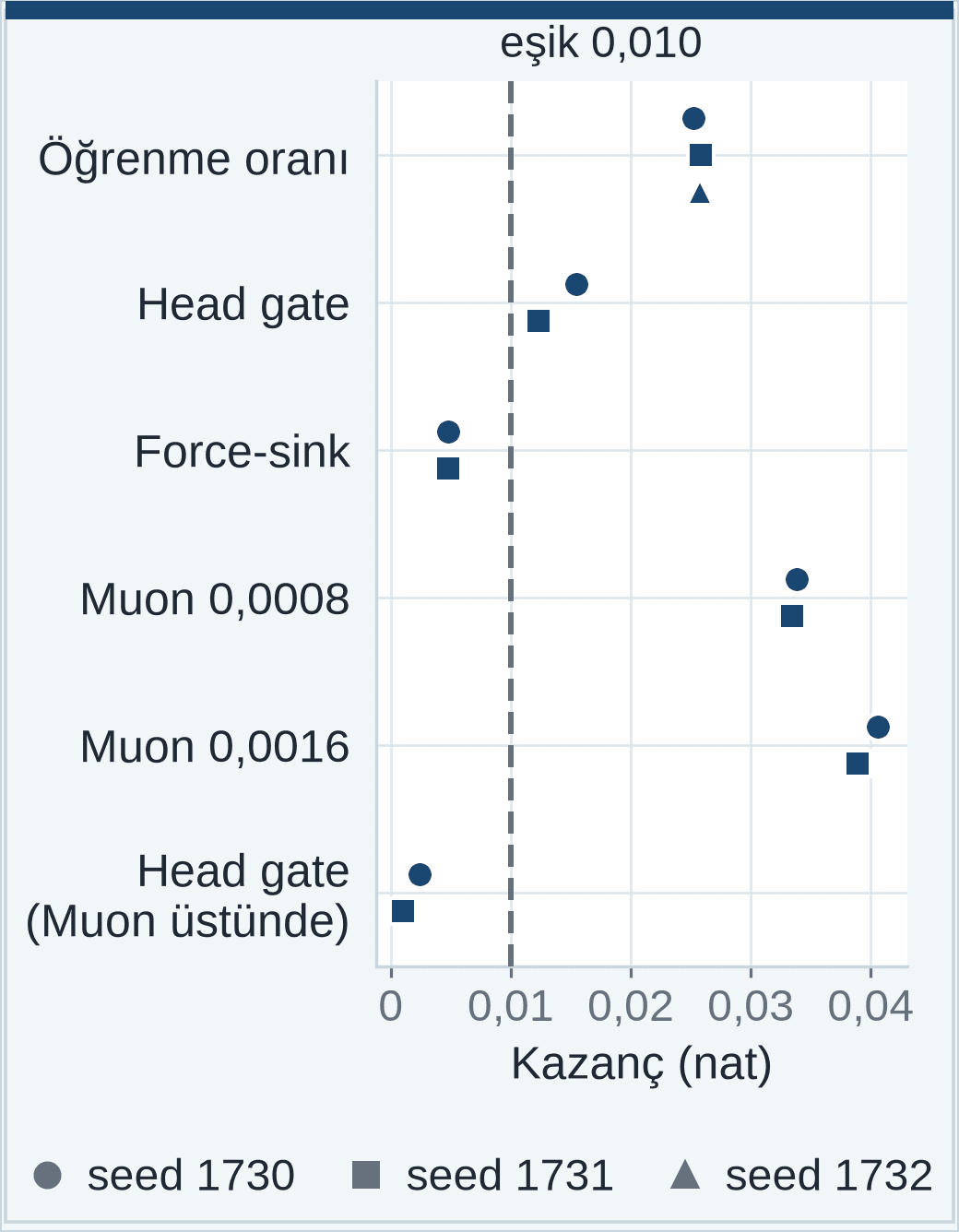
1B Gain per Seed and Threshold in Budget (Generated by Artificial Intelligence)
To examine this possibility, the learning rate, head gate, and Muon experiments were repeated in 2B with seeds 1730 and 1731. Each training started from scratch, and the learning rate schedule was scaled according to the new budget. To observe the remaining difference in 2B, the average 2B gain for the two seeds was divided by the average 1B gain for the same seeds. Gain ratios in the tables were calculated this way.
For acceptance in 2B, a minimum gain of 0.010 nat was again sought in both seeds. If the average gain ratio for Muon fell below 0.50, expectations for longer training would be lowered. The first Muon rule was written before any 2B training began and applied to a single seed. The average calculation and comparison of the two Muon learning rates were added after observing the result of seed 1730 and before seed 1731 began. The gain ratio for Muon remained above 0.50 in both seeds (Table 3). Rules for the learning rate and head gate were recorded after obtaining the Muon result and before these experiments began. If the gain decreased in both seeds and the ratio fell to at most 0.80, the result would be recorded as “reduced.” If no decrease was observed in either seed, the result would be “not reduced”; otherwise, it would be “indistinguishable.”
Muon’s gain decreased in 2B and met the acceptance threshold in both seeds. The loss difference at a learning rate of 0.0016 was 0.0406 nat and 0.0389 nat in 1B, and 0.0213 nat and 0.0239 nat in 2B. The average gain ratio was approximately 0.57 for both learning rates (Table 3). Both results remained above 0.50. The difference between the two Muon configurations stayed below the threshold in 2B, at 0.0033 nat and 0.0036 nat. The learning rate of 0.0016, which yielded lower loss in both budgets and both seeds, was selected.
The effect of increasing AdamW’s learning rate also decreased in 2B. The gain in both seeds was 0.0253 nat and 0.0258 nat in 1B, and 0.0158 nat and 0.0157 nat in 2B. The acceptance threshold was met in both seeds in 2B. The gain decreased in both seeds. Since the average gain ratio of 0.62 remained below 0.80, the result was recorded as “reduced.”
Head gate yielded different results in the two seeds. The gain decreased from 0.0155 nat to 0.0129 nat in seed 1730, but increased from 0.0123 nat to 0.0126 nat in seed 1731. The acceptance threshold was met in both seeds in 2B. The average gain ratio was 0.92. Since the gain decreased in one seed and increased in the other, the effect of the budget could not be distinguished.
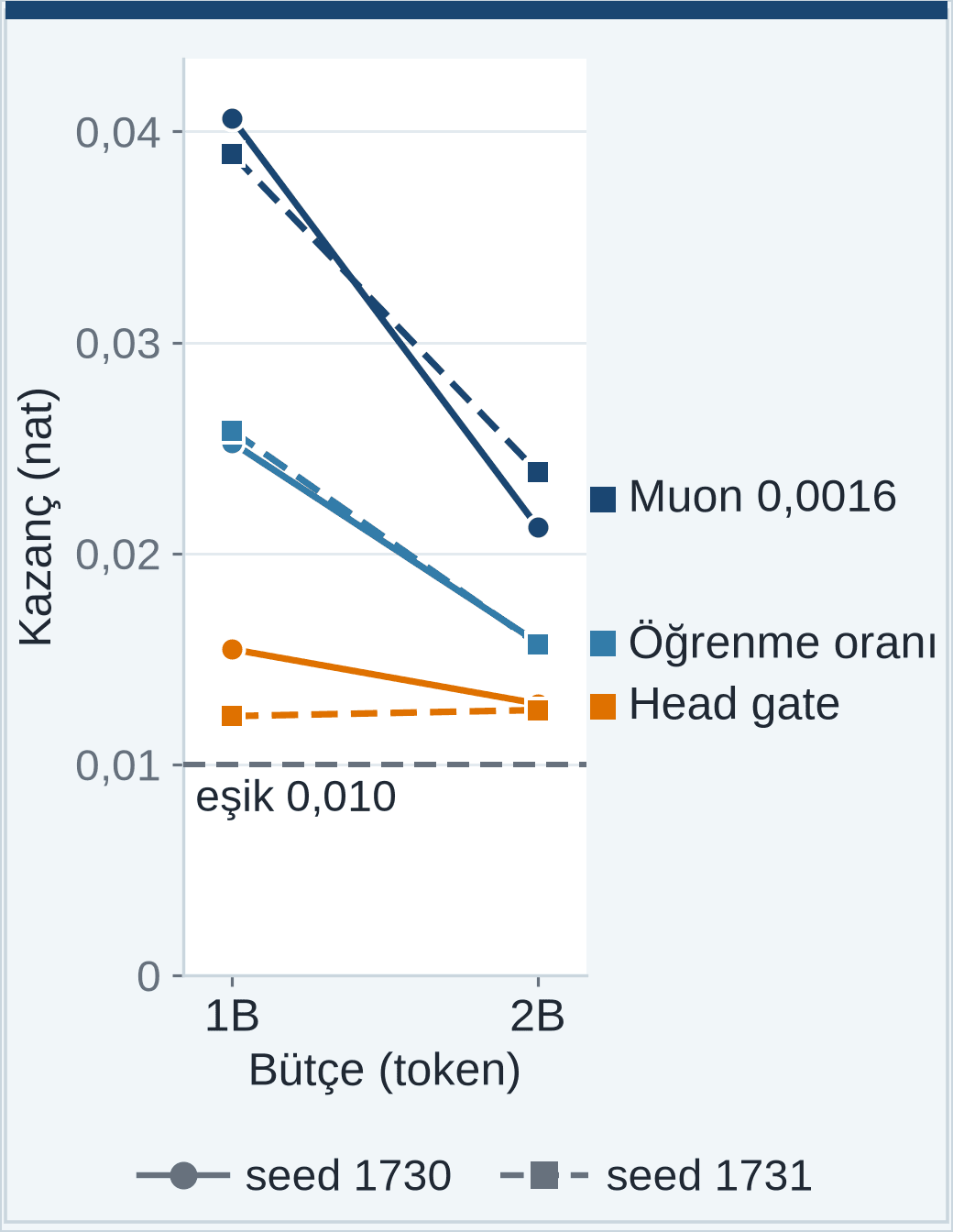
Change in Profit According to Budget (Generated by Artificial Intelligence.)
For the selected configurations, Muon’s learning rate for layer matrices was set to 0.0016, and AdamW’s learning rate for other parameters was set to 0.0008. Compared to the initial version’s settings, the loss decreased from 0.0659 nat and 0.0647 nat in 1B to 0.0370 nat and 0.0396 nat in 2B in the two seeds. The total gain of the selected training configurations in 2B was 0.59 times that in 1B. No prior reduction criterion had been defined for Muon. Nevertheless, the decrease in both seeds and the gain ratio met the reduction criterion defined for the learning rate. The reduction in the difference between 1B and 2B suggested that part of the advantage in 1B may have stemmed from faster learning. Measurements for head gate did not show a consistent direction sufficient to support this interpretation. A published comparison reported that for small models, matrix-based optimizers like Muon increase their speed ratio with data budget. That study measured the speed of reaching a specific loss. Here, the compared value was the loss difference after processing the same number of tokens.【20】
Increasing the data budget created a larger difference than the individual tuned configurations. Simply moving from 1B to 2B reduced the loss of the AdamW reference by 0.1089 and 0.1058 nats across two seeds.
Intermediate measurements also showed how the results could vary. Muon’s 2B gain with a learning rate of 0.0016 averaged 0.0036 nats at step 12,000. In the final phase, where the learning rate approached zero, the difference increased to 0.0226 nats. In AdamW, the same intermediate step with a 0.0008 rate yielded a loss 0.0046 nats higher than the low rate, while at the final step it produced a loss 0.0157 nats lower.
Table 3: Gains in 1B and 2B Budgets
Gains are given in nat units. A positive value indicates that the new setting reduced loss. For the average rows, the mean gain of the two seeds in each budget was first calculated. Then the 2B average was divided by the 1B average.
Table 4 shows the required criterion for each decision alongside the value measured in the experiment.
Table 4: Predefined Rules and Their Outcomes
Results not labeled as 2B in the table belong to 1B training. In the Muon rows, the learning rate was set to 0.0016 unless otherwise specified. When using the number of steps selected by the router instead of a fixed three steps, the acceptance decisions and budget evaluations for the three methods remained unchanged.
The experiments are limited to this 427.7 million parameter looped transformer and an open corpus of 2.03 billion tokens. Results may vary with different sizes and architectures.
The 2B training corpus was processed nearly once. Increasing the budget without data repetition requires a larger corpus.
The new training settings were selected based on the 1B results and Muon’s 2B result. The learning rate and head gate experiments for 2B were completed afterward. The learning rate choice was supported by the results. The head gate met the acceptance threshold even with AdamW in 2B. The measurement of what Muon contributes when added is limited to 1B.
Most comparisons were conducted with two seeds. The learning rate was compared across three seeds in 1B. Additional learning rate sweeps and Muon’s highest rate were tested with a single seed. Such limited repetition makes it difficult to estimate how much the gains might vary across different seeds. No confidence intervals or significance tests were reported. The standard deviation of the loss in reference training was 0.0005 nat across three seeds in 1B and 0.0016 nat across two seeds in 2B. Both values were below the acceptance threshold.
The experiments measured the loss of predicting the next token. The impact of a 0.010 nat improvement on tasks such as question answering requires separate evaluation.
Each pair processed the same number of tokens. Since head gate extends the number of steps, with equal time allocated, training without head gate can process more tokens. No equal-time comparison was performed.
The sweeps for AdamW and Muon were limited to learning rate. AdamW’s beta values, weight decay coefficient, and the duration of increased learning rate remained fixed. Since Muon multiplies weight decay by the learning rate, doubling the rate also doubles the weight decay applied to the matrices. The difference between the two Muon results encompasses both effects. For training using Muon, other parameters remained fixed at the AdamW rate of 0.0008. A rate of 0.0004 for these parameters was not separately tested.
The initial noise and learning rate measurements were taken on NVIDIA H100 hardware. The initial selection of the reference was based on these measurements. Raw files were not preserved. All paired measurements compared here were taken on NVIDIA B300 hardware. Repetitions with seed 1731 and 1732 using the initial configuration were completed after the other 1B experiments and did not alter the prior decision. In the three-seed comparison using the initial configuration, the difference between the two hardware platforms did not exceed 0.001 nat.
Three versions of the code were used in the training. It was verified through tests that the default AdamW operations remained unchanged across versions.
The last six trainings were interrupted due to machine restarts. Training was resumed from the last saved checkpoint. Across all 2,222 re-computed steps, the data, learning rate, and training loss matched the previous recordings exactly.
The results of every experiment, along with the registration dates of rules and the source data of shapes, are recorded within institutional records. Table 5 shows which information is documented to enable replication of the experiments.
Table 5: Reproducibility Areas
The term “Saved” indicates that the information in the experiment records is available, while “Not available” refers to files not shared alongside the text. Due to the fact that the raw files from the initial measurements were not preserved, the term “Unpreserved” was used in this row.
Head gate’s contribution depended on which optimizer it was used with. The modification that worked with AdamW, when added to Muon, produced only a minor difference in 1B and extended the step duration. Therefore, head gate was not adopted in the new configuration. Force-sink also failed to meet the acceptance threshold.
Experiments were conducted on a single model and two training budgets. Primary comparisons were based on two or three seeds. The new configurations yielded lower validation loss than the initial settings in both budgets. On average across two seeds, this gain decreased to 0.59 times the 1B result in 2B. The loss difference under longer training has not yet been measured.
In 1B, the median step durations for Muon and AdamW were also similar. Therefore, in the new training setup, layer matrices will be updated by Muon while other parameters will be updated by AdamW with a higher learning rate.
CodeParrot. “github-code-clean.” Hugging Face. Accessed November 16, 2026.https://huggingface.co/datasets/codeparrot/github-code-clean
ITU Perceptron. “turkish-math-186k.” Hugging Face. Accessed November 16, 2026.https://huggingface.co/datasets/ituperceptron/turkish-math-186k
PyTorch. “torch.optim.Muon.” PyTorch 2.15 Documentation. Accessed November 16, 2026.https://docs.pytorch.org/docs/stable/generated/torch.optim.Muon.html
Turkish-NLP-Suite. “BellaTurca.” Hugging Face. Accessed November 16, 2026.https://huggingface.co/datasets/turkish-nlp-suite/BellaTurca
Barbero, Federico, Álvaro Arroyo, Xiangming Gu, Christos Perivolaropoulos, Michael Bronstein, Petar Veličković, and Razvan Pascanu. “Why do LLMs attend to the first token?” arXiv 2025. Accessed November 16, 2026.https://arxiv.org/abs/2504.02732
Dehghani, Mostafa, Stephan Gouws, Oriol Vinyals, Jakob Uszkoreit, and Łukasz Kaiser. “Universal Transformers.” arXiv 2019. Accessed November 16, 2026.https://arxiv.org/abs/1807.03819
Graves, Alex. “Adaptive Computation Time for Recurrent Neural Networks.” arXiv 2017. Accessed November 16, 2026.https://arxiv.org/abs/1603.08983
Gu, Xiangming, Tianyu Pang, Chao Du, Qian Liu, Fengzhuo Zhang, Cunxiao Du, Ye Wang, and Min Lin. “When Attention Sink Emerges in Language Models: An Empirical View.” arXiv 2025. Accessed November 16, 2026.https://arxiv.org/abs/2410.10781
Helsinki-NLP. “OPUS-100.” Hugging Face. Accessed November 16, 2026.https://huggingface.co/datasets/Helsinki-NLP/opus-100
HuggingFaceFW. “FineWeb.” Hugging Face. Accessed November 16, 2026.https://huggingface.co/datasets/HuggingFaceFW/fineweb
Hägele, Alexander, Elie Bakouch, Atli Kosson, Loubna Ben Allal, Leandro Von Werra, and Martin Jaggi. “Scaling Laws and Compute-Optimal Training Beyond Fixed Training Durations.” arXiv 2024. Accessed November 16, 2026.https://arxiv.org/abs/2405.18392
Jordan, Keller. “Muon: An optimizer for hidden layers in neural networks.” Keller Jordan Blog. December 8, 2024. Accessed November 16, 2026.https://kellerjordan.github.io/posts/muon/
Liu, Jingyuan, Jianlin Su, Xingcheng Yao, Zhejun Jiang, Guokun Lai, et al. “Muon is Scalable for LLM Training.” arXiv 2025. Accessed November 16, 2026.https://arxiv.org/abs/2502.16982
Loshchilov, Ilya and Frank Hutter. “Decoupled Weight Decay Regularization.” arXiv 2019. Accessed November 16, 2026.https://arxiv.org/abs/1711.05101
NVIDIA. “OpenMathInstruct-2.” Hugging Face. Accessed November 16, 2026.https://huggingface.co/datasets/nvidia/OpenMathInstruct-2
Peng, Runyu, Ruixiao Li, Mingshu Chen, Yunhua Zhou, Qipeng Guo, Xipeng Qiu, Yucheng Lu, and Chen Zhao. “What Makes Position Zero Special? A Mechanistic Study of Position Zero Attention Sinks in LLMs.” arXiv 2026. Accessed November 16, 2026.https://arxiv.org/abs/2603.06591
Qiu, Zihan, Zekun Wang, Bo Zheng, Zeyu Huang, Kaiyue Wen, et al. “Gated Attention for Large Language Models: Non-linearity, Sparsity, and Attention-Sink-Free.” arXiv 2025. Accessed November 16, 2026.https://arxiv.org/abs/2505.06708
Wen, Kaiyue, David Hall, Tengyu Ma, and Percy Liang. “Fantastic Pretraining Optimizers and Where to Find Them.” arXiv 2026. Accessed November 16, 2026.https://arxiv.org/abs/2509.02046
Yang, Liu, Kangwook Lee, Robert Nowak, and Dimitris Papailiopoulos. “Looped Transformers are Better at Learning Learning Algorithms.” arXiv 2024. Accessed November 16, 2026.https://arxiv.org/abs/2311.12424
[1]
Mostafa Dehghani, Stephan Gouws, Oriol Vinyals, Jakob Uszkoreit, and Łukasz Kaiser, “Universal Transformers,” arXiv 2019, 1. Accessed November 16, 2026.https://arxiv.org/abs/1807.03819
[2]
Alex Graves, “Adaptive Computation Time for Recurrent Neural Networks,” arXiv 2017, 1. Accessed November 16, 2026.https://arxiv.org/abs/1603.08983
[3]
Liu Yang, Kangwook Lee, Robert Nowak, and Dimitris Papailiopoulos, “Looped Transformers are Better at Learning Learning Algorithms,” arXiv 2024, 1, Accessed November 16, 2026.https://arxiv.org/abs/2311.12424
[4]
Turkish-NLP-Suite, “BellaTurca,” Hugging Face, Accessed November 16, 2026.https://huggingface.co/datasets/turkish-nlp-suite/BellaTurca
[5]
HuggingFaceFW, “FineWeb,” Hugging Face, Accessed November 16, 2026.https://huggingface.co/datasets/HuggingFaceFW/fineweb
[6]
NVIDIA, “OpenMathInstruct-2,” Hugging Face, Accessed November 16, 2026.https://huggingface.co/datasets/nvidia/OpenMathInstruct-2
[7]
ITU Perceptron, “turkish-math-186k,” Hugging Face, Accessed November 16, 2026.https://huggingface.co/datasets/ituperceptron/turkish-math-186k
[8]
Helsinki-NLP, “OPUS-100,” Hugging Face, Accessed November 16, 2026.https://huggingface.co/datasets/Helsinki-NLP/opus-100
[9]
CodeParrot, “github-code-clean,” Hugging Face, Accessed November 16, 2026.https://huggingface.co/datasets/codeparrot/github-code-clean
[10]
Ilya Loshchilov and Frank Hutter, “Decoupled Weight Decay Regularization,” arXiv 2019, 1. Accessed November 16, 2026.https://arxiv.org/abs/1711.05101
[11]
Alexander Hägele, Elie Bakouch, Atli Kosson, et al. “Scaling Laws and Compute-Optimal Training Beyond Fixed Training Durations,” arXiv 2024, 1. Accessed November 16, 2026.https://arxiv.org/abs/2405.18392
[12]
Xiangming Gu, Tianyu Pang, Chao Du, et al. “When Attention Sink Emerges in Language Models: An Empirical View,” arXiv 2025, 1. Accessed November 16, 2026.https://arxiv.org/abs/2410.10781
[13]
Federico Barbero, Álvaro Arroyo, Xiangming Gu, et al. “Why do LLMs attend to the first token?” arXiv 2025, 1. Accessed November 16, 2026.https://arxiv.org/abs/2504.02732
[14]
Zihan Qiu, Zekun Wang, Bo Zheng, et al. “Gated Attention for Large Language Models: Non-linearity, Sparsity, and Attention-Sink-Free,” arXiv 2025, 1. Accessed November 16, 2026.https://arxiv.org/abs/2505.06708
[15]
Runyu Peng, Ruixiao Li, Mingshu Chen, et al. "What Makes Position Zero Special? A Mechanistic Study of Position Zero Attention Sinks in LLMs." arXiv 2026, 1. Accessed November 16, 2026.https://arxiv.org/abs/2603.06591
[16]
Keller Jordan, “Muon: An optimizer for hidden layers in neural networks,” Keller Jordan Blog, December 8, 2024, Accessed November 16, 2026.https://kellerjordan.github.io/posts/muon/
[17]
Jingyuan Liu, Jianlin Su, Xingcheng Yao, et al. “Muon is Scalable for LLM Training,” arXiv 2025, 1. Accessed November 16, 2026.https://arxiv.org/abs/2502.16982
[18]
Kaiyue Wen, David Hall, Tengyu Ma, and Percy Liang, “Fantastic Pretraining Optimizers and Where to Find Them,” arXiv 2026, 1. Accessed November 16, 2026.https://arxiv.org/abs/2509.02046
[19]
PyTorch, “torch.optim.Muon,” PyTorch 2.15 Documentation, Accessed November 16, 2026.https://docs.pytorch.org/docs/stable/generated/torch.optim.Muon.html
[20]
Wen et al., “Fantastic Pretraining Optimizers and Where to Find Them,” 9-10.

Deeper Computation with the Same Core
How Was the Impact of a Change Measured?
When the Learning Rate Is Doubled
Changing Attention Allocated to the First Token
How Are Muon Weights Updated?
What Did Head Gate Add to Muon?
Did the Gain Persist When the Data Budget Increased?
Decision Criteria and Experimental Results
How Far Do the Results Extend?
Reproducibility
Results
This article was created with the support of artificial intelligence.