This article was automatically translated from the original Turkish version.
+2 More
Location | Yalvaç Isparta / Türkiye | ||||||||
|---|---|---|---|---|---|---|---|---|---|
Date(s) | 8th century BC – Byzantine Period | ||||||||
Construction Type | Rock tomb / Rock church | ||||||||
Dimension(s) | ceiling height 3.10 m interior width 3.50 m Facade 5.50x5.50 m | ||||||||
The Hoyran Rock Tombs are ancient burial structures located on steep cliffs descending eastward toward Hoyran Lake, which forms the northern extension of Eğirdir Lake, approximately 25 km west of the Yalvaç district in Isparta Province, Türkiye. These monumental rock tombs in the region hold a unique position within Anatolian rock tomb architecture due to their architectural and decorative features.
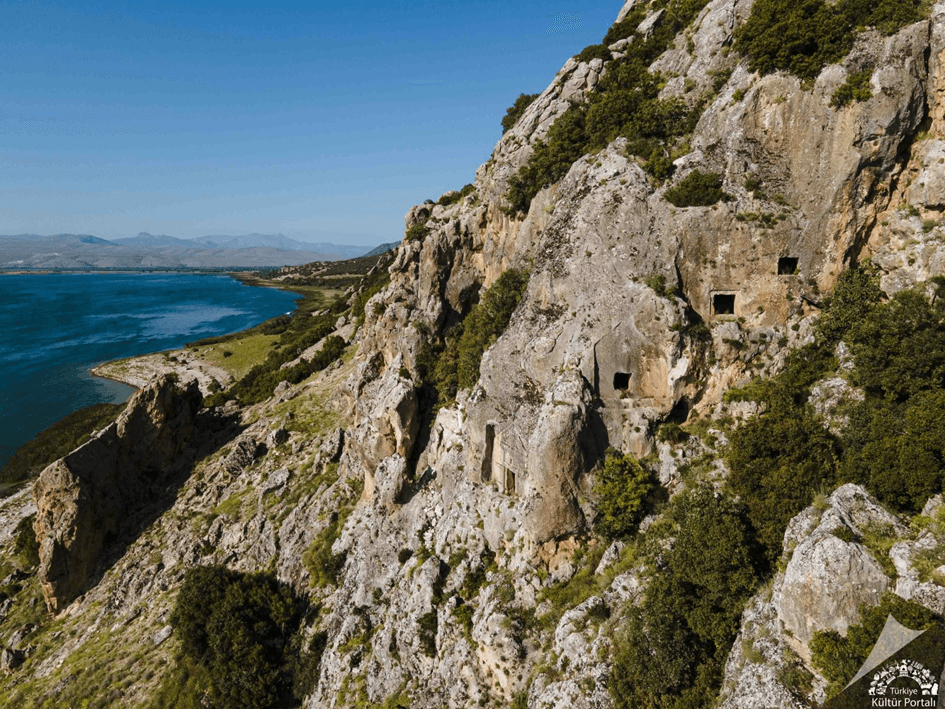
Hoyran Rock Tombs (Türkiye Culture Portal)
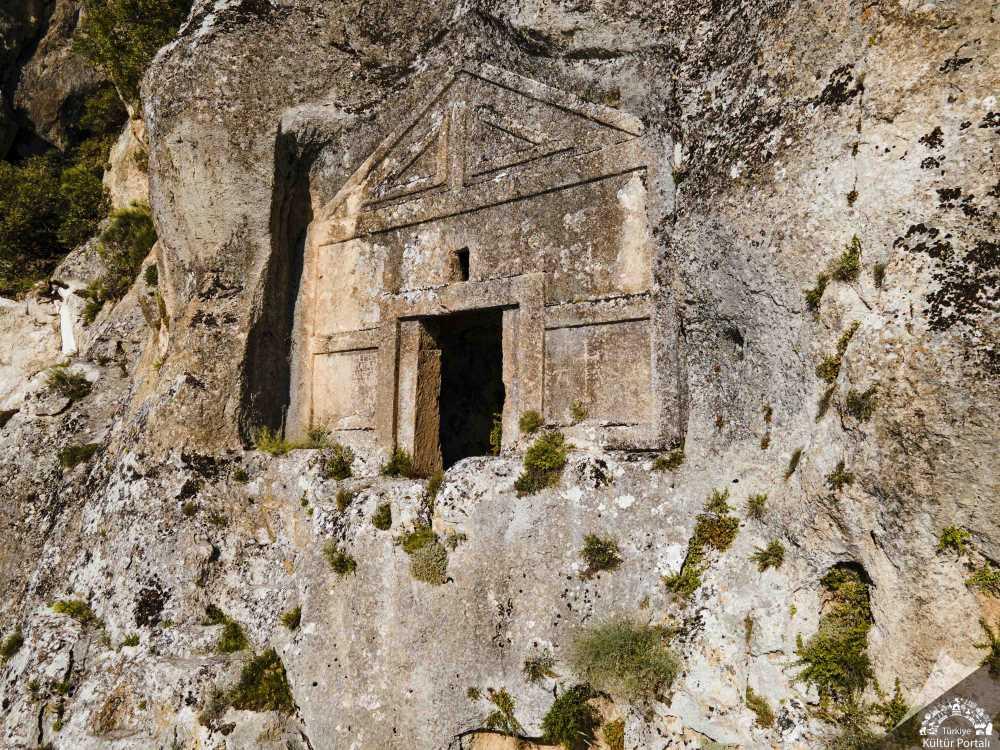
The Hoyran Rock Tombs are situated on a rocky slope dominating Hoyran Lake to the northeast of Eğirdir Lake. This group of three tomb structures includes one example that stands out for its minimalist craftsmanship. This particular tomb is distinguished by its position, facing the lake and the sunset from a height of 30 meters. Its refined workmanship and triangular pediment composed of unique geometric patterns suggest it belonged to a noble individual, likely a local ruler.
The tomb has a rectangular facade measuring 5.50 meters in width and height, with a depth of approximately the same dimension. Inside, the burial chamber narrows to a width of 3.50 meters; its ceiling rises in a steep gable form to a height of 3.10 meters. The structure, with its triangular pediment evoking the simple facade of a temple, occupies a unique position among similar examples in the region in terms of facade design and craftsmanship.

Hoyran Rock Tombs (Türkiye Culture Portal)
These monumental rock tombs in the region hold a unique position within Anatolian rock tomb architecture due to their architectural and decorative features.
The pedimented type of rock tomb is a distinctive tradition of the Phrygian region in Anatolia. Its origins trace back to the Urartian culture of eastern Anatolia in the 9th century BCE. The technique of rock tomb construction transmitted from the Urartians to Phrygia evolved in harmony with Phrygian domestic architecture and persisted through the Roman period with its pedimented facades. Compared to the dense concentration of similar examples in the Afyon-Kütahya-Eskişehir triangle, the Hoyran Rock Tombs are regarded as a manifestation of this cultural tradition in the Pisidia region. However, the unparalleled nature of the facade patterns distinguishes these structures from Phrygian influence and endows them with local originality. It is believed that the tombs were constructed earlier than the foundation of Antiocheia.
During the Byzantine period, one of the Hoyran Rock Tombs underwent a functional transformation and was converted into a rock church. Modifications were made to both its interior and exterior, particularly the carving of an apse into the eastern wall to adapt it for religious use. Frescoes depicting scenes from the Bible were applied to the walls of the burial chamber. In the apse, the central figure depicted with a halo, beardless, dressed in white, is believed to represent Christ. On the ceiling, a saint is shown riding a white horse, holding a shield and spear, and wearing a halo. The letters beside the saint’s head read the name of Saint Cornutus, the bishop of Iconium (Konya), who was venerated in Cappadocia. However, the military identity portrayed here differs from known depictions of this saint.
The Hoyran Rock Tombs and the associated Byzantine rock church attract attention among similar structures in the region due to their original architectural form and the wall paintings within. Although the frescoes surviving to the present day are largely damaged, the existing remains reflect the historical and cultural significance of the site.
T.C. Kültür ve Turizm Bakanlığı. "Hoyran Kaya Mezarları - Isparta." Türkiye Kültür Portalı. Accessed August 16, 2025. https://www.kulturportali.gov.tr/turkiye/isparta/gezilecekyer/hoyran-kaya-mezarlari-
Yalvaç Municipality. "Hoyran Kaya Mezarları." Yalvaç Municipality Website. Accessed August 16, 2025. https://www.yalvac.bel.tr/kentrehberidetay/739

Location | Yalvaç Isparta / Türkiye | ||||||||
|---|---|---|---|---|---|---|---|---|---|
Date(s) | 8th century BC – Byzantine Period | ||||||||
Construction Type | Rock tomb / Rock church | ||||||||
Dimension(s) | ceiling height 3.10 m interior width 3.50 m Facade 5.50x5.50 m | ||||||||
Location and General Features
Architectural Features
Historical and Cultural Context
Byzantine Period and Transformation
Current Condition