


This article was automatically translated from the original Turkish version.
Definition(s) | A cosmological relation stating a linear relationship between the recession velocities of galaxies and their distances from the observer. | ||||||||
|---|---|---|---|---|---|---|---|---|---|
Application Area(s) | Examination of cosmological models Measurement of the expansion rate of the universe Determination of galaxy distances | ||||||||
Area(s)(Text) | Cosmology Astrophysics | ||||||||
Basic Concepts | Hubble constant, Cosmological redshift, Expansion of the universe | ||||||||
Proposer | Edwin Hubble (1929) | ||||||||
Formula | 𝑣 = H₀ D | ||||||||
Hubble's Law is a cosmological relation stating a linear relationship between the recession velocities of galaxies and their distances from the observer. This relationship was established in 1929 by Edwin Hubble through the comparison of distance measurements of galaxies with spectroscopic redshift observations. Hubble's work demonstrated that the redshift observed in the light of distant galaxies increases systematically, revealing that galaxies are moving away from each other. These observations led to significant conclusions indicating that the universe is not static and that its large-scale structure can change over time.
Spectroscopic observations conducted in the early 20th century revealed redshifts in the spectra of many galaxies. When these spectral shifts were compared with distance measurements made by Edwin Hubble, it became clear that the recession velocities of galaxies are correlated with their distances. As a result, a relationship was established stating that the recession velocity of a galaxy is proportional to its distance. Hubble's work has been regarded as one of the observational evidences for the expansion of the universe.
Hubble's Law is expressed by an equation that relates the recession velocity of a galaxy to its distance from the observer:
𝑣 = H0 D
In this equation
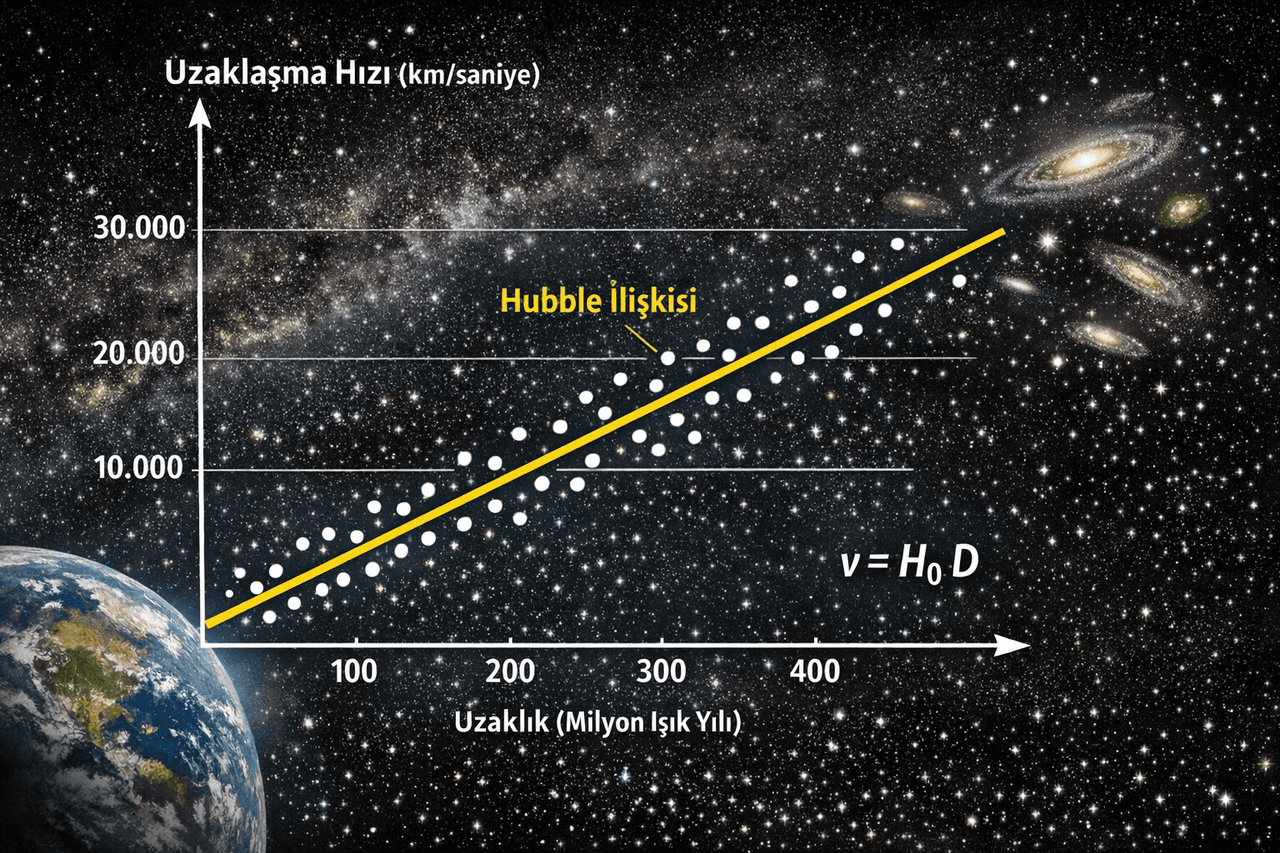
According to this relation, the recession velocities of galaxies increase with increasing distance from the observer. In other words, more distant galaxies recede at higher velocities. This relationship is used to explain the connection between the distribution of galaxies on cosmological scales and the expansion of the universe.

Hubble Diagram Showing the Linear Relationship Between Galaxy Recession Velocities and Distances (Generated by Artificial Intelligence)
The recession velocities of galaxies are typically determined through measurements of redshift in their spectra. Redshift, caused by the elongation of the wavelength of electromagnetic radiation, is a key indicator that galaxies are moving away from the observer. Cosmological redshift is associated with the stretching of light's wavelength over time due to the expansion of space. Therefore, the redshift values observed in galaxy spectra are used to study the rate of expansion of the universe.
The Hubble constant appearing in Hubble's Law is one of the fundamental cosmological parameters that determine the rate of expansion of the universe. This constant expresses the ratio of galaxies' recession velocities to their distances. Today, the value of the Hubble constant is measured using various observational methods. Measurements made with modern telescopes and space observatories have contributed to a more precise determination of the expansion rate.
Hubble's Law is recognized as one of the fundamental observational relationships used in modern cosmology to study the large-scale structure of the universe. Today, observatories such as the Hubble Space Telescope and the James Webb Space Telescope enable more detailed measurements of galaxy distances and redshift values. These observations facilitate ongoing research into determining the rate of expansion of the universe.
Hubble's Law is employed in numerous research areas including the study of galaxy distribution, cosmological redshift, and the large-scale structure of the universe. This relationship also serves as an important tool for estimating the age of the universe, testing cosmological models, and investigating the history of the universe's expansion.
European Space Agency (ESA). “Webb & Hubble Confirm Universe’s Expansion Rate.” ESA, March 11, 2024. Accessed March 10, 2026. https://www.esa.int/Science_Exploration/Space_Science/Webb/Webb_Hubble_confirm_Universe_s_expansion_rate
Kaya, Ali. “Hubble’s Law and Faster than Light Expansion Speeds.” *American Journal of Physics* 79, no. 11 (2011): 1151–1154. Accessed March 10, 2026. https://doi.org/10.1119/1.3625871
Kolomoyets, N. V., et al. “Hubble’s Law in Heavy Ion Collisions.” *Physical Review C* 112, no. 6 (2025). Accessed March 10, 2026. https://doi.org/10.1103/hwkq-9szq
NASA. "Hubble Cosmological Redshift." *NASA Science*. Accessed March 10, 2026. https://science.nasa.gov/mission/hubble/science/science-behind-the-discoveries/hubble-cosmological-redshift/
NASA. “What Does Hubble’s Law Actually Mean?” Imagine the Universe! NASA Goddard Space Flight Center. Accessed March 10, 2026. https://imagine.gsfc.nasa.gov/features/yba/M31_velocity/hubble_law/hubble_meaning.html
Rodriguez, Brandon. “Exploring the Mystery of Our Expanding Universe.” *NASA Jet Propulsion Laboratory*. Accessed March 10, 2026. https://www.jpl.nasa.gov/edu/resources/teachable-moment/exploring-the-mystery-of-our-expanding-universe/

Definition(s) | A cosmological relation stating a linear relationship between the recession velocities of galaxies and their distances from the observer. | ||||||||
|---|---|---|---|---|---|---|---|---|---|
Application Area(s) | Examination of cosmological models Measurement of the expansion rate of the universe Determination of galaxy distances | ||||||||
Area(s)(Text) | Cosmology Astrophysics | ||||||||
Basic Concepts | Hubble constant, Cosmological redshift, Expansion of the universe | ||||||||
Proposer | Edwin Hubble (1929) | ||||||||
Formula | 𝑣 = H₀ D | ||||||||
Historical Development
Mathematical Expression of Hubble's Law
Redshift and Observational Measurements
The Hubble Constant
Modern Observations and Research
Use in Cosmology