
This article was automatically translated from the original Turkish version.
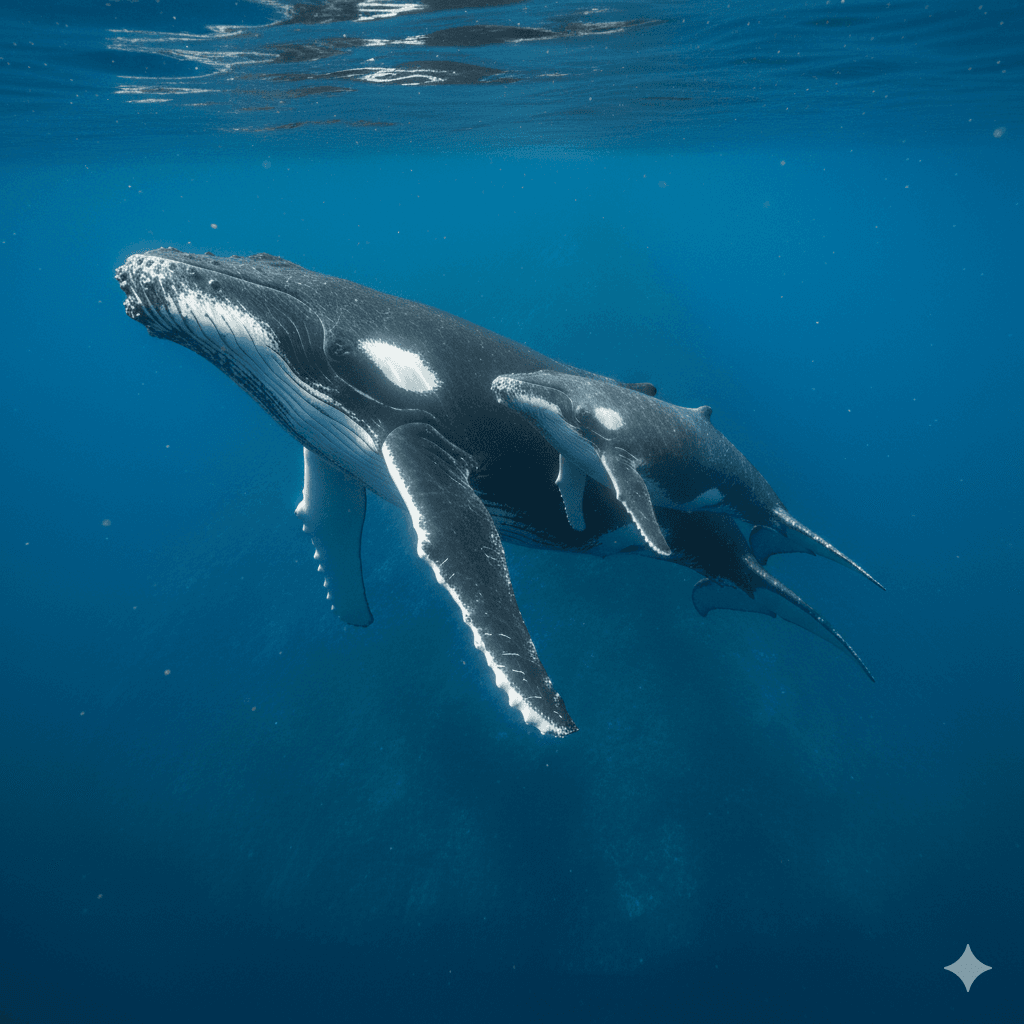
Kambur Balina (Yapay Zeka ile Oluşturulmuştur.)
The humpback whale (Megaptera novaeangliae) is a baleen whale species belonging to the Balaenopteridae (rorqual) family and is the only species within the genus Megaptera. Its common name is derived from the prominent hump on its back. The scientific genus name Megaptera means “large-winged” and refers to its exceptionally long pectoral fins.
Adult humpback whales can reach lengths of up to 60 feet (approximately 18 metres) and weigh up to 40 tonnes. Females are generally larger than males, a trait found in only a few mammal species. Their bodies are primarily black, but individuals display varying amounts of white on their pectoral fins, undersides and the undersurfaces of their flukes. Whales in the Southern Hemisphere typically have more extensive white markings than those in the Northern Hemisphere. Prominent external features include the size of their flippers, the colour and shape of their tails, and the shape of their dorsal fin. The pectoral fins are exceptionally long, reaching nearly one-third of the body length. The leading edges of these flippers contain bumps (tubercles), which are thought to have a sensory function due to their rich nerve supply. The flukes are shaped like a butterfly and can span up to 18 feet (approximately 5.5 metres) in width, with a serrated trailing edge. The pattern of grey and white pigmentation on the underside of the fluke is unique to each individual and is used like a “fingerprint” to identify them. Humpback whales have the highest blubber thickness relative to body size of any whale species.

Humpback Whale (Generated by Artificial Intelligence)
The humpback whale (Megaptera novaeangliae) is a baleen whale species in the Balaenopteridae (rorqual) family and the sole member of the genus Megaptera. This species belongs to the phylum Chordata and the class Mammalia within the kingdom Animalia. The common name derives from the prominent hump on its back. The genus name Megaptera, meaning “large-winged,” refers to its elongated pectoral fins. The species epithet novaeangliae means “New England” and was assigned either because European whalers first encountered the species in those waters or because Mathurin Jacques Brisson regularly observed them along the coast of New England. It was first described by Mathurin Jacques Brisson in 1756, and the current species name novaeangliae was reintroduced in 1932 by Remington Kellogg, referencing Borowski’s 1781 description.
Humpback whales inhabit the major oceans of the world, ranging from polar waters to tropical seas. Their distribution includes the Atlantic, Arctic and Pacific Oceans, as well as waters surrounding Antarctica and the Bering Sea. This species undertakes one of the longest migrations of any mammal. Typically, they migrate to shallow, warm tropical waters near the equator during winter for breeding and calving, and spend the summer months in cold, productive high-latitude feeding grounds. Some populations have been recorded traveling up to 8,000 kilometres between their tropical breeding areas and feeding grounds. Some humpback whales in the North Pacific complete a 3,000-mile (approximately 4,800 km) migration from Alaska to Hawaii in as little as 28 days. During migration, they occur in both coastal and open ocean waters. Humpback whale populations are generally divided into several distinct segments: seven separate populations in the Southern Hemisphere, two in the North Pacific, and two in the North Atlantic Ocean. One population in the Arabian Sea is estimated to have been isolated for 70,000 years.

Humpback Whale (Generated by Artificial Intelligence)
Humpback whales feed from spring through autumn and store fat (blubber) to sustain them through the winter. Their diet consists primarily of krill, copepods, other plankton, and small schooling fish such as herring, capelin, sand lance and Atlantic mackerel. They capture prey by filtering ocean water through their baleen plates, which act as sieves. Feeding strategies include using bubbles, vocalizations, the seafloor and flippers to corral and confuse prey. One feeding method, known as “bubble-net feeding,” involves blowing a circular net of bubbles to concentrate prey, then lunging upward through the centre while swallowing large quantities. This technique can involve dives of up to 20 metres. Humpback whales are highly active at the surface, exhibiting behaviours such as breaching, lobtailing (slapping the water with their flukes), and flipper slapping. They are typically seen in small groups, and groups other than mother-calf pairs rarely remain together for more than a few weeks.
Humpback whales have a lifespan of approximately 80 to 90 years. They reach sexual maturity between the ages of 4 and 5. The breeding season occurs in tropical waters during winter. Gestation lasts 11 to 11.5 months, and females give birth to a single calf on average every 2 to 3 years. Calves are born measuring about 4 to 5 metres in length and weighing approximately 680 kg. Mothers nurse and protect their calves for about a year. Male humpback whales produce complex songs during the winter breeding season. These songs consist of frequencies ranging from 100 Hz to 4 kHz and have been recorded lasting up to seven hours. Although the function of these songs remains debated, they are thought to have echolocation-like properties that help other whales locate one another.

Humpback Whale (Generated by Artificial Intelligence)
Commercial whaling reduced humpback whale populations to more than 95% below historical levels. The International Whaling Commission’s ban on commercial whaling, in effect since 1985, has played a key role in their recovery. Today, the species is classified as Least Concern by the International Union for Conservation of Nature (IUCN). However, under the United States Endangered Species Act (ESA), the Central America and Western North Pacific population segments are listed as Endangered, while the Mexico population segment is listed as Threatened. Major threats include entanglement in fishing gear, ship strikes (particularly in coastal areas with high vessel traffic), vessel disturbance and underwater noise pollution. Climate change is also considered a threat, as it alters the distribution of sea ice in high-latitude feeding areas. The primary natural predators of humpback whales are orcas (killer whales). Their bodies commonly host barnacles and whale lice.
Childerhouse, S., J. Jackson, C. S. Baker, N. Gales, P. J. Clapham, and R. L. Brownell Jr. “Megaptera novaeangliae (Oceania subpopulation) - Humpback Whale.” The IUCN Red List of Threatened Species 2008: e.T132832A3463914. International Union for Conservation of Nature. Accessed October 20, 2025. https://www.iucnredlist.org/species/pdf/3463914
Mindy B. Kurlansky. “Megaptera novaeangliae.” *Animal Diversity Web*. Accessed October 20, 2025. https://animaldiversity.org/accounts/Megaptera_novaeangliae/
NOAA Fisheries. “Humpback Whale.” *NOAA Fisheries*. Accessed October 20, 2025. https://www.fisheries.noaa.gov/species/humpback-whale

Kambur Balina (Yapay Zeka ile Oluşturulmuştur.)
No Discussion Added Yet
Start discussion for "Humpback Whale (Megaptera novaeangliae)" article
Physical Characteristics
Scientific Classification and Nomenclature
Geographic Range and Habitat
Behavior and Diet
Reproduction and Life Cycle
Conservation Status and Threats