This article was automatically translated from the original Turkish version.
Location | Türkiye Istanbul Sultanahmet Square | ||||||||
|---|---|---|---|---|---|---|---|---|---|
Architect(s) | Mimar Sinan | ||||||||
Construction Year | 1556–1557 | ||||||||
Plan Feature | Counter-oriented placement on the same axis | ||||||||
Event that Caused Damage | 1913 Istanbul Fire | ||||||||
Last Restoration | 2008–2010 | ||||||||
Current Use | Touristic bath (known as Ayasofya Hamamı) | ||||||||
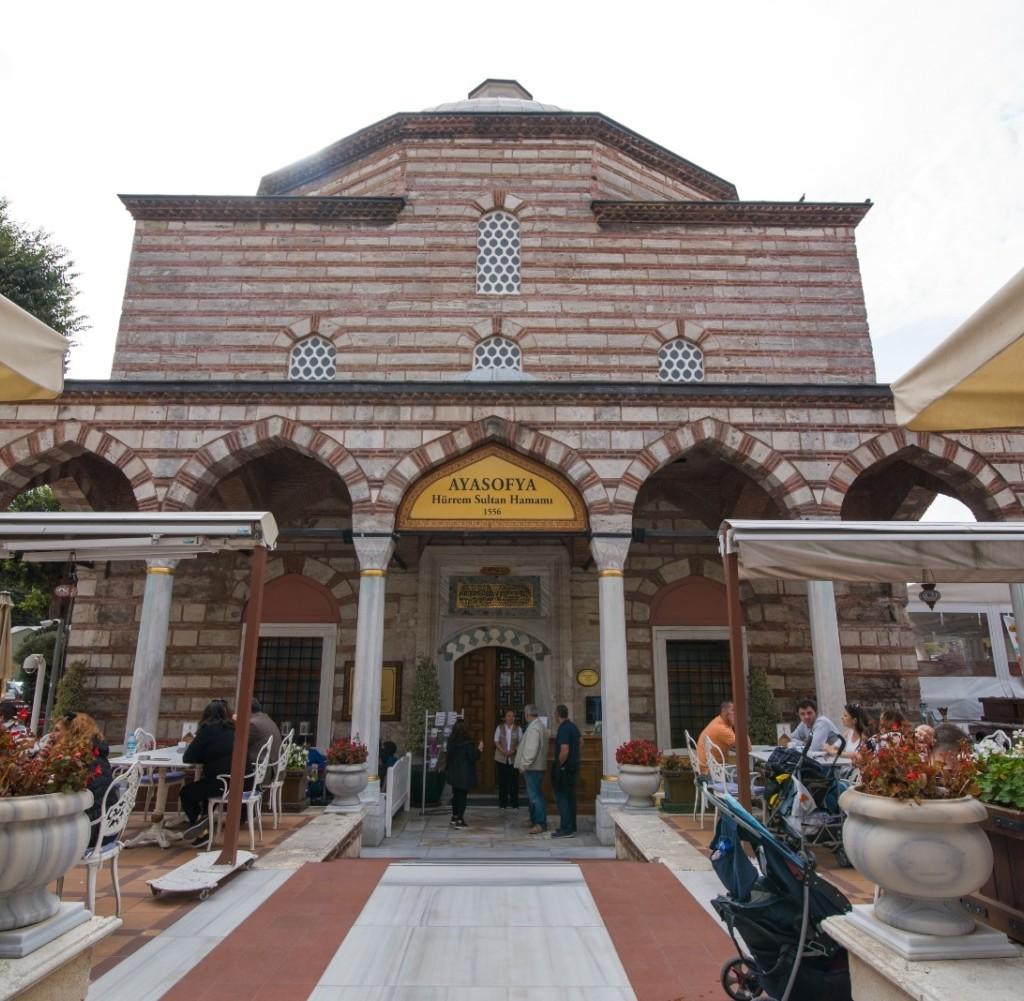
Hürrem Sultan Hamamı is one of the double bathhouses constructed during the classical period of Ottoman architecture, located on Istanbul’s historic peninsula in Sultanahmet Square. It was commissioned by Haseki Hürrem Sultan, wife of Sultan Süleyman the Magnificent, and built by the architect Mimar Sinan between 1556 and 1557. The bathhouse was erected near the site of the Byzantine Zeuxippus Baths, between Hagia Sophia and Sultanahmet Camii.

Hürrem Sultan Hamamı (Istanbul Metropolitan Municipality Cultural Heritage)
The construction date of the bathhouse has been determined through abjad calculations of the inscription located at the entrance as 1556–1557. Its attribution to Mimar Sinan is confirmed in his biographical records, Tezkiretü’l-Bünyan and Tezkiretü’l-Ebniye. The structure was built concurrently with the Süleymaniye Camii to generate income for the charitable endowments established by Hürrem Sultan. Although no formal vakfiye document has survived, it is well documented that bathhouses in the Ottoman period were commonly operated as waqf properties for revenue generation.
Hürrem Sultan Hamamı holds a unique position within Ottoman bath architecture in terms of both planning and execution. The symmetrical yet reversed placement of the women’s and men’s sections along the same central axis creates the building’s distinctive architectural arrangement, stretching 75 metres in length. This unusual layout deviates from the conventional side-by-side arrangement typical of double bathhouses of the period.
At the entrance of each section, large domes rest upon octagonal drums. These areas functioned as changing rooms and cold rooms. Moving along the central axis, one progresses through the warm rooms and finally reaches the hot rooms. The hot rooms feature a star-shaped plan with an octagonal central marble slab (göbek taşı), four iwan-like niches surrounding it, and small private chambers (halvet) at the corners. The floor decoration around the göbek taşı is notable for its star and geometric patterns executed in black, white, blue and red marble.
The changing rooms of both the women’s and men’s sections achieve a monumental appearance through their height of up to 22 metres and the central fountains within them. Access to the women’s section is via a staircase descending from the western facade of the building, while the entrance to the men’s section is located on the northeast facade facing Hagia Sophia. This facade features six marble columns supporting five pointed arches with fluted capitals. The central arch of the arcade is wider and covered by a dome.
The exterior walls of the bathhouse employ a alternating system of stone and brick, with corner joints constructed using finely cut ashlar blocks. The walls of the warm and hot rooms are covered with plaster. Auxiliary units such as the furnace and water reservoir are situated to the south.
The bathhouse remained in active use until 1910, after which it lost its original function. During the 20th century, it was repurposed for non-traditional uses including as a prison, a gasoline storage facility, and a paper warehouse. Severely damaged in the 1913 Istanbul fire, the structure was repaired between 1957 and 1958, and its interior spaces were restored in 1986 with the installation of a new heating system. In 1988 it served as an exhibition hall and later as a sales outlet for DÖSİMM, under the Ministry of Culture and Tourism.
Following a comprehensive restoration initiated in 2008, the bathhouse reopened as a functioning hamam in 2010 and has since become one of Istanbul’s prominent tourist attractions under the name “Ayasofya Hamamı”.
Hürrem Sultan Hamamı is a significant work that demonstrates Mimar Sinan’s innovative approaches and architectural diversity within Ottoman architecture. The equal size of the men’s and women’s sections and their axial symmetry with reversed orientation represent a rare configuration in Ottoman bath design.
Two other structures with similar layout features are the Kızlarağası Hamamı, which no longer survives, and the Fındıklı Molla Çelebi Hamamı, demolished in 1957. Although it is believed that the area of Hürrem Sultan Hamamı may have been connected to Byzantine water structures, no definitive evidence supports this claim. The bathhouse is also known by other names including Haseki Hamamı, Ayasofya Hamamı, and Ayasofya Haseki Hamamı.
Kültürel Miras İBB. "Haseki Hürrem Sultan Hamamı." Accessed June 27, 2025. https://kulturelmiras.ibb.istanbul/haseki-hurrem-sultan-hamami/.
Polat, Turgay. “Hürrem Sultan Hamamı.” *Türkiye Turizm Ansiklopedisi.* Accessed June 27, 2025. https://turkiyeturizmansiklopedisi.com/hurrem-sultan-hamami.

Location | Türkiye Istanbul Sultanahmet Square | ||||||||
|---|---|---|---|---|---|---|---|---|---|
Architect(s) | Mimar Sinan | ||||||||
Construction Year | 1556–1557 | ||||||||
Plan Feature | Counter-oriented placement on the same axis | ||||||||
Event that Caused Damage | 1913 Istanbul Fire | ||||||||
Last Restoration | 2008–2010 | ||||||||
Current Use | Touristic bath (known as Ayasofya Hamamı) | ||||||||
No Discussion Added Yet
Start discussion for "Hürrem Sultan Hamamı" article
History
Architectural Features and Layout
Functional Changes and Restorations