


This article was automatically translated from the original Turkish version.
+2 More
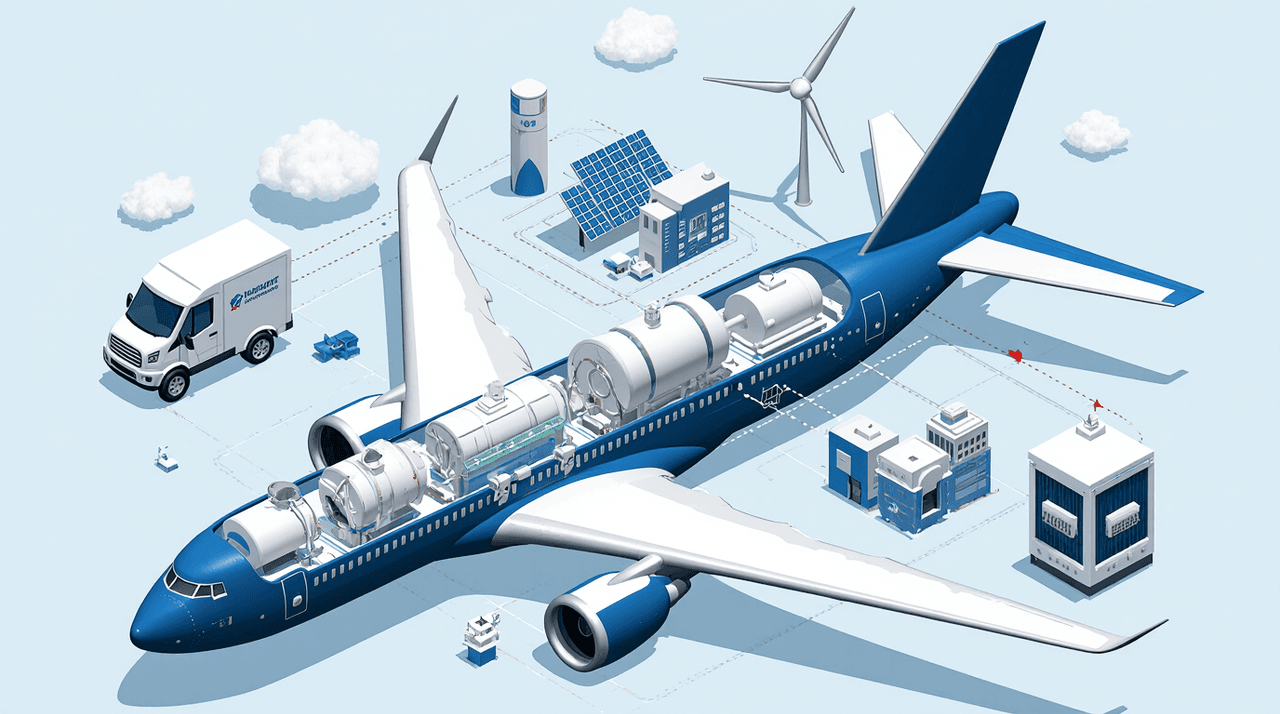
Hydrogen Fuel Systems (Generated with Artificial Intelligence)
Advantage(s) | There is no CO₂ emission. It is lightweight and has high energy content. Noise and vibration levels are low. | ||||||||
|---|---|---|---|---|---|---|---|---|---|
Application Area(s) | Short- and medium-range passenger aircraft and airport vehicles regional air transport | ||||||||
Challenge(s) | Requires cryogenic storage and necessitates safety and infrastructure transformation. demands a large fuel volume | ||||||||
Usage Methods | Fuel Cell: Converts hydrogen into electricity to power motors; Direct Combustion: Produces thrust by burning hydrogen in turbines. | ||||||||
Hydrogen fuel systems encompass the technologies and equipment that convert the chemical energy of hydrogen into usable power. In these systems, hydrogen generates energy either through combustion or via electrochemical reactions to produce electricity. Structurally, they consist of storage units, transmission lines, pressure and temperature control mechanisms, and safety sensors.
In general terms, hydrogen fuel systems refer to the technological infrastructure that uses hydrogen as an energy carrier to generate power. This infrastructure enables the safe storage, transportation, and conversion of hydrogen into energy.
Hydrogen fuel systems are among the most important technological approaches with the potential to enable carbon-free energy conversion in the aviation industry. The environmental impacts of fossil fuel dependency and global sustainability goals have elevated hydrogen’s importance as an alternative energy carrier. The primary advantage of hydrogen as a fuel is that it emits no carbon dioxide during combustion or electrochemical conversion. Therefore, hydrogen-based aviation systems are regarded as a solution that aligns with climate targets and supports long-term energy security.
Hydrogen has a high specific energy density, offering approximately three times the energy efficiency per unit mass compared to conventional jet fuels. However, its volumetric energy density is very low, necessitating larger fuel storage volumes in aircraft design. In aviation, hydrogen can be used in two forms: liquefied hydrogen (LH₂) and compressed gaseous hydrogen (GH₂). Liquefied hydrogen is considered more suitable for flight applications due to its high energy density and low pressure requirements. However, its storage at -253°C demands advanced insulation, cryogenic tanks, and thermal management systems.
One of the most complex components of hydrogen fuel systems is the storage and distribution infrastructure. To prevent evaporation of LH₂ at low temperatures, multilayer insulation materials, vacuum-jacketed piping, and active thermal control systems are employed. Advanced heat exchangers maintain fuel pressure stability by controlling evaporation and ensuring consistent delivery to the engine. Additionally, composite materials and specialized alloys are preferred in fuel lines to prevent hydrogen embrittlement. Ground refueling processes are also being redesigned, with autonomous or robotic fueling systems under development.

Hydrogen Use in Aviation (Generated by Artificial Intelligence)
Two primary methods are used to convert hydrogen into energy: fuel cell-based electric propulsion systems and direct hydrogen-combusting gas turbines. Fuel cells generate electricity through the electrochemical reaction of hydrogen and oxygen; these systems produce zero carbon emissions and operate at low noise levels. The most common fuel cell types are low-temperature (LT-PEMFC) and high-temperature (HT-PEMFC) polymer electrolyte membrane fuel cells. LT-PEMFC systems offer high power density but are complex due to challenges in cooling and humidity control. HT-PEMFC systems operate at higher temperatures, reducing the need for cooling and humidification and enabling simpler integration.
When hydrogen is combusted directly, energy can be produced by modifying conventional gas turbines. In such turbines, fuel injection, flame stability, and NOx emission control are the most critical technical challenges. Low-temperature and premixed combustion systems are effective in reducing emissions. Manufacturers such as Rolls-Royce, Airbus, and General Electric have conducted test flights with hydrogen-adapted turbines.
Thermal management is a critical aspect of hydrogen system operation. Both fuel cells and cryogenic storage systems can suffer performance losses under conditions of excessive heating or cooling. Therefore, integrated heat recovery systems, thermoacoustic coolers, and multilayer insulation materials are used to balance heat flow. Additionally, continuous monitoring is implemented using optical sensors, electrochemical detectors, and emergency venting systems to mitigate safety risks such as hydrogen leakage, ignition, and embrittlement.
The environmental performance of liquid hydrogen varies depending on its production method. “Green hydrogen,” produced via electrolysis using renewable energy sources, significantly reduces carbon emissions. However, energy consumption during production, liquefaction, and transportation affects overall life cycle emissions. Life cycle analyses indicate that renewable energy-based hydrogen has 60–70 percent lower greenhouse gas impact compared to conventional jet fuel. Nevertheless, water vapor emitted during hydrogen combustion can contribute to contrail formation, leading to short-term radiative effects; research on this issue is ongoing.
The integration of hydrogen into aviation is not limited to aircraft technology alone. Airports must redesign hydrogen storage, transportation, refueling stations, and safety procedures. Reports by the International Air Transport Association (IATA) and the Airports Council International (ACI) emphasize that hydrogen can serve both as an aircraft fuel and as an energy source for ground support equipment. In the medium term, hydrogen-based systems are projected to enter commercial service from 2035 onward.
Hydrogen fuel systems play a fundamental role in the decarbonization of aviation. However, their widespread adoption requires the simultaneous development of highly efficient hydrogen production chains, safe cryogenic storage technologies, and appropriate infrastructure standards. Current research demonstrates the feasibility of hydrogen, particularly for short- and medium-haul flights. In the long term, advanced fuel cells, hybrid systems, and liquid hydrogen-based engines are regarded as the most promising components for achieving zero emissions in aviation.
Bridgelall, Raj. “Hydrogen-Powered Aviation: Insights from a Cross-Sectional Scientometric and Thematic Analysis of Patent Claims.” *Applied Sciences* 15, no. 10 (2025): 5555. Accessed November 7, 2025. https://doi.org/10.3390/app15105555.
Gopalasingam, Daisan, Bassam Rakhshani, and Cristina Rodriguez. “Hydrogen Propulsion Technologies for Aviation: A Review of Fuel Cell and Direct Combustion Systems Towards Decarbonising Medium-Haul Aircraft.” *Hydrogen* 6, no. 4 (2025): 92. Accessed November 7, 2025. https://doi.org/10.3390/hydrogen6040092.
International Air Transport Association (IATA). *Hydrogen for Aviation – Facts and Insights.* IATA Publications. Accessed November 7, 2025. https://www.iata.org/globalassets/iata/publications/sustainability/h2-for-aviation-facts.pdf.
Kazula, Stefan, Stefanie de Graaf, and Lars Enghardt. “Review of Fuel Cell Technologies and Evaluation of Their Potential and Challenges for Electrified Propulsion Systems in Commercial Aviation.” *Journal of the Global Power and Propulsion Society* 7 (2023): 43–57. Accessed November 7, 2025. https://doi.org/10.33737/jgpps/158036.
Miller, T. R., M. Chertow, and E. Hertwich. “Liquid Hydrogen: A Mirage or Potent Solution for Aviation's Climate Woes?” *Environmental Science & Technology* 57, no. 26 (2023): 9627–9638. Accessed November 7, 2025. https://doi.org/10.1021/acs.est.2c06286.
Soleymani, Mehdi, Vahid Mostafavi, Marie Hebert, Sousso Kelouwani, and Loïc Boulon. “Hydrogen Propulsion Systems for Aircraft: A Review on Recent Advances and Ongoing Challenges.” *International Journal of Hydrogen Energy* 91 (2024): 137–171. Accessed November 7, 2025. https://doi.org/10.1016/j.ijhydene.2024.10.131.
Tiwari, Saurav, Michael Pekris, and John Doherty. “A Review of Liquid Hydrogen Aircraft and Propulsion Technologies.” *International Journal of Hydrogen Energy* 57 (2024): 1174–1196. Accessed November 7, 2025. https://doi.org/10.1016/j.ijhydene.2023.12.263.
Yusaf, Talal, Abu Shadate Faisal Mahamude, Kumaran Kadirgama, Devarajan Ramasamy, Kaniz Farhana, Hayder A. Dhahad, and ABD Rahim Abu Talib. “Sustainable Hydrogen Energy in Aviation – A Narrative Review.” *International Journal of Hydrogen Energy* 52, Part C (2024): 1026–1045. Accessed November 7, 2025. https://doi.org/10.1016/j.ijhydene.2023.02.086.

Hydrogen Fuel Systems (Generated with Artificial Intelligence)
Advantage(s) | There is no CO₂ emission. It is lightweight and has high energy content. Noise and vibration levels are low. | ||||||||
|---|---|---|---|---|---|---|---|---|---|
Application Area(s) | Short- and medium-range passenger aircraft and airport vehicles regional air transport | ||||||||
Challenge(s) | Requires cryogenic storage and necessitates safety and infrastructure transformation. demands a large fuel volume | ||||||||
Usage Methods | Fuel Cell: Converts hydrogen into electricity to power motors; Direct Combustion: Produces thrust by burning hydrogen in turbines. | ||||||||
No Discussion Added Yet
Start discussion for "Hydrogen Fuel Systems" article
Properties of Hydrogen as an Energy Carrier
Fuel Storage and Distribution Systems in Aviation
Fuel Cell and Combustion Systems
Thermal Management and Safety Systems
Environmental Impact and Life Cycle Assessment
Infrastructure and Operational Transformation