


This article was automatically translated from the original Turkish version.
Hydroponic Farming
Main System Types | Aeroponics Aggregate (Media-based) Systems Deep Water Culture (DFT) Nutrient Film Technique (NFT) | ||||||||
|---|---|---|---|---|---|---|---|---|---|
Advantage(s) | Controlled Production Rapid Growth Land Use Efficiency Water Conservation | ||||||||
Disadvantages | Disease Risk Energy Dependency Technical Knowledge Requirement High Installation Cost | ||||||||
Commonly Grown Products | Animal Feed (Crop) Fruits Herbs Vegetables | ||||||||
Hydroponic farming is a soilless cultivation method in which plants are grown in a water-based nutrient solution that provides the minerals their roots require. In this system, plant roots may be suspended directly in the nutrient solution or supported by an inert growing medium such as perlite, gravel, or rockwool. The term "hydroponic" is derived from the Greek words "hydro" meaning water and "ponos" meaning labor.

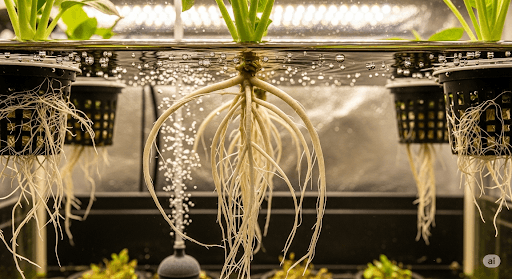
Modern Plant Production in a Hydroponic System (Generated by Artificial Intelligence)
The concept of soilless plant cultivation dates back to ancient times; the Hanging Gardens of Babylon and the floating gardens of the Aztecs are among its early examples. Modern hydroponic systems began with rudimentary applications in England in 1699. The system evolved in Europe during the 1920s and 1930s with the introduction of plant nutrient solutions. In India, the method was introduced in 1946 by British scientist W. J. Shalto Douglas, who established a laboratory in West Bengal.
Commercial development of the system occurred at the beginning of the 2000s and was further commercialized between 2004 and 2005 for the production of animal feed (forage). In Türkiye, starting in 2009, some companies began adopting it as an alternative method for roughage production. Commercial hydroponic farms were established worldwide during the 1960s and 1970s, and by the 1980s, facilities equipped with automation and computer systems became widespread.
Hydroponic systems are classified according to the method of nutrient solution delivery and whether or not a growing medium is used. Broadly, they fall into two main categories: liquid (non-aggregate) systems and aggregate systems.
In these systems, no solid medium supports the plant roots; the roots are suspended directly in or above the nutrient solution.
In these systems, a solid and inert growing medium (substrate) is used to support the plant roots. Systems may be open or closed depending on whether the nutrient solution is reused.
The nutrient solution is delivered to the plant root zone in the form of droplets. This method is commonly used in bag, pot, or bed culture.
Inorganic materials include rockwool, perlite, vermiculite, pumice, sand, gravel, and expanded clay. Organic materials include peat, coconut coir, and wood shavings.
Closely related to hydroponics, this method suspends plant roots in air while the nutrient solution is sprayed or misted onto them. This system provides high levels of oxygen to the root zone.
The foundation of hydroponic farming lies in nutrient solutions containing all the macro and micronutrients required by plants. The chemicals used to prepare these solutions must be fully soluble in water. Commonly used salts include potassium nitrate (N, K), calcium nitrate (Ca, N), and magnesium sulfate (Mg, S).
For the system to succeed, environmental factors must be carefully controlled:
Hydroponic farming is a versatile technology used for various purposes.
In animal husbandry, particularly for ruminant nutrition, hydroponics is widely used to produce fresh forage. Grains such as barley, wheat, and oats are germinated and harvested in controlled environments within approximately seven days. This method ensures a supply of fresh feed throughout the year. It has been reported that hydroponically grown barley achieves digestibility levels of up to 98% and crude protein content ranging from 17% to 22%.
Many vegetables and fruits, including lettuce, tomatoes, cucumbers, peppers, strawberries, and various greens, are commercially grown using hydroponic systems. This method enables food production in areas unsuitable for conventional agriculture or in urban environments.
Hydroponic technology is also applied under special conditions such as arid regions (e.g., Israel), areas with limited land due to high population density (e.g., Tokyo), and space programs (as researched by NASA).
Bingöl, B. “Alternatif Tarım Yöntemleri; Aeroponik, Akuaponik, Hidroponik.” *Harman Time Dergisi* 7, no. 82 (2019): 34–42. Accessed August 16, 2025. https://www.researchgate.net/publication/346052997_Alternatif_Tarim_Yontemleri_Aeroponik_Akuaponik_Hidroponik.
Bulut, Nurten. *Derin Öğrenme ve Makine Öğrenmesi Yöntemleri ile Hidroponik Tarım*. Master's thesis, Necmettin Erbakan Üniversitesi, 2023. Accessed August 16, 2025. https://www.proquest.com/openview/cd93c282343097450f39219c103c0856/1?pq-origsite=gscholar&cbl=2026366&diss=y.
Kılıç, Ünal. 2016. “Hydroponic Systems in Forage Production.” *Turkish Journal of Agriculture - Food Science and Technology* 4, no. 9: 793–99. Accessed August 16, 2025. https://doi.org/10.24925/turjaf.v4i9.793-799.859.
Sardare, Mamta D., and Shraddha V. Admane. “A Review on Plant without Soil-Hydroponics.” *International Journal of Research in Engineering and Technology* 2, no. 3 (2013): 299–304. Accessed August 16, 2025. https://citeseerx.ist.psu.edu/document?repid=rep1&type=pdf&doi=5aa3e080c162f361f657cc700a9ee169ef1fd3b1.

Hydroponic Farming
Main System Types | Aeroponics Aggregate (Media-based) Systems Deep Water Culture (DFT) Nutrient Film Technique (NFT) | ||||||||
|---|---|---|---|---|---|---|---|---|---|
Advantage(s) | Controlled Production Rapid Growth Land Use Efficiency Water Conservation | ||||||||
Disadvantages | Disease Risk Energy Dependency Technical Knowledge Requirement High Installation Cost | ||||||||
Commonly Grown Products | Animal Feed (Crop) Fruits Herbs Vegetables | ||||||||
Historical Development
System Types and Operation
Liquid Hydroponic Systems
Aggregate Hydroponic Systems:
Drip Irrigation System
Growing Media (Substrates)
Aeroponic Systems
Nutrient Solutions and Environmental Control
Applications
Forage Production:
Food Production
Special Applications
Advantages and Disadvantages
Advantages
Disadvantages