

Ibrahim Traoré
Doğum tarihi | 1988-03-14 | ||||||||
|---|---|---|---|---|---|---|---|---|---|
Yaş | 37 | ||||||||
Previous Duty | Captain – Burkina Faso Armed Forces | ||||||||
Military Education | Georges-Namoano Academy, Royal Air Force School | ||||||||
Education | University of Ouagadougou (Geology) | ||||||||
Political Movement | MPSR (Patriotic Movement for Safeguard and Restoration) | ||||||||
Language(s) | French | ||||||||
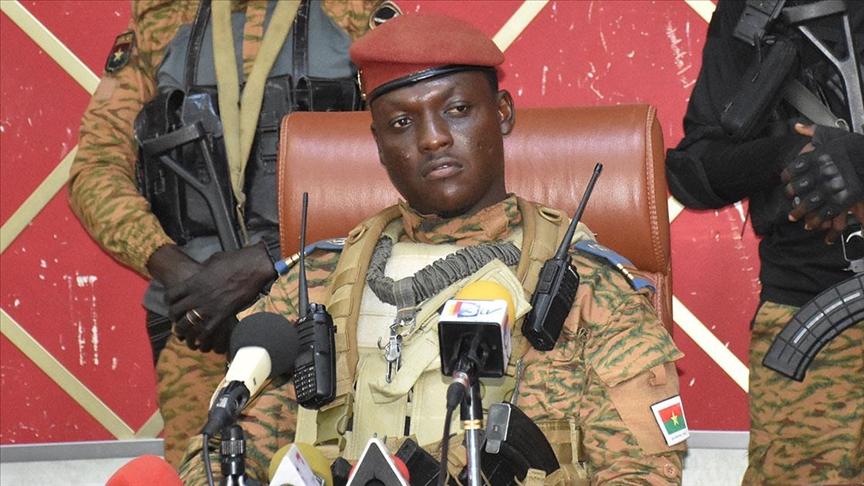
Ibrahim Traoré (born 14 March 1988, Bondokuy, Burkina Faso) is a military officer of the Burkina Faso Armed Forces and has been the country’s transitional head of state since 2022. Born in the village of Kéra, Traoré pursued higher education in geology alongside his military career and assumed control of the country following the military intervention in 2022. He continues to serve as interim president of Burkina Faso.
Ibrahim Traoré was born on 14 March 1988 in the village of Bondokuy (Kéra), located in the Mouhoun region of western Burkina Faso. He began his primary education in his native village and later completed secondary school in Bobo-Dioulasso, graduating from Accart Mixed High School. Following secondary education, in 2006 he enrolled at the Faculty of Science and Technology of Ouagadougou University (now known as Joseph Ki-Zerbo University). During his university studies, he specialized in the Department of Chemistry-Biochemistry-Biology-Geology, focusing his undergraduate and graduate academic work on geology, and graduated in 2010 with a Master’s degree in Geology.
After completing his university education, Traoré pursued a military career and applied to the entrance examination of the Georges Namoano Military Academy (Académie Militaire Georges Namoano – AMGN) located in the Nahouri province of central-southern Burkina Faso. After successfully passing the examination, he underwent two years of intensive training at the academy and graduated second in his class. As a result of this achievement, he joined the armed forces with the rank of Second Lieutenant.
Ibrahim Traoré’s military career began after his graduation from the Georges Namoano Military Academy. He was officially promoted to the rank of Lieutenant in 2014 and held various military posts during this period, gaining particular recognition for his field experience. He actively participated in operations against jihadist groups operating in northern and eastern Burkina Faso, and his combat experience led to his advancement within the military hierarchy. By 2020, he had been promoted to the rank of Captain and assumed a more active role in implementing national security policies.
Ibrahim Traoré’s political ascent coincided with a period of deepening security crises and administrative instability within the country. On 24 January 2022, he joined the MPSR (Patriotic Movement for Safeguard and Restoration – Patriotik Koruma ve Yeniden İnşa için Yurtsever Hareket), a military faction that advocated for intervention in response to rising insecurity. This movement criticized the administration of then-President Paul-Henri Sandaogo Damiba, particularly for its perceived ineffectiveness in combating jihadist attacks.
On 30 September 2022, a military coup removed Paul-Henri Damiba from power, and Traoré effectively assumed control of the country. On 21 October 2022, he took the oath of office as interim president in a formal ceremony and officially began his leadership of Burkina Faso’s transitional process. Since assuming power, Traoré has implemented comprehensive policies across multiple domains, including security, economy, social welfare, cultural independence, and foreign relations. As of 2025, he continues to serve as leader of the transitional period.
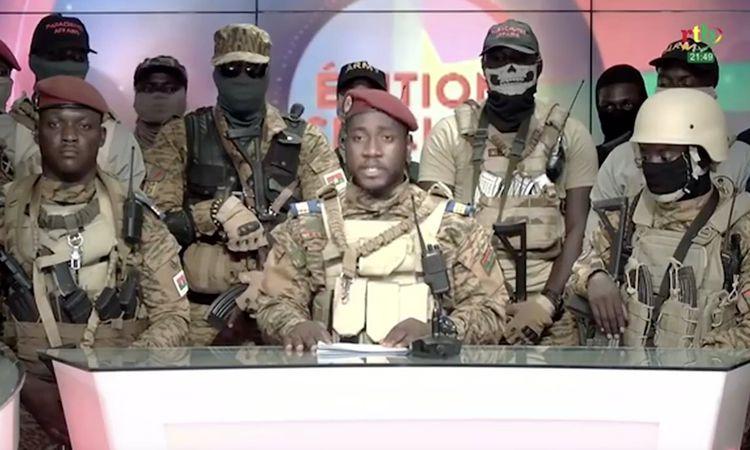
Reading of the 30 September 2022 Coup Announcement (AA)
As of 2025, Captain Ibrahim Traoré, born on 14 March 1988, is the world’s youngest head of state. He is approximately three and a half months younger than Ecuador’s President Daniel Noboa, the world’s second youngest head of state, and 55 years younger than Cameroon’s President Paul Biya, the world’s oldest head of state at 92.
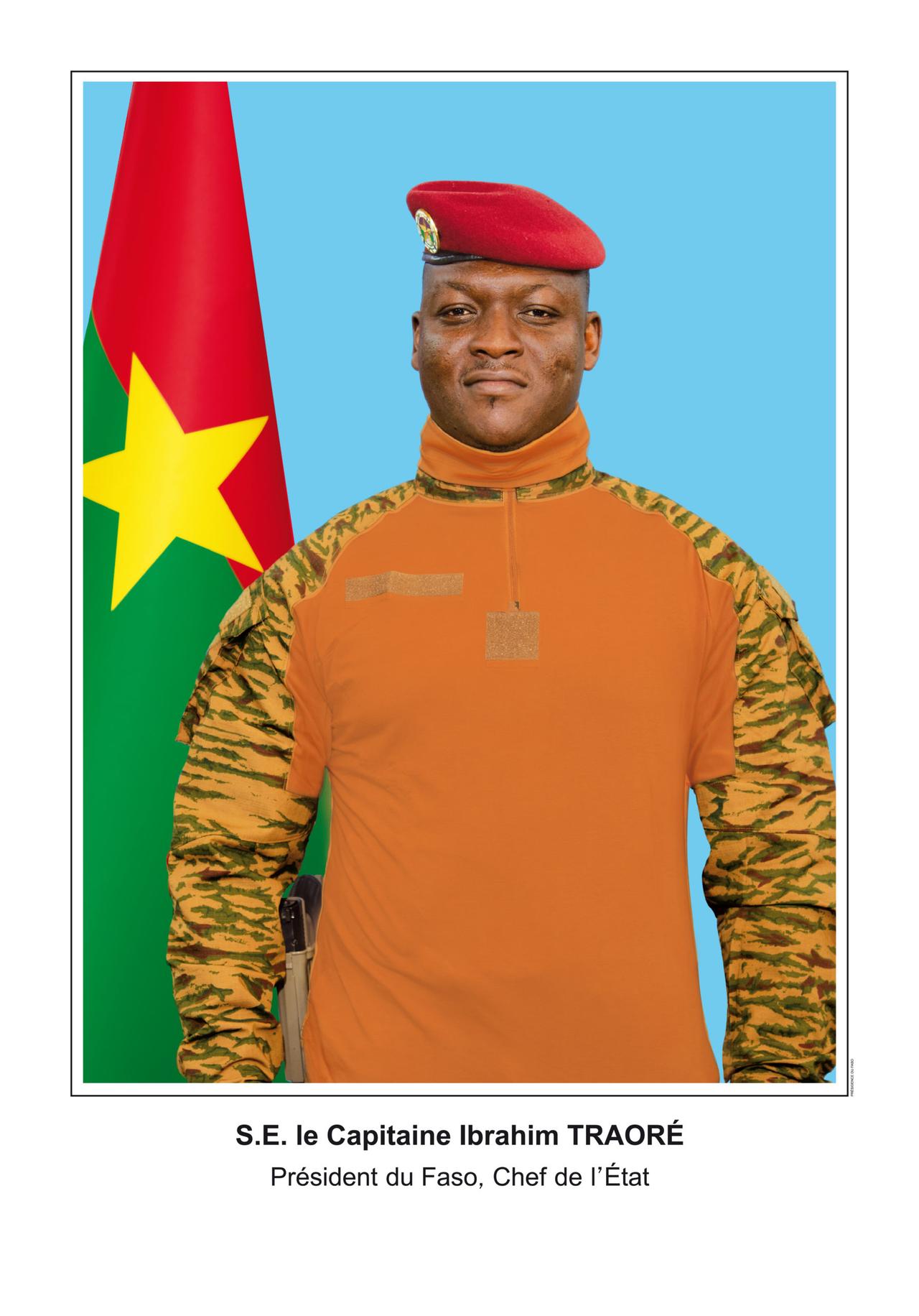
Burkina Faso President Ibrahim Traoré (Government of Burkina Faso Official Website)
Upon assuming power, Traoré positioned himself as the foremost advocate of national defense, citing the escalating threat posed by jihadist attacks. In public statements, he argued that holding elections without first ensuring a secure environment would endanger both the population and the state, and consequently postponed the electoral calendar. By the end of 2023, he had successfully suppressed coup attempts against his rule and, following consultation processes, extended his term by an additional five years.
The Traoré administration has made reducing the national economy’s dependence on external sources a top priority. To this end, it has sought to limit the influence of international financial institutions on domestic economic decision-making and adopted a cautious stance toward borrowing. Notably, the government rejected credit offers from institutions such as the International Monetary Fund (IMF) and the World Bank, representing the most concrete examples of this policy.
To support economic development, the administration has prioritized industrialization initiatives. New facilities have been established across various sectors to encourage local production and reduce reliance on raw material exports. These include a refinery for processing precious minerals, food processing plants designed to add value to agricultural products, and industrial units dedicated to cotton, one of the country’s key livelihood resources.
Simultaneously, strengthening rural production has been a key priority. Farmers have been provided with modern equipment and machinery to increase agricultural mechanization, and technical tools to improve irrigation and production efficiency have been delivered to rural communities. Additional support has been extended in the form of vehicles to facilitate rural transport and logistics. These measures aim to enhance agricultural output capacity and promote more active economic participation by rural populations.
Agricultural policies have aimed to increase production capacity while reinforcing food security. Strategic crops have seen expanded cultivation, with particular emphasis placed on achieving self-sufficiency in essential foodstuffs. This expansion in agricultural output has not only improved domestic consumption capacity but has also supported economic participation among rural populations.
A significant dimension of the agricultural strategy has been the Agro-Pastoral Development Strategy, which adopts an integrated approach combining crop production and livestock farming to strengthen the food supply chain. The administration aims, within this framework, to meet the majority of the country’s food needs through local production in the future. This approach is designed to reduce external dependency, improve the economic standing of rural producers, and establish durable national food security.
The long-term impact of these policies is expected to extend beyond merely increasing production volumes. They are anticipated to foster modernization in agriculture, improve irrigation techniques, generate added value along the production chain, and strengthen rural infrastructure.
Among the first measures announced after Traoré assumed office was a commitment to discipline and savings in public spending. Restrictions were imposed on the financial benefits of ministers and members of parliament, while salary improvements were granted to public servants. This approach has been interpreted as an effort to achieve balance in income distribution within public administration.
The administration has also taken steps to address social needs beyond income policy. A large-scale housing project has been launched to meet the demand for social housing, particularly targeting displaced citizens. Financed directly from the state budget, this social housing initiative aims to improve living conditions for vulnerable groups and promote planned urban development.
These initiatives demonstrate the administration’s prioritization of social justice and policies that directly affect broad segments of the population. The simultaneous pursuit of fiscal restraint and social programs reflects the state’s commitment to maintaining economic stability while safeguarding the population’s fundamental needs.
During Traoré’s tenure, several symbolic changes have been introduced to emphasize cultural independence. Judges and other judicial personnel now wear traditional garments made from Faso Dan Fani fabric in courtrooms. This practice is viewed as a clear expression of the desire to distance the country culturally from decades of French influence. Additionally, the reburial of revolutionary leader Thomas Sankara’s remains and the administration’s characterization of its mission as the “Progressive and Popular Revolution” align with policies that highlight Pan-African identity.
A significant shift has occurred in foreign relations. As of 2023, the Russian Federation reopened its embassy in Burkina Faso, while French military personnel were withdrawn from the country’s territory. To strengthen regional security cooperation, Burkina Faso, along with its neighbors Mali and Niger, established a new regional alliance called the Alliance of Sahel States (AES). Within this framework, efforts have been initiated to develop a common provisional currency and coordinated security strategies.
Akeyo, Millicent. "Why Is Burkina Faso’s Traoré Seen as a ‘Different’ Leader?" TRT Global. Accessed August 6, 2025. https://trt.global/afrika-english/article/5729903d809f.
Anadolu Ajansı. “Burkina Faso Cumhurbaşkanı Traoré, Seçimlerin Öncelik Olmadığını Söyledi.” Accessed August 5, 2025. https://www.aa.com.tr/tr/dunya/burkina-faso-cumhurbaskani-traore-secimlerin-oncelik-olmadigini-soyledi/3004383.
Anadolu Ajansı. “Burkina Faso’da Ordu İktidara El Koydu.” Accessed August 5, 2025. https://www.aa.com.tr/tr/dunya/burkina-fasoda-ordu-iktidara-el-koydu/2699634.
BBC News. “Ibrahim Traoré: Burkina Faso’s Leader Who Says He Fears Only God.” Accessed January 6, 2024. https://www.bbc.com/news/articles/c1egely9v3go.
Picryl. “Ibrahim Traoré, Président de la Transition du Burkina Faso (2023).” Accessed August 6, 2025. https://picryl.com/media/ibrahim-traore-president-de-la-transition-du-burkina-faso-2023-6e75f1.
Presidency of the Faso. "Biographie du Président." Accessed August 2, 2025. https://www.presidencedufaso.bf/biographie-du-president/.
Presidency of the Faso. "Photo Officielle." Accessed August 2, 2025. https://www.presidencedufaso.bf/photo-officielle/.
Sidwaya. “Ibrahim Traoré, Président de la Transition: Parcours d’un Artilleur.” Accessed August 2, 2025. https://www.sidwaya.info/ibrahim-traore-president-de-la-transition-parcours-dun-artilleur/.
TRT Afrika English. “Ibrahim Traoré: The World’s Youngest Leader.” Accessed August 2, 2025. https://trt.global/afrika-english/article/03eb4ce7df6c.
VOA Africa. “Traoré Officially Appointed Burkina Faso President.” Accessed October 14, 2022. https://www.voaafrica.com/a/traore-officially-appointed-burkina-faso-president-/6778569.html.

Ibrahim Traoré
Doğum tarihi | 1988-03-14 | ||||||||
|---|---|---|---|---|---|---|---|---|---|
Yaş | 37 | ||||||||
Previous Duty | Captain – Burkina Faso Armed Forces | ||||||||
Military Education | Georges-Namoano Academy, Royal Air Force School | ||||||||
Education | University of Ouagadougou (Geology) | ||||||||
Political Movement | MPSR (Patriotic Movement for Safeguard and Restoration) | ||||||||
Language(s) | French | ||||||||
Education
Military Career
Political Rise and Ascension to Power
Presidency and Policies
Security and Governance
Economic and Industrial Policies
Agriculture and Food Security
Social Policies
Cultural and Symbolic Reforms
Foreign Policy and Security Alliances