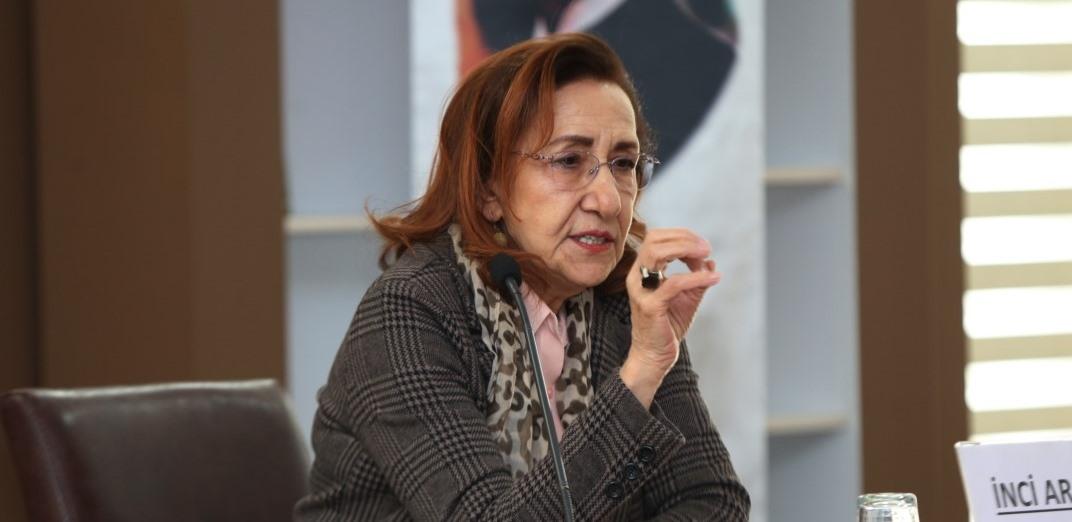



Inci Aral was born on November 27, 1944, in Denizli. Her father, Şahabettin Aral, was a forest engineer from Alanya, while her mother, Ayfer Hanım, was the daughter of an Istanbul family, and they married through an arranged match. The first major turning point in Aral’s life began in late 1948, when her father suffered a stroke at the age of thirty-five. After the stroke, Şahabettin Aral could no longer speak properly and began using a cane; his psychological state deteriorated. When the family moved to Manisa in 1952, one day while Inci Aral was alone at home, her father attempted to hang himself from a medlar tree in the garden. Aral has said that this event created a deep fracture and wound in her psyche, making her feel insecure, introverted, and neurotic. Her father died in 1953 at the age of forty, following a second stroke after this suicide attempt. Two years after her father’s death, in 1955, her mother Ayfer Hanım also became ill with high blood pressure and suffered a stroke that left her paralyzed. She passed away a few months after leaving the hospital, when Inci Aral was eleven years old. After her mother’s death, the responsibility of caring for the children fell to their aunts. Inci Aral moved in with her aunt in Bursa, while her younger sister Sevil was taken in by another aunt in Muğla. Her older brother was already attending a boarding school, and thus the family was completely fragmented.
Due to her father’s civil service postings, Aral spent her childhood in various towns and cities across Anatolia, including Denizli, Niksar, Bolu, Karadeniz Ereğli, and Manisa. She began primary school in Bolu in 1950.
In the early years of her schooling, alongside regularly delivered books and magazines at home, she preferred reading several crates of books she found in the attic of their house to playing. When her mother began working, Inci Aral was assigned household chores, yet she never abandoned her passion for reading. While living with her aunt in Bursa, she had a disciplined childhood and carried the responsibility of being an “exemplary student” at Çelebi Mehmet Middle School, where her uncle was principal. This status made her a more serious and shy student. During middle school, her curiosity about literature allowed her to read works by important authors such as Cahit Sıtkı Tarancı and Halikarnas Balıkçısı. At the age of thirteen, her first poem was published in a wall newspaper and she received her first award. She completed her high school education as a free boarding student at the Manisa Girls’ Teacher Training School. During this time, she extensively used the school library and read Russian, English, and French classics. She loved writing letters and stated that she felt a need to validate her existence by seeking approval from others. She continued her higher education at the Gazi Institute of Education in the Painting and Crafts Department. She did not excel in subjects other than painting and literature. Her training in painting influenced the way characters in her works engage with art.
Her passion for writing began with poetry, letters, and diaries. She entered the world of publication in 1976, when she submitted four short stories for her first collection, “Ağda Zamanı,” to the magazines Varlık and Türk Dili. These stories received great acclaim and encouraged her. In 1979, she self-published her first short story collection, “Ağda Zamanı.” The book attracted attention in literary circles and won the Akademi Bookstore “First Book Success Award” in 1980. In 1983, she received the Nevzat Üstün Short Story Award for her work “Kıran Resimleri,” which recounts the 1978 Kahramanmaraş events.
Her first novel, “Ölü Erkek Kuşlar,” written in 1991, earned her the Yunus Nadi Novel Award. In 2000, she won the Yunus Nadi Short Story Award again for her collection “Gölgede Kırk Derece.” In 2004, her novel “Mor” received the Orhan Kemal Novel Prize.
She began her writing career with short stories, but after “Ölü Erkek Kuşlar,” she focused primarily on novels.
Inci Aral centers her works on women and examines their various issues—divorce, infidelity, suicide, motherhood, love, loneliness, boarding school life, and art. She approaches the psychological states of her female characters and their struggles to exist in society with the precision and success of a psychologist. Her novels possess the qualities of psychological fiction and also address themes such as communication breakdown, love, marriage, sexuality, suicide, religion, politics, death, family, and art. Aral has stated that she does not consider herself a “woman’s voice” in women’s writing and does not subscribe to the view that gender creates immutable differences in linguistic, psychological, intellectual, and social conditions. According to her, the feminine and masculine aspects within every individual are in constant conflict. She argues that rejecting or demonizing men prevents reconciliation and believes that the feminist movement cannot succeed without drawing men into its fold.
She says there are two reasons she writes more about women: first, to stand against injustice and stand beside the oppressed woman in a society where women are treated as second-class citizens; second, because women’s lives are rich and they express themselves with great sincerity. When writing about women, she also writes about men, since a large part of women’s problems are connected to men.
Aral’s works reflect the subjectivity and unconventional nature of her view of life. She does not shy away from incorporating her own life story and way of engaging with life into her writing. It is possible to say that the losses and ruptures of her childhood and youth became the source of her creativity. Particularly, her novel “Ölü Erkek Kuşlar” bears clear traces of her own life—Suna’s early loss of her father, her mother’s employment, her boarding school experience, her marriage, and her divorce. After being diagnosed with cancer and confronting death, she felt it would be beneficial to tell her own story in her own words and completed this confrontation by writing down her experiences.
Inci Aral currently lives with her husband, Ali Gür, in their home in Çengelköy, Istanbul. She has no children from her second marriage. After becoming a grandmother, she began writing children’s books. In 2019, she published an autobiographical children’s book titled “İnci Aral Küçükken Ne Olmak İstiyordu?”
Altıkulaç Demirdağ, Refika. “Aral, İnci.” *Türkiye Edebiyatı İsimler Sözlüğü*. Accessed July 1, 2025. https://teis.yesevi.edu.tr/madde-detay/aral-inci
Baykal, Nezaket. *İnci Aral’ın Hikâye ve Romanlarında Kadın*. Master's thesis, İstanbul University, Department of Turkish Language and Literature, Department of New Turkish Literature, İstanbul, 2011. https://nek.istanbul.edu.tr/ekos/TEZ/47516.pdf
Historical - Bachelor's thesis, Department of Turkish Language and Literature, Thesis Advisor: Prof. Dr. Yakup Çelik, January 2022. https://openaccess.iku.edu.tr/server/api/core/bitstreams/c1ed1a88-22e4-4ed2-93c4-ff033b7987fa/content
Küçükçekmece Belediyesi. "İnci Aral Fotoğrafı – Etkinlik Görseli." Accessed July 1, 2025. https://kucukcekmece.istanbul/Content/piclib/bigsize/icerikler/31250/img-31182-007193.jpg
Tonta, Ayşe Mine. İnci Aral'ın Devir Romanlarında Yakın Dönem
Özyeğin Üniversitesi. "İnci Aral." Women Writers Project. Accessed July 1, 2025. https://womenwriters.ozyegin.edu.tr/tr/node/320
Üsküdar Kitap Günleri. "İnci Aral Fotoğrafı – 2025." Accessed July 1, 2025. https://www.uskudarkitapgunleri.com/wp-content/uploads/2025/04/inciaral.jpg

Childhood and Education
Beginning and Development of Her Literary Career
Themes and Artistic Approach in Her Works
Current Life