This article was automatically translated from the original Turkish version.
+1 More
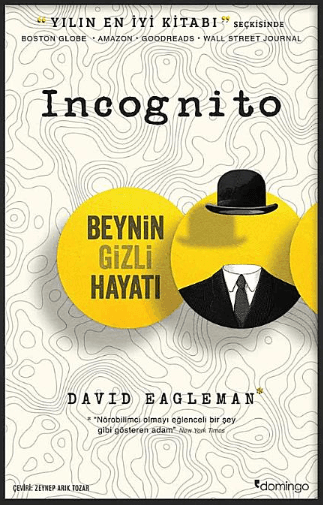
Incognito: The Secret Life of the Brain
Author(s) | David Eagleman | ||||||||
|---|---|---|---|---|---|---|---|---|---|
Original Name(s) | Incognito: The Secret Lives of the Brain | ||||||||
Translation | Zeynep Arık Tozar | ||||||||
Publication Year | 2023 | ||||||||
Number of Pages | 294 | ||||||||
Type(s) | Popular Science / Neuroscience | ||||||||
David Eagleman’s book Incognito: The Secret Lives of the Brain examines the boundaries of consciousness, the scope of unconscious processes, and the neurological foundations underlying human behavior within the framework of modern neuroscience. The author argues that a significant portion of perception, decision-making, and response mechanisms in everyday life are carried out automatically by the brain, outside the awareness of the conscious subject.
David Eagleman is an American scientist specializing in neuroscience. He has served as a faculty member in neurology and psychiatry at Baylor College of Medicine and is particularly known for his research on consciousness, time perception, decision-making, and neurotechnology. In addition to his scientific research, he has reached a broad audience through popular science books, documentaries, and public science communication initiatives. Eagleman adopts an interdisciplinary approach in his academic work and is distinguished by his ability to connect neuroscience findings with everyday life.
Incognito: The Secret Lives of the Brain was first published in English in 2011 and translated into Turkish by Zeynep Arık Tozar, with the Turkish edition published by Domingo Yayınları in 2012. The book belongs to the genre of popular science, aiming to communicate accumulated academic knowledge in neuroscience using accessible language free of technical jargon. It explores themes such as consciousness, the unconscious mind, decision-making processes, free will, and the neurological basis of behavior.
The book consists of seven main chapters. In the first chapter, the distinction between the conscious mind and unconscious processes is defined. Eagleman contends that a large part of human behavior occurs beyond conscious control. Subsequent chapters explain perception mechanisms, unconscious decision-making, impulse control, moral judgments, self-perception, and the concept of responsibility using neurological examples. The effects of brain injuries on personality and behavior are used to demonstrate the inadequacy of explanations limited to the conscious mind. In the final chapters, the potential implications of these scientific findings for law, ethics, and social structure are discussed. Eagleman argues that the brain is a multilayered system that operates largely without conscious awareness.
The work is written in a clear and accessible style that maintains academic accuracy while appealing to a broad readership. Technical terms are explained, and abstract concepts are made concrete through case examples. Eagleman’s narrative occasionally employs metaphors and analogies, making neurological processes more comprehensible to readers. The language is objective, yet the exposition sometimes adopts an interactive tone through question-and-answer structures and thought experiments.
Incognito is one of the examples of neuroscience research that gained momentum in the early 21st century and reached the public sphere. This period represents a time when brain-based explanations began extending beyond medicine into fields such as law, ethics, economics, and education. The book offers a modern scientific perspective that challenges classical philosophical and cultural approaches which elevate the individual as a rational agent. The neurological underpinnings of concepts such as free will, personal responsibility, and the self are directly connected to contemporary cultural debates about self-perception.
Eagleman, David. 2013. *Incognito – Beynin Gizli Hayatı*. Trans. Zeynep Arık Tozar. Istanbul: Domingo Yayınevi. ISBN 978-6054729074. Accessed June 28, 2025. https://domingo.com.tr/products/incognito-beynin-gizli-hayati?srsltid=AfmBOoobI7vf6-dNsQDLc0_8PwRr24i7nBZf7EENo1HHSVRqCrmtuTX0
Eagleman, David. Incognito: Beynin Gizli Hayatı. Çev. Zeynep Arık Tozar. 47. baskı. İstanbul: Domingo Yayınları, 2023.

Incognito: The Secret Life of the Brain
Author(s) | David Eagleman | ||||||||
|---|---|---|---|---|---|---|---|---|---|
Original Name(s) | Incognito: The Secret Lives of the Brain | ||||||||
Translation | Zeynep Arık Tozar | ||||||||
Publication Year | 2023 | ||||||||
Number of Pages | 294 | ||||||||
Type(s) | Popular Science / Neuroscience | ||||||||
No Discussion Added Yet
Start discussion for "Incognito: The Secret Life of the Brain" article
Author’s Background
General Features of the Work
Structure and Summary
Linguistic and Stylistic Features
Historical and Cultural Context