


This article was automatically translated from the original Turkish version.

Computer Mouse
Inventor | Douglas Engelbart | ||||||||
|---|---|---|---|---|---|---|---|---|---|
Initial Development Year | 1964 | ||||||||
First Working Prototype | Wooden casing, two-wheeled metal mechanism | ||||||||
First Demonstration | 1968 – Fall Joint Computer Conference (The Mother of All Demos) | ||||||||
Patent Information | US Patent 3,541,541 (1970) – “X-Y Position Indicator for a Display System” | ||||||||
First System Used | Xerox Alto computer (1973) | ||||||||
Computer mouse is an input device used to move the cursor on the screen and issue commands. With the development of graphical user interfaces, this device enabled users to interact more effectively with computers and was first designed in the 1960s by Douglas Engelbart. Engelbart’s goal was to make human-computer interaction more efficient. In this context, the computer mouse was developed as a tool allowing users to easily select and manage objects on the screen.
In the early 1960s, Douglas Engelbart worked at the Augmentation Research Center (ARC) within Stanford Research Institute (SRI) on improving human-computer interaction. In 1964, under Engelbart’s leadership, engineer Bill English developed the first prototype of the computer mouse. This prototype featured a wooden casing with two metal wheels underneath. The device, called an “X-Y position indicator,” allowed users to move the cursor on the screen. Engelbart believed this device would significantly increase the productivity of computer users.
Engelbart filed a patent application for the device in 1967 and was granted the patent in 1970 under the title “X-Y Position Indicator for a Display System” (US Patent 3,541,541). However, this invention was first introduced to the public in 1968 at the Fall Joint Computer Conference in San Francisco. Engelbart’s presentation, known as “The Mother of All Demos,” also showcased many other innovations including hypertext, video conferencing, and the graphical user interface.
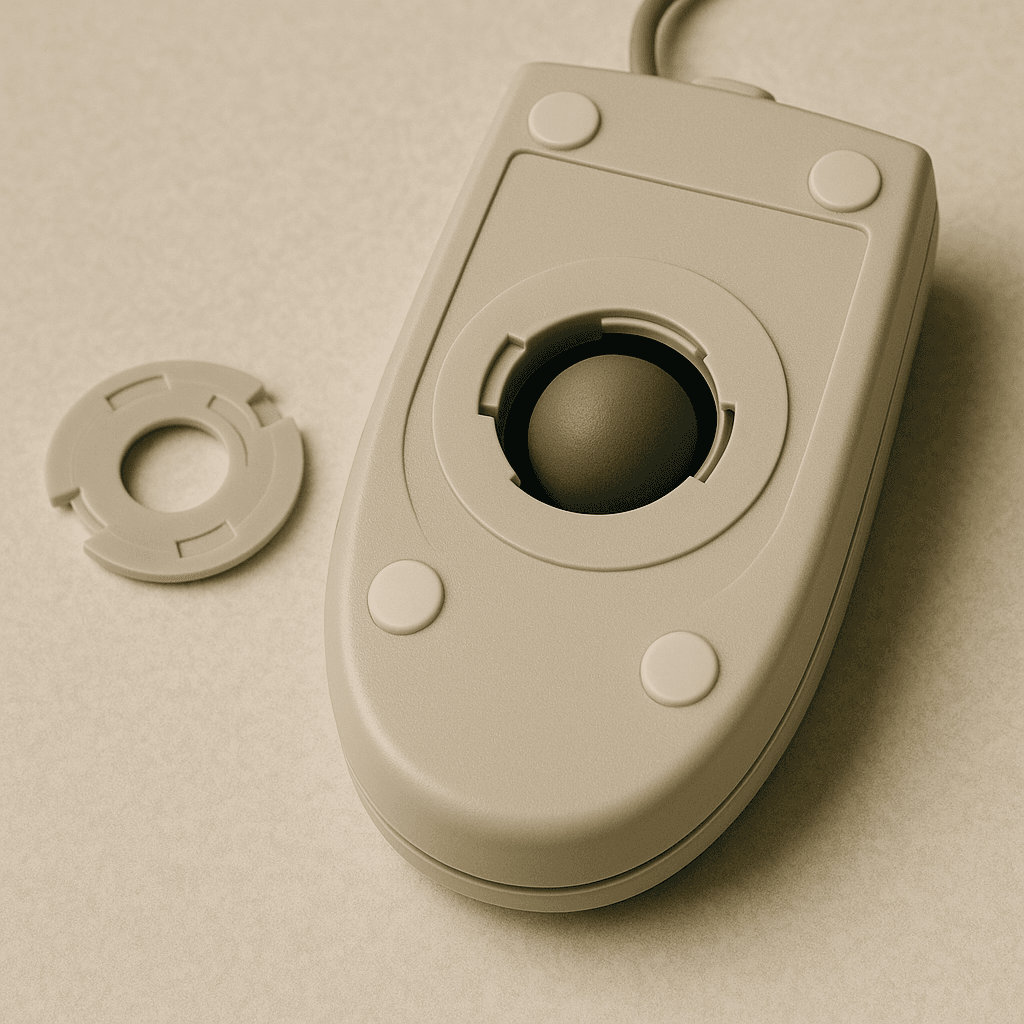
Mechanical mouse. (Generated by artificial intelligence.)
Commercial use of the computer mouse began in the early 1980s. The Xerox Alto, developed by Xerox PARC, was among the first computers to use a mouse. However, it was Apple’s Macintosh computer, released in 1984, that brought the mouse to a broad audience. During this period, mice typically had a mechanical design with a rolling ball underneath. Over time, with advances in optical and laser technologies, more precise and durable mice began to be produced.
Computer mice have been produced in various types in parallel with technological advancements:
Bilgisayar Nedir. "Mouse." Accessed April 26, 2025. Link
Computer Science. "Dersimiz Mouse." Accessed April 26, 2025. Link
Digital Lesson. "Fare (Mouse)." Accessed April 26, 2025. Link
Explain That Stuff. "Computer Mouse." Accessed April 26, 2025. Link
GeeksforGeeks. "Different Types of Computer Mouse." Accessed April 26, 2025. Link
Google Patents. "US Patent 3,541,541: X-Y Position Indicator for a Display System." Accessed April 26, 2025. Link
Made How. "Computer Mouse." Accessed April 26, 2025. Link
SRI International. "The Computer Mouse and Interactive Computing." Accessed April 26, 2025. Link
SRI International. “75 Years of Innovation: The Computer Mouse.” Accessed April 26, 2025. Link

Computer Mouse
Inventor | Douglas Engelbart | ||||||||
|---|---|---|---|---|---|---|---|---|---|
Initial Development Year | 1964 | ||||||||
First Working Prototype | Wooden casing, two-wheeled metal mechanism | ||||||||
First Demonstration | 1968 – Fall Joint Computer Conference (The Mother of All Demos) | ||||||||
Patent Information | US Patent 3,541,541 (1970) – “X-Y Position Indicator for a Display System” | ||||||||
First System Used | Xerox Alto computer (1973) | ||||||||
No Discussion Added Yet
Start discussion for "Invention of the Computer Mouse" article
History and Development
Patent Process and First Demonstration
Commercial Use and Popularization
Technological Advancements and Variants