


This article was automatically translated from the original Turkish version.
+2 More
Location | İskilip Çorum | ||||||||
|---|---|---|---|---|---|---|---|---|---|
Period(s) | Rome (3rd–5th century BCE) | ||||||||
Structure(s) | Rock tomb on natural rock | ||||||||
Entrance | Two-column, rectangular | ||||||||
Decoration | Lion figure, Eros relief | ||||||||
The İskilip Rock Tombs are located in the town center of İskilip district in Çorum, situated on the southern and southeast slopes of the İskilip Castle, which dates to the Ottoman period. The tombs have been carved into the slope of a natural rock mass approximately 100 meters high. This area is dated to the Roman period; some researchers attribute it to the Paphlagonian civilization (3rd–4th century BCE), while others directly link it to the Roman era. It is reported that during their passage through Anatolia toward Constantinople between 715 and 717 CE, the Umayyads named the fortress containing these tombs “Menkuriye” (Perforated Fortress).
İskilip was one of the settlements that maintained its geostrategic and geo-economic significance throughout the Roman period and remained a prominent settlement center for nearly a thousand years. During the Byzantine era, İskilip is noted as one of the three most important cities in the region. The name İskilip is said to derive from Asclepius, the Greek god of healing, as mentioned in sources on Paphlagonian history. In the 2nd century CE, İskilip lay between Bithynia and Pontus and appears in Byzantine sources as Neoklauniopolis.

İskilip Rock Tombs (Culture Portal)
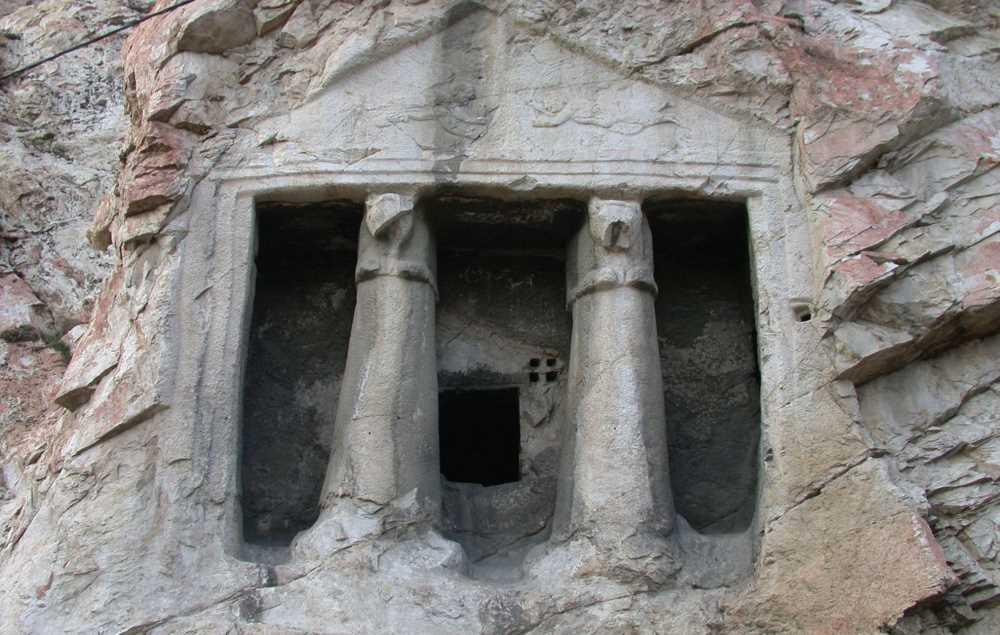
The İskilip Rock Tombs are single-chamber structures carved directly into the rock and consist of four distinct tombs. Most of the tombs feature columns and triangular pediments above the entrance. The first tomb is located approximately three meters above ground level and has two columns and a single entrance on its front facade. Inside, directly opposite the entrance, there is a burial couch approximately two meters long, with a second couch on the left wall.
On the triangular pediment above the entrance, two naked, winged Eros figures are depicted facing each other; one holds a bunch of grapes and extends it toward the other. The second tomb is located two meters above ground, has a vaulted ceiling and a single chamber, with two columns and an entrance on the front facade. Inside, there is a burial couch approximately three meters long and one meter wide. Beneath this tomb lies another tomb. The third tomb lacks columns; only a triangular pediment above the entrance remains.
Although no burial couch is present inside, its fine craftsmanship evokes Phrygian architectural style and is considered the only example of its kind in the Paphlagonian region. The fourth tomb is carved into the rock at a height of three meters above ground, with its entrance marked by an incomplete column. This tomb was abandoned for unknown reasons. Across all these tombs, the cylindrical column shafts narrow toward the top, and lion figures are depicted seated on ring-like elements at the capitals. The triangular pediments feature relief carvings of opposing figures holding cups and swords. The burial platforms inside the tombs, known as klinai, were carved directly from the rock to accommodate the deceased.
Among the decorative elements of the rock tombs, the most notable are the lion figures seated on the column capitals and the relief carvings on the triangular pediments. In some examples, these pediments depict opposing naked, winged Eros figures; in others, they show lion figures holding cups and swords in their hands. The column shafts taper upward, and the capitals feature lions positioned atop ring-shaped elements. Inside the tombs, stone burial couches (sedir) carved from the rock were used to lay the deceased.
Ormankıran, Yusuf. “İskilip Kaya Mezarları.” *Türkiye Turizm Ansiklopedisi*. Accessed June 18, 2025. https://turkiyeturizmansiklopedisi.com/iskilip-kaya-mezarlari.
Türkiye Kültür Portalı. “İskilip Kaya Mezarı - Çorum.” *T.C. Kültür ve Turizm Bakanlığı*. Accessed June 18, 2025. https://www.kulturportali.gov.tr/turkiye/corum/gezilecekyer/skilip-kaya-mezari.
Çorum İl Directorate of Culture and Tourism. "Anıtlar-Meydanlar." *Republic of Turkey Ministry of Culture and Tourism.* Accessed June 18, 2025. https://corum.ktb.gov.tr/TR-58716/anitlar-meydanlar.html.
İskilip Belediyesi. “Kaya Mezarları.” İskilip Belediyesi. Accessed June 18, 2025. https://www.iskilip.bel.tr/iskilip/kaya-mezarlari/.
İskilip Kaymakamlığı. "Kaya Mezarlığı." İskilip Kaymakamlığı. Accessed June 18, 2025. http://www.iskilip.gov.tr/kaya-mezarligi.

Location | İskilip Çorum | ||||||||
|---|---|---|---|---|---|---|---|---|---|
Period(s) | Rome (3rd–5th century BCE) | ||||||||
Structure(s) | Rock tomb on natural rock | ||||||||
Entrance | Two-column, rectangular | ||||||||
Decoration | Lion figure, Eros relief | ||||||||
No Discussion Added Yet
Start discussion for "İskilip Kaya Mezarı" article
Historical Background
Architectural Features and Tombs
Decorations and Figures